 The requirements to the safety of food packaging have been specified, talking paper, grass paper and edible cups have been invented. We would like to bring to your attention these and other events of May in TOP of the main news of the packaging market from Vera Bokareva.
In the international market – the next invention, to some extent meeting the trend of environmental friendliness.
Through 3D printing, plastic bottles have been turned into a universal designer
Plastic bottles are already used in the role of building material, which allows you to simultaneously use them and save on materials. In such solutions, bottles are used as bricks.
Engineers from the German Hasso Plattner Institute have developed a technology to create designs from plastic bottles. Engineers decided to use plastic bottles as elements of a truss structure – a system consisting of rods that remains geometrically unchanged when changing its rigid knots by hinged ones. Using this design allows you to use for strengthening the force of compression and stretching, more evenly distribute the load.
Developed special software TrussFab allows you to calculate the design at home and prepare the connectors that can be printed on a regular 3D printer. The user creates the desired form of the design, and the system itself selects bottles of the right size from a set of typical bottles. Along with this, the system can simulate the behavior of the structure under load and show which elements have the greatest load. As a result, the user receives the files of plastic connecting elements between the bottles in the STL format, it is supported by most 3D printers. Printing and further assembly of the elements does not take much time because of their small size. For example, within a few hours you can create designs that withstand human weight.
Through this technology engineers have created a bridge, chairs, dome and boat.
Lidloc – a new cup for which you do not need a separate lid
Metsä Board, part of the Metsä Group (Finland), introduced a new concept for the Lidloc cardboard cup. The patented design of the company is a glass with extended edges that bend, can mate with each other, thereby forming a lid. These cups are made from renewable natural resources.
Cyril Drouet, director of design and innovation, explained: “We have developed a one-piece structure that eliminates the need for a separate plastic cover. It is easy to assemble and fold, it is safe. The integrated lid facilitates the printing process. The lid is equipped with a mechanism that facilitates the swallowing of hot drinks, and is also ideal for consuming cold drinks with a tube. ”
Economical grass paper
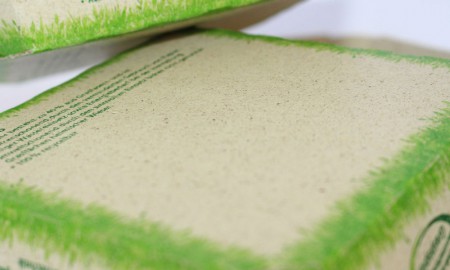
Paper manufacturer Scheufelen (Germany) produced “herbal” paper Scheufelen Graspapier, which is suitable for printing and packaging food, in particular, fruits and vegetables. More than 50% of the paper consists of fibers of sun-dried grass collected in the vicinity of the plant in Lenningen (Germany).
A key advantage when making paper from grass is that this process requires almost 1000 times less water than paper made from wood pulp. In addition, in the production process, up to 80% of energy is saved and no chemicals are used.
The paper is biodegradable, recyclable and FSC-Mix certified. Implemented by Paper2Day.
New packaging film without phthalates
The problem of using phthalates in polymers remains relevant. It is established that getting into the human body, they can cause serious violations in the endocrine and sexual systems. Increasing demand for packaging materials without their content, especially for use in packaging in contact with food.
Producer of biaxially oriented film (BOPR) from Germany Treofan produced a packaging film without phthalates. This film is produced by extrusion from base polymers that do not contain phthalates. The company offers customers the production of such a film on request. According to the company’s representatives, the standard films have a low phthalate content (0.001%, <10 mg / kg) compared to PVC, where their concentration reaches 30%.
The global market for thermoformed packaging – an average annual growth forecast of 5.9%
According to the forecast of Transparency Market Research (USA), in the period 2016-2024. The market of thermoformed packaging will grow by an average of 5.90% per year and will reach $ 57.6 billion by 2024.
The largest share of the world market of thermoformed packaging falls on North America. Analysts believe that in the coming years the region will retain its leading position. High growth rates are explained by the presence in North America of a large number of branded retailers. In the coming years, the Asia-Pacific market will also grow intensively, which is promoted by the development of the public catering sector, a change in the lifestyle of consumers and an increase in their incomes.
Analysts note that the world market of thermoformed packaging has a high degree of consolidation. A significant share of the market accounts for only a few large companies, the largest of which are Amcor, Bemis and Sonoco.
The largest producers are constantly expanding the range of products. Along with this, the development of innovative methods aimed at improving the technology of 3D-modeling, the rapid creation of prototypes and visualization of products.
The global market for thermoformed packaging until 2024 will grow due to increased demand from food, beverages and pharmaceuticals. As for the segments of the thermoformed packaging market, in the forecast period the leading positions will belong to the blister pack. Growth will be ensured by increasing its use in the pharmaceutical sector. The number of spheres of application of blister packs is also increasing.
Analysts among the advantages of thermoformed packaging stand out from the ecological side – when using it, it is possible to reduce the volume of waste generated. In addition, it is cost-effective. Restraining factors of the market growth of thermoformed packaging: it is not suitable for packing heavy objects, technical and legal requirements to it are complicated. However, an increase in the volume of funding for research in the short term will provide an opportunity for further development of technology.
Speaking paper
American physicists made a breakthrough in science. They created matter that can transform mechanical vibrations into electricity or produce sound.
One of the creators of Nelson Sepulveda (Nelson Sepulveda) notes that the appearance of the newspaper’s number, able to talk with the reader, listen to him and answer his questions, is quite realistic.
A group of physicists in 2016 developed a nanomaterial FENG, capable of becoming one of the main sources of power for flexible electronics. After the scientists built nanoparticles of silicon and silver into a foamy polymer film, it turned into an electricity generator that converts mechanical energy into a current. If such a film is inserted into clothing, a person during the movement along the street or around the house will produce a current. Subsequently, conducting further experiments, physicists have found that FENG can be used to convert electricity into mechanical vibrations and recording acoustic waves.
Such materials, according to scientists, can be used to suppress noise, and in hazard warning systems, and for other facilities where flexibility, mechanical reliability and low energy consumption are needed.
New biofilms for sterilization
Toray Plastics introduced polyester films for the manufacture of sterilization packages adapted to gamma radiation in the product line. These films perfectly retain tensile properties and the desired optical characteristics (gloss, turbidity, color) for two years after the initial irradiation.
Films manufactured using this technology are less susceptible to destruction, better preserved. Preservation of optical properties provides a clear visibility of the packaged product. This also ensures to the end user that the storage time does not adversely affect the packaged product, and the product is still sterile. Each of the films of this series has a unique functionality: adaptability for printing, good heat-sealing, They can be used independently and in laminates.
Advanced chemical indicators for intelligent packaging
As is known, special indicators are used in intellectual packaging, which show the state and safety of its contents. Brazilian manufacturer of polymers Braskem has perfected the technology of intellectual packaging. Principle of production: chemical substances are introduced into thermoplastic materials, which are capable of reacting to damage and spoilage of the product. If the integrity of the product packaging is violated, it changes its color, which is a signal to the consumer.
As part of a joint project with the University of Clemson (USA) and the Brazilian University of Rio Grande do Sul Federal University (UFRGS) from Porto Alegre, the company developed chemical indicators. Braskem began to conduct research in the field of intellectual packaging from 2013 to 2015. The first prototypes of such a package were received by the company in 2016. During the research, meat, fish, and poultry were placed in the packaging. The change in pH within the package led to a change in its color. Patrick Teyssonneyre, director of technology and innovation at Braskem, notes its convenience not only for consumers, but also for manufacturers. The latter is easier to control the integrity of the product after its production, during transportation and at points of sale.
Today the company continues research in this direction and is working on the possibility of using such packaging in other areas.
New requirements for the safety of food packaging come into force on the territory of the Eurasian Economic Union.
New requirements to the safety of food packaging come into force
Since May 21, 2017, the requirements for the safety of food packaging for countries belonging to the Eurasian Economic Union come into force, the requirements for the safety of packaging of food products, including baby food, are being specified.
The amendments concern the technical regulations adopted in August 2011, which detail the requirements for the safety of packaging. In the innovations can be noted several points.
The requirements for the packaging of food and baby food had previously been rather stringent. Now they are clarified due to the introduction of an indicator of organoleptic properties. So, packaging for food, baby food should not give off no smells, no color when exposed to water.
A number of new concepts have been introduced. For example, “combined material” – when the package consists of two or more materials (paper and plastic, etc.).
The technical regulation now does not apply to cargo containers and pallets for the carriage of goods by road, rail, sea and air. This will help carriers save time on processing related documents.
The first vice-president of the Russian Union of Engineers Ivan Andrievsky explained: “The scope of the technical regulations has been reduced and clarified. For the consumer, this means that the products of the countries that make up the union (Russia, Belarus, Kazakhstan, Armenia, Kyrgyzstan) should become generally safer, and labeling the package will less mislead consumers. ” In his estimation, one of the main goals of the regulation is to increase confidence in goods from the countries of the economic union.
Along with this, the documents on assessing the conformity of products to the requirements of the technical regulations, adopted before May 21 of this year, are valid until the end of their validity.
Edible cups for tea and coffee
Students from Gomel Olga Pokhvalova and Anastasia Talantova have developed a business project “Eat Me” and offer investors the idea of making and selling edible cups for tea and coffee.
The girls did not remain indifferent to the problem of the overabundance of garbage. In their opinion, the rejection of disposable plastic dishes can help solve it. They decided to make an edible dish that you do not have to discard after use.
The glasses are made of dough, baked and internally processed with icing made from heat-resistant chocolate, flavors can be added. In such dishes, you can serve both hot and cold drinks. The creators of the business project position this cup with coffee as a full-fledged dessert.
Girls were offered cooperation of business schools, capital coffee houses are interested in the project. Initially, one cup was planned to be sold for three, now the price was reduced to one Belarusian ruble (this is slightly more than 30 cents).
While the cups of cookies are made for girls and relatives. Now they are looking for equipment to automate production.
In the development of the students other projects: edible packaging for food (a wrapper for chocolate from food paper) and making cups of jelly.
Author: Vera Bokareva, independent expert in the packaging market