At each production of plastic products appear waste. Recycling may allow the reuse of new compositions in the production of their own products, if the physico-mechanical parameters will almost match the original values. The following are the results of studies of the mechanical properties of the composition of waste PE 100 and PE 80 and PSD (medium pressure polyethylene). He, in fact, according to the properties corresponds to the IPA. Samples of PE 100 + PE80 and PE 100 + PSD were made by injection molding. The tests were carried out from a sample of five samples of each composition. Table 1 shows the values of the hardness of the compositions of the waste. It is seen that the hardness of the composition when adding PE80 begins to increase only after 50% of the input PE80. Adding PSD more sharply reduces the hardness – already, approximately, from 25%. It turns out that if PE80 is added up to 70% in PE100, the hardness of the new composition will increase by 4%. And adding PSD to 70% hardness will decrease by 6.5%.
Table number 1
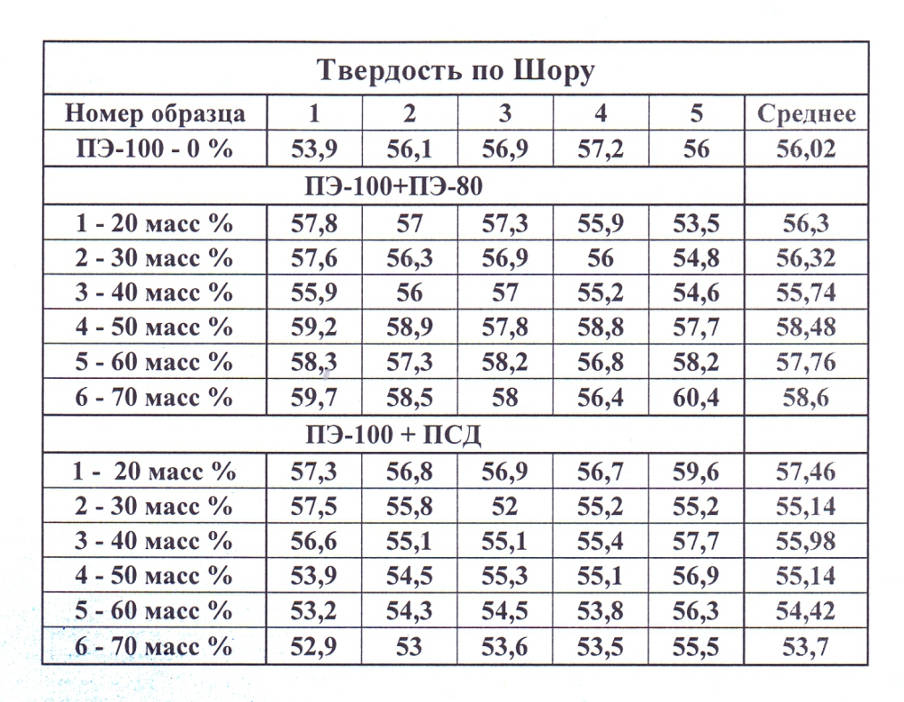
Table 2 shows the test results of the obtained samples for the strength parameters and graphs of changes for each parameter depending on the percentage of input of PE80 and PSD. Yield point – this is when the material is stretched already without the impact of the load. The deformation at the yield point is the percentage of elongation of the material in the state of fluidity without load. Tensile strength – ultimate load at which the material is destroyed. Deformation at tensile strength – the relative elongation of the sample at the time of destruction. Young’s modulus (modulus of longitudinal elasticity) is a physical quantity characterizing the properties of a material to resist stretching, compression under elastic deformation.
Table number 2
