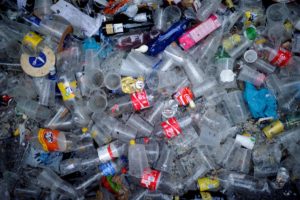
 The European Parliament adopted a law on a fundamental restriction of the use of plastic and products from it. UNIAN understood when such a ban could be introduced by Ukraine, following the course of European integration. The European Parliament at the end of March approved a bill to reduce the volume of plastic garbage. He will earn after approval by the European Council. Objections, most likely, will not be, as the representatives of the European Parliament and the EU countries as a whole agreed all the details of the document last December. It is proposed to ban from 2021 the use in the EU of disposable plastic products, in particular, plastic dishes, cotton sticks, drinking straws. All this will be made from other environmentally friendly materials. From 2024, plastic bottles will only be sold with caps attached to them. The use of plastic products that do not have an environmental alternative, such as plastic cups and food packaging, will be limited to the maximum. In addition, on the packaging of disposable goods containing a certain amount of plastic, including wet wipes, feminine hygiene pads, an indication of their negative environmental impact will be mandatory written out. The document also increases the quota for the separation of garbage. By 2025, at least 77% of plastic bottles must be disposed of with plastic waste, by 2030 this figure should be 90%. From 2025, plastic bottles should consist of at least 25% recycled materials, by 2030 – 30%. All of the above is supported by the data of the European Commission: a year in Europe, on average, there are 31 kg of plastic waste per inhabitant, in Germany – 37 kg. On average, about a third of plastic waste in the EU is recyclable, and other waste is exported. Plastic accounts for 85% of all garbage in the world’s oceans, half of which are one-off plastic products. The UN research data is even more depressing – if nothing changes, then in 2050 there will be more plastic waste in the oceans, seas and other bodies of water than fish. In order to draw attention to the problem, the UN adopted the Environment Support Program – UNEP, which in turn launched a global campaign against debris. According to UNEP environmentalists, pollution from dumping garbage into the sea leads to degradation of the coastal and coastal zones. 80% of this garbage is plastic, which accumulates toxic substances in the ocean. And every year more than eight million tons of plastic waste are released into the ocean. At the same time, the current production of plastics is 20 times higher than in the 60s of the last century. By 2050, the production of plastic can grow another 3-4 times. One plastic bag decomposes within 400 years, in the process of decomposition it releases a toxin. Because of the direct environmental threat to peace within the United Nations Environment Assembly, which was held in Nairobi, 170 countries have pledged to reduce the use of plastic by 2030. To begin with, they decided to abandon the disposable plastic used for packaging and in the service sector. But while someone decides to abandon the plastic, some have already done so. So, the first in the world in 2016 France banned plastic dishes. Even earlier, individual US cities, as well as a number of industrial companies, refused to use plastic straws and other disposable products. Some African countries have banned the use of plastic bags. In Ukraine, the problem of garbage is particularly acute. 95% of all solid waste is landfilled. Every Ukrainian generates about 350 kg of garbage every year. And annually about 14 million tons of household waste are transported to landfills and unofficial dumps. The total area of all landfills is over 7% of the country. Since January 1, 2018, we have earned a law on obligatory sorting of garbage, as well as a ban on the export of waste to landfills. They need to be recycled and disposed of.
First – cleaning landfills, then – the rejection of plastic
The head of the Association of Suppliers of Retail Networks, Alexei Doroshenko, believes that Ukraine, first of all, should become economically stronger, more prosperous, and only then introduce bans on plastic. “When it comes to bans, refusals in favor of the environment, it can afford wealthy countries that are beginning to realize what they specifically want and now. Ukraine today is actually a huge dump, under this status is 7% of the country. In Europe, such a problem does not exist, there are recycling plants, sorting and other technologies that solve the issue. If Ukraine starts from the end, it will actually ban plastic, and only food, and this will in no way solve the problem. And every Ukrainian will have to pay more for this reform. For example, in the turnover of a supermarket disposable tableware takes 1%. Ecological packaging will be 2%. It is necessary to introduce laws prohibiting plastic, when people’s incomes will grow at a higher rate than expenses, and paying 1-2% for the environment from above will not be so significant. So far, over the years, there has been a decline in the purchasing power of citizens, and this is not the time to impose sharp restrictions to maintain the environment. To begin with, we must try in an expedited manner to start processing those wastes that are already stored in our territory. But more than once I had to deal with the fact that settlements, even villages, are categorically opposed to building close to them any, even a sorting plant. But at the same time, people massively take the garbage to landfills near their houses, even burning ones. And in the epicenter of the fire. Therefore, you need to start from the beginning – with processing, sorting, the latter can fix a lot. Our landfill is a storehouse of income. Who works with these, he knows for sure. And then you need to work with the consumer, ”the expert said.
In his opinion, it is also impossible to dismiss the fact that all the plastic bans imposed by Europe have a transition period of five years. It turns out that in the EU not all are ready for innovations. For example, the situation with separate waste in Germany: according to sociological research, 20% of the population of this country stated that they would never adhere to this norm. Therefore, when in Ukraine up to 95% of the population are not going to at least sort garbage, the new bans will not significantly change anything. And we must also have a transitional period of several years. In addition, the culture of waste management must be taught. “This process has been going on for a single year in the EU. Europeans are psychologically, culturally prepared for various failures, ”Doroshenko said. In addition, according to him, our industry will need additional investments to switch to another environmental plastic, more expensive, which implies the introduction of new equipment and technologies. But while the business has no opportunity to invest in it. Therefore, the forbidden rules will not work now. Everything is in the timeliness of the decision, in a few years it will be appropriate. And another important point – a person, regardless of the ban, must decide for himself whether to use plastic, plastic bag or not. “When we have 30% of the population make a choice in favor of ecology, then it will be necessary to impose a ban on plastic. For the time being, these norms will only be stillborn. A very positive point could be a social, state program on the ecology. But the state is now deeply do not care about consumer policy. I have no hope that something will change in the near future. I hope more that people, mostly of the younger generation, who now go abroad and see how everything happens there, will adopt this experience, then he will move from one family to another, and so on. Such a word of mouth for several years will do much more than various bans and advertisements, ”the expert emphasized. Yevheniya Aratovska, head of the public organization “Ukraine Without Garbage,” believes that the fight against plastic should be started with the adoption of the Framework Law on Waste Management, which will fully regulate this sphere. It has already been developed with the participation of experts, business, public organizations, is located in the Ministry of Ecology and is being coordinated with the relevant departments. “But the process is severely inhibited. For example, in the Ministry of Economic Development and Trade, the document was “reviewed” for five months. Meanwhile, the country is turning into a common dump. We even went out with the action under the walls of the Ministry of Environment to remind the agency that the country does not have time to wait for the appearance of this law. The document is very important and relevant, it contains all the definitions for waste – municipal duties, waste management, and so on. And only after its adoption will it be possible to talk about other legislative initiatives. Everything that will go in parallel will not be comprehensive solutions. All forbidden solutions, even good ones – in favor of ecology, will not work without Framework Law. By the way, the Waste Management Strategy until 2030, adopted and approved by the President, was developed to adopt the Framework Law, ”the expert noted. She also said that now in Ukraine the law of 1998 is acting in this area, it has long been untrue. A separate clause was added to it on separate collection of waste and its treatment. From 1 January 2018, it entered into force and obliged local governments to dispose of waste only after processing, and the garbage should be divided into paper, glass, plastic and metals. But innovation still does not work. According to this norm, it is even impossible to hold landfills for storage of unprocessed waste. The term treatment refers to the physical, chemical and other properties of exposure. In fact, it turns out that if you drive a skating rink through dumped garbage, then this is already a physical effect. In general, this rule was written out as a result of obligations under the Association Agreement with the EU, but it was done so that it could be easily circumvented. That is, taken “for show”.
“Now Ukraine is very far to impose any prohibitions, for example, on the use of plastic. At the Kyiv City State Administration, we have been addressing environmental initiatives, including separate waste collection. But we were told that there is no point now in supporting this inefficient model, in other words – separate garbage collection is unprofitable. That is, the authorities do not think about the consequences, they think only about money. Of course, we still need to introduce the principle of responsibility of manufacturers of disposable containers. Or increase the tax, for example, on the production of plastic bags and similar products in order to economically limit these production. An information campaign should be developed to increase the culture of the population – how not to harm the environment, how to be more responsible at the household level. Moreover, such a campaign should be at the state level, but money is not allocated for this. But before teaching behavior, you must also create the conditions for this. There are not even the necessary containers for receiving separate waste. Everything can correct the Framework Law. But he has not even got to Rada yet, and the very adoption in parliament may be delayed due to lobbying someone’s interests, ”the expert commented on the situation.
According to Anna Tarantsova, an expert on waste management, the law on reducing the use of plastics adopted by the European Parliament is part of the EU Strategy in support of the environment. The main goal is to ensure that all plastic products before 2030 are one that can be reused or recycled. The Plastic Directive is part of the EU’s comprehensive legislation and the Action Plan for the closed cycle economy. In Ukraine, the approach should also be comprehensive, balanced, compliant with EU directives on waste management. To do this, we need to adopt the Framework Law on Waste, as well as sectoral laws that introduce treatment principles for various types of waste: on extended producer responsibility, on packaging and packaging waste, on batteries, on electronic waste, and so on. And the introduction of the principle of extended producer responsibility will create economic mechanisms for the introduction of separate garbage collection in Ukraine. However, any prohibitions and restrictions should be part of comprehensive legislation, they should not contradict the National Waste Management Strategy. “The actions of restriction, the prohibition of certain products can significantly affect economic processes, therefore, should be introduced gradually, and only with careful discussion with business, the public, experts,” Tarantsova summed up. Innovations in the field of waste management, and therefore in terms of the use of plastic, can be expected after the adoption of a number of laws. One of them – the Framework – has already been developed, but it is “frozen” on coordination. And it is unlikely that the hands of deputies will reach him during the election campaign to parliament. So for now Ukraine will continue to be a mass dump. But a lot depends on the Ukrainians themselves. It’s time, without waiting for the introduction of any rules and regulations, to take care of their own country, which is buried in waste.