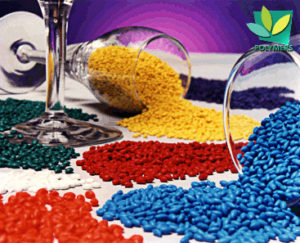
 Almost all plastic products are made in colored form (except for products where transparency is necessary). Color plays a significant role in shaping consumer preferences. By introducing pigments and dyes into the secondary polymers, one can mask the non-uniform color, the wish and give them a presentation.
Problems of secondary PE staining and solutions
Problem Possible remedies
1. Opaque and non-uniform color of granules.
Unlike transparent primary polyethylene, secondary granules are heterogeneous in light transmission and shade. This factor may affect the color of the final product after dyeing. 1. In order to achieve a uniform and maximum pure tone of plastic, it is necessary to toned (dull) the natural shade of polyethylene. A very good result will give the introduction of a small amount of chalk or micro-calcite of the order of 10%. In addition to masking the heterogeneity of the material, the filler in this concentration will increase the strength, frost resistance and rigidity. Titanium dioxide has an excellent hiding power. It will not give a perfectly white shade. But he will create the necessary “base” on which practically any color pigment can then be applied. The presence of titanium dioxide imparts opacity to the plastic.
2.Homogeneous impurities.
The presence of even the smallest inclusions will affect light scattering and the final color will be perceived by the eye in a completely different way. 2. Mechanical impurities are well removed during extrusion by installing a mesh on the melt filter (size 0.4 and 0.6 mm). A more serious problem is the formation of helices, especially in PND. Gel-like inclusions are oxidation products of polyethylene, they have a cross-linked structure. Their formation can be prevented by administering a reactive antioxidant (for example, Irganox 1010 or 1076) in a dosage of 0.1%. It is better to choose the real proportion for each equipment individually, since the area of contact with the metal is different everywhere.
3. Changing the rheology of the secondary polymer.
Low viscosity compared with primary PE leads to worse pigment distribution. As a result, stripes and nonprokras arise; 3. The adjustment of rheology can be done by introducing a small amount of pure polyethylene, as close as possible by MFR. Entering a small amount of an equally proportioned mixture of primary and secondary antioxidants prevents further decomposition of polyethylene and stabilizes processing. Another good way to increase the flow of PE is to introduce polyethylene wax. The addition of a 1% mixture of oxidized and non-oxidized waxes, in addition to adjusting the flowability, will allow the pigment to be distributed more evenly.
4. Poor thermo and light stability.
The degradation products in polyethylene are able to destroy the dye molecules. Color fades and burns out much faster. 4. It is possible to increase the resistance to fading using antioxidants. The standard dosage of 0.2% can be increased, especially when working with temperature-sensitive pigments (red, orange, yellow tones). The introduction of light stabilizers is justified when using products in the sun.
Practical tips for getting some colors:
White. The most complex shade. Pure snow-white tone on the secondary polyethylene is impossible to obtain. Especially on thin-walled products and films. To achieve maximum whiteness, you need a very clean, non-polygon secondary material from industrial waste (film trimming, clean gates, casting reject, etc.). When regranulation which used heat stabilizers. For white staining you can try:
Enter the microcalcite treated with stearic acid in a dosage of up to 10%;
To increase the content of titanium dioxide. For example, the standard recommendation for a 60% titanium dioxide masterbatch is 1%. In secondary polyethylene will require at least 2%. Pure titanium dioxide in itself gives yellowness, therefore toners are needed (ultramarine P.V. 19 or P.B. 29), they will need very little to adjust from 0.01 to 0.05%;
Red. Red organic pigments, by their chemical nature, are unstable to light (light fastness of 3-4 units) and to temperature. Even in pure PE, they are very capricious in coloring. If requirements permit, it is best to paint with iron oxide pigments. They are very stable and do not require additional stabilization. The only drawback is their hue (the color of red brick), there are no options to get a bright rich tone on them. For dyeing secondary PE in a bright red tone, you need a pigment with a color index of 53: 1 and titanium dioxide (it is better to work on masterbatches based on these dyes). The dosage is 2% and 1%, respectively; in addition, a federal-type antioxidant is needed in an amount of 1%.
Blue. Blue organic pigments have a high hiding power, thermal stability and light resistance. Optimal in terms of price-quality blue phthalocyanine pigments with a color index R.V. 15: 1 and R.V. 15: 3. For recycled polyethylene, a dosage of 0.5% pure blue pigment and 1% titanium dioxide is appropriate. There are blue-shaded masterbatches, they already have titanium dioxide and blue pigments. Their content in the finished recipe can be increased to 2-3%.
Green. There is not a lot of pigments and dye of green color, green P.G.7 is mainly used. To obtain a saturated color, it is necessary to introduce up to 0.5% for 1% pure titanium dioxide and 0.05%