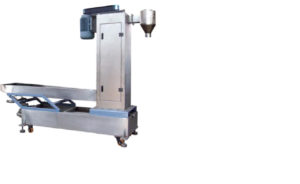
 One of the key stages in the processing of recycled polymers is the drying of semi-finished and finished granules. It allows you to significantly improve the quality of plastic products and improve the behavior of polymers during extrusion or casting. When recycling plastic waste, the process of separating moisture is inevitable. This article will discuss the main aspects of drying, the features of equipment and technology.
Polyethylene Drying Basics
Polyethylene refers to a group of polymers that contain only surface hygroscopic moisture. Depending on the supramolecular structure, the amount of moisture may vary. For example, more densely packed PND molecules have less moisture content than friable PVD. Removing surface moisture is relatively easy. In addition, polyethylene is thermally stable. Therefore, for draining, you can use almost any method. When using thermal drying with hot air, it is necessary to withstand the following parameters:
Temperature. The recommended range is from 90 to 110 ° C. It is selected depending on the thickness of the material. For example, for a thin film, a lower temperature regime is suitable (helps prevent melting);
Drying time. Depending on the loaded volume, it can be dried from 1 to 1.5 hours in a stream of hot air, or in drying cabinets.
In the process of drying the secondary polyethylene, it is also possible to remove volatile aromatic impurities (the remaining traces of liquids with which the package came in contact).
Defects caused by excess moisture:
Increased pore formation and shells on the surface of finished products;
Atypical behavior of polyethylene melt during extrusion. The viscosity of the mass decreases, the process is unstable;
Decrease in strength and impact characteristics. This is especially noticeable on thin-walled products and films of regranulate;
Foaming granules.
Technological solutions for drying recycled polyethylene
The separation of excess moisture may be required not only directly in the secondary recycling cycle. For example, sometimes you need to dry the material imported from the warehouse. This is especially necessary to produce in the winter time, because cold material with a gradual heating absorbs moisture from the air. Long-term storage in the conditions of an unheated shop also adversely affects the quality of the material.
Since there are no special requirements for polyethylene, the simplest and most uncomplicated equipment can be used in the technological scheme:
Centrifuge. It is used for preliminary separation of water from film materials and from shredded. Separation occurs under the action of centrifugal force. Ideal as the first stage of drying, because it is fed raw materials immediately after washing, i.e. very raw. The residual moisture of the product is about 10-15%, depending on the size of the fraction.
Air cyclone system. Ideally, these are two or three vertical conical bunkers equipped with heated blowers. Captured by a stream of warm air, the material moves through the duct system, getting from one bunker to another. The last cyclone can be used as a packaging bin. Such a system is only suitable for small fraction. Residual moisture can reach 2%.
Taper-type batch dryer. It is a bunker in the form of a vertical cone, where hot air is fed. The dryer is loaded, and after a certain time has expired. It can be connected to the cyclone system through the duct. Periodically, when filling the dryer with a certain portion of material, it will automatically be unloaded. The level is chosen empirically for residual moisture. The amount of moisture at the outlet is normalized in the region of 0.2-0.5%.
Drying cabinet. It is a metal cabinet, equipped with trays. The material is dried when heated to a certain temperature. Air can circulate if necessary. Such a system is not suitable for high productivity, since it is necessary to withstand a certain interval during drying.
Turbine type dryer. Ideal for large pieces of film. Inside the dryer there are ring-shaped shelves rotating around an axis. Bottom are blown by the air flow and heated by heaters mounted on the walls of the case. An air intake is installed in the upper part of the apparatus.
Dryer tunnel type. Also recommended for film waste. A slow moving conveyor with material passes through a tunnel equipped with heaters and blowers.
Analytical moisture control
To assess the moisture content in the material, you can resort to the two simplest methods:
Buck method. Equipment required: analytical scales, glass cups, desiccator, drying cabinet. Pre-weighted pieces of polymer are placed in the tubes for drying in the cabinet. Recommending