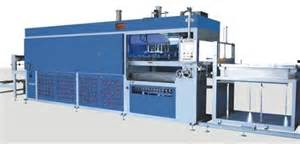
 Thermoforming technology integrates several techniques: vacuum, pneumatic, mechanical, as well as some other types of heated molding plastic sheet or membrane preparations, with their different possible combinations.
Widespread thermoforming processes is due to the simplicity, compactness, relatively low cost of the equipment and tooling. Thermoforming is used primarily in the production of packaging for food, fragrance, pharmaceutical, chemical, oil industries, disposable tableware, as well as a number of hollow polymer products having different technical purpose. Many types of polymeric articles, for example, large-sized and thin-walled complex configuration methods can only produce a pneumatic or vacuum forming. All the above reasons make it possible to compete with other thermoforming processes alternative methods manufacture of products from polymeric materials.
Implementation of thermoforming method is quite simple: a polymer sheet or a foil preform is heated to the temperature of the highly elastic state, and then deforming it in different ways, give the final required shape, which is carried out by fixing the cooling of the molded article.
Depending on the mode of propulsion workpiece deformation process are distinguished in the finished product the following basic methods plastics thermoforming: vacuum, pneumatic, hydraulic, mechanical, combined.
vacuum forming
When vacuum forming flat blank of thermoplastic resin material are pressed on to the perimeter of the vacuum pressure molding machine frame working chamber, first with a heating device to heat the highly elastic state. Then, in the cavity formed by the surfaces of the preform and the shaping die (punch or forming) create negative pressure, whereby due to the pressure difference arising molding products occurs.
After cooling the product until its dimensional stability temperature recently removed from the forming tool (the tool is removed from the mold), after opening the clamping frame.
Driving the implementation of the vacuum molding process
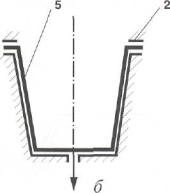

I – a heating device; 2 – clamping frame; 3 – flat polymer preform; 4 – form of a matrix; 5 – molded article
blow
The implementation differs from the blow molding process a vacuum forming only in that the pressure drop created by the use of a compressed gas as a working medium, usually compressed air, pressurized to 2.5 MPa.
In hydraulic forming part of the working environment is warmed fluid is pumped under pressure 0,15-2,5 MPa.
mechanical molding
Mechanical molding (mehanotermoformovanie) differs from the process air molding in that flattening the heated workpiece shape of the finished product is carried out at the expense of its mechanical drawing metal punch.
Driving the implementation process mehanotermoformovaniya
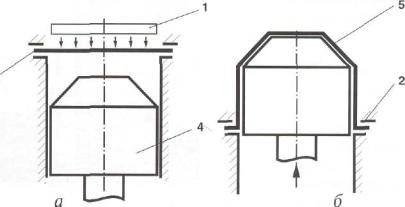
I – a heating device; 2 – clamping frame; 3 – flat polymer preform; 4 – molding punch; 5 – molded article
It should be noted that modern technology and provide the combination of different methods of molding products, such as pneumatic vacuum, rotor, etc. Scheme implementation mehanovakuumnogo molding is shown in Fig. 3.
The implementation of this combined molding method consists of two stages: the first of them (. Fig For) heated to the required temperature of the heater 1 slab 2 is mechanically stretched by a punch 4. In the second stage (Fig. 36) extended the blank is formed into a matrix of 5 by creating a vacuum in its cavity.
Among all kinds of pneumatic and vacuum forming three main: positive, negative and free. With a positive molding (molding on the punch), the internal surface of the product is exactly reproduces the shape or design of the molding tool. Negative molding (forming in the matrix) allows to obtain articles whose outer surface exactly reproduces the shape of the inner surface or the pattern matrix. Free forming is carried out in the armhole clamping frame without the use of a forming tool. In addition to these basic, there are other kinds of technological methods of thermoforming products from flat polymer preforms.
Driving the implementation of the combined process mehanovakuumformovaniya products of flat plastic pieces
(And – pre-heating and mechanical drawing blanks, b – vacuum forming product)
Figure 3
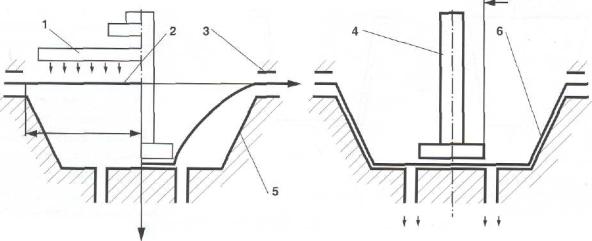
1 – heater; 2 – slab; 3 – clamping of the Roma; 4 – punch; 5 – matrix; 6 – molded article
Features thermoforming technology
In all methods of forming articles from thermoplastic plastics sheet before molding is heated to a temperature rubber elasticity, and then mounted on the workpiece contour set on the molding chamber. Shaping takes place under the influence of pressure difference created between the inner and outer surfaces of the sheet. By vacuum forming the differential pressure is equal to the difference of the ambient pressure and the residual form, when blown – the difference between the air pressure and the atmospheric pressure, when punching – pressure on the workpiece by means of special mechanical punches. In many cases, molding is preceded by a preparatory operation for the manufacture of preforms. When mass and large-scale production of products, as a rule, either factory-supplier of raw materials, according to the agreement, provides dimensional blanks or projected Multi rigging taking into account the size of the thermoplastic sheet is issued. Furthermore, in the case of complete lines, the extruder is configured to produce sheets with the desired dimensions. In the manufacture of small series manufactured cutting pieces of standard sheets. It is recognized that sheet thermoplastics shrink when heated. Therefore, before cutting the material should be determined shrinkage of the batch material along and across the direction of extrusion. Consider when cutting follows the orientation of the original sheet material (extrusion direction). The direction of the reference workpiece orientation most finished product is to get the smallest hood and, on the contrary, in the direction in which the workpiece was less oriented (transverse extrusion), extractor hood should be the greatest. Non-compliance arises uneven thinning material inhomogeneity deformation properties, residual stress that results in deformation of the product after removal from the mold.
Cutting of sheet material made by hand cutters and guillotine shears, disc or tape saws. Today, generally used with extruders ploskoschelevye extruded sheet working width equal to the width of the matrix molding machine. In the case of the wide extruder mounted cutting station and an additional winding posts. For the procurement of thermoplastics to be molded, imposed such requirements: they must be homogeneous, without extraneous inclusions and flaws; blanks unevenness should not exceed 10% relative to the nominal thickness; for blanks melt viscosity of materials must be capable of heating in a fixed frame and not to give a large sag of the sheet; sheet thermal shrinkage should be minimal and does not exceed 3.5%.
Before molding the preform heated to a forming temperature. Typically, the heating is carried out in different zones of the molding of electric devices. When blown sheet is heated in a free state without fixing a clamping frame. This improves the heating quality of the resulting product at the expense of maximum relaxation of internal stresses. When heated in vacuum forming the sheet rigidly clamped state, so the sheet may sag under its own weight due to thermal expansion or excessive viscosity reduction of the material at a molding temperature. To prevent sagging of the sheet is used pre-stretch and orientation of the sheet material during the extrusion. The resulting heating of sheets up to operating temperature shrinkage compensates for the thermal expansion of the material. The heating plate should be carried out uniformly. Uneven heating leads to the appearance of sheet stress, uneven stretching and formation of creases on the product. To create a uniform temperature field temperature was raised peripheral portions of the heater to compensate for heat losses to the environment. In this case the heater must be divided into zones with individual controls for differential regulation of the entire surface of the heating plate temperature. The allowable temperature drop on the surface of the sheet ± (5-10) ° C. Heating the sheet to a forming temperature of infrared heaters may be arranged on one or both sides of the heated sheet. As the heaters use resistance elements made of nichrome wire, strips or rods. On some machines in tubular heaters (heating elements) are used as heating elements. They consist of a heat-resistant metal tubes which are located inside the Nichrome spiral electrically isolated from the walls of the tube material having good thermal conductivity (e.g., magnesium oxide). Applied also quartz emitters tube which is filled with an inert gas. According to the tube axis in the disk insulators passes tungsten spiral, heats up during operation to 2473 ° C. These heaters work in the short-wave infrared range. They have low inertia and high efficiency. Heater design must provide a uniform temperature across the surface of the heated sheet. Therefore, if the heated sheet area exceeds 0.5 m2, the heater is divided into several heating zones with individual temperature control. In each zone, equipped with individual temperature control, includes one or more heating elements, grouped in such a way as to provide compensation for the heat loss at the edges of the heating lista.Dlya hard (polystyrene, polycarbonate, polypropylene) thick sheet of thermoplastics and reversible heating is recommended. Therefore, the machine is provided with two heaters with the same area of heat radiating surfaces are directed towards each other. In most cases, the upper heater power 1.5 times more power nizhnego.Na one- and two-position machines often used by mobile heaters, moving in a horizontal plane; Multipositional typically used on stationary heaters. The movable heater sided heating consists of a frame and heating elements. The heater is in the operating position, in which it remains as long as no sheet is heated to a predetermined temperature. After the heating is switched off and he is moved to the left. He turns over a stack of blanks, the top of which is pre-heated by heat generated cools nagrevatelem.V some designs heating blanks made in closed chambers. The operating principle of the camera may be divided into chambers with purely convective heating (with hot air), infrared heaters cameras and camera-mixed radiant convective heating. The cells with a convection heater heating the workpiece is carried out a stream of hot air coming from the fan through an electric heater. The disadvantage of these cameras is the long duration of heat reaching for plate blanks for 40 minutes. The cells typically use infrared heating reversible heat. The use of these cells eliminates the impact of microclimate management on the rate and uniformity of heat, but the presence of cameras weigh down the car and increases its size. Best results are obtained by combined use of cameras, combining infrared and convection nagrev.Kontrol heated sheet temperature can be carried out either for the duration of heating, or by meter reading. Applied as a contact and non-contact measurement techniques. To contact methods include the use of various thermocouple sensor which comes into contact with the workpiece surface. Sometimes they resort to sealing of the junction in the thickness of the sheet. Non-contact temperature measurement methods are based on the use of various thermometers. When heated thermoplastics can note two clearly expressed transition: from a rigid glassy state to a rubbery, and then in a plastic. Between the glass transition temperature and the flow temperature region is highly elastic state, in which the thermoplastics, rubber-like, can be stretched if they are subjected to an external force and return to its original shape if the action of this force is terminated. This area can be very small or so large that pour point can be practically unattainable because before the transition to the plastic state polymer undergoes thermal decomposition. In amorphous polymers (PS, PMMA) is significant area of highly elastic state (to 60-70 ° C), polymers with a predominance of the same crystal structure (PE, PP) have a smaller range (about 10 ° C), which introduces some difficulties in processing these materials thermoforming methods. At the time of drawing the preform into a material having elastic force, which, after removal of the molding pressure the product tend to return to the original flat form of the workpiece. To fix the configuration of the molded article without removing the molding pressure, the product is cooled to a temperature below the glass transition temperature.
The equipment used for the implementation of the thermoforming process
The entire range of molding machines that implement the processes thermoforming products from flat plastic pieces, share the following characteristics: molding method, a control mean, mean the material being processed, the destination, the number of positions.
Method of molding, as mentioned, determined by the method of creating the driving force of the deformation process of the initial preform in the finished product.
Control type molding equipment determines the degree of automation of plastics molding process. There are three basic types of control: the machine manually operated, semi-automatic machines, machine. Cars with manual control is used in small-scale production. All necessary operations (cutting and fixing the workpiece, its heating, molding, cooling, and eat products) provides the operator. The machines, semi-automatic workpiece clamping and removal of the finished product is done by hand, and the rest of the operation (heating, molding, cooling) are performed on a predetermined program. Machine do not require the presence of the operator, and all operations are carried out automatically.
By type of material to be processed (type of polymer used flat blanks) molding equipment is divided into classes: cars, working with individual sheet or film blanks; machines working with the web material; machines fed sheet or film, coming directly from the calender or an extruder. It should be noted that the power machines separate flat blanks requires the introduction into the production cycle an additional step – a preliminary cut workpieces, which increases the total cycle time. Usually powered by individual workpieces is carried out on a manual or semi-automatic machines. Round billet feed molding equipment operating in automatic mode. Moulding machines fed sheet or film coming directly from an extruder or calender, comprises as a rule, the circuit lines. Coming from the calender slab of polymeric material on the forming equipment is processed and sent to further processing or to storage.
By appointment molding machine is divided into universal, specialized and combined. On mainframes small series manufactured a wide range of products of various sizes. They are designed to work with single or multicavity shapes and process various thermoplastic materials. Special machines are designed to produce only a specific type of product from a particular polymeric material. On a combined molding machine producing medium and large series of products. When you change the product mix readjusted equipment.
According to the number of positions molding machines are divided into the following classes: single station, two- and three-position, multi-position. In the single-position equipment of all technological operations carried out on the same area of the machine. Separation process steps into two or three portions products accelerates the release process, and it operates according to a two- or three-position machines. On multiposition machines simultaneously perform all technological operations as part of manufacturing. Such equipment is most applicable in industrial production and has high productivity. In turn, the machine is divided into multiposition rotary, belt and drum. The multiposition rotary machine used carousel principle. The workpiece moves along a circle passing sequentially from the fixing step, heat and cooling to molding and removal of the finished product. carousel-type machines usually work in semi-automatic mode. Belt principle is usually applied in cases when the machine is powered by the web material. Ribbon with molded articles after molding machine moves on along the conveyor for further processing. The drum-type machines also use the web material.
Moulding equipment for the implementation of thermoforming processes often equipped with additional devices: for trimming, punching, blanking, pre-stretch, etc. Such equipment may be part of the production lines for the production and filling of plastic containers and packaging.
One of the most important pieces of equipment for thermoforming is a device for heating the plastic preforms. workpieces may be heated in different ways:. convection, thermoradia-, contact, etc. In the modern thermoforming equipment is mainly used thermoradia- way to billet heating, with automated equipment control system allows for distributed heating blanks on their surface, which significantly expands its technological capabilities.