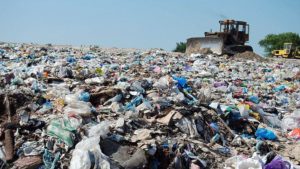
 From January 1, 2018, the law comes into force, obliging the population of Ukraine to sort household waste. How this will be implemented in practice, they do not even know in the Ministry of Ecology – in fact the legislators did not provide for any mechanisms or normative documents for this procedure. And most importantly, it is not clear what will happen next with this sorted garbage: who will export it, how and where, and how much it will cost. For the time being, only one thing is clear: in a country where about 7% of the territory is occupied by landfills, and the existing landfills are overflowing, it is crucially necessary to change approaches to recycling household waste and increase the share of recycled waste. The UU’s voice figured out who and what sort of garbage now is, how much it costs, who benefits from processing of recyclables and whether this process is introduced everywhere.
The idea of separate collection is not shared by all
Kieviana Catherine carefully examines all household waste in his house. The package for wet fractions in her house does not get any plastic bag. The plastic container is thoroughly washed and folded apart from the organic material, under the paper, batteries and lids from the plastic bottles are allotted large containers in the lobby of its entrance to a new building in Poznyak. This was taken care of by the local management company, the initiative is actively supported by the residents of the house. Catherine lives in a new building on Poznyaky, and her neighbors are all young and enterprising. It is through the efforts of such indifferent people in many retail chains that containers for the same used batteries have appeared, there have been projects to collect extremely harmful fluorescent lamps. After the tragedy at the Gribovichi dump, supporters of separate collection of garbage and its further processing in Ukraine became much more, because numerous reports and press materials, like one, warn that such problems are relevant for all the country’s polygons. So, according to the head of the All-Ukrainian ecological league Tatyana Timochko, in such a Gribovichy state there are most landfills in Ukraine. They are overcrowded, although, according to the ecologist, Ukrainians can already now sort out up to 15-30% of waste by themselves, which provides for a separate collection system, which, as the law suggests, will be introduced from the new year.
However, if it is easy with educated youth, then it will be difficult to force to lay out garbage on various tanks of elderly people, former housing minister Alexander Kucherenko thinks. “It is very interesting how they will go and the grandmothers in these Khrushchev kitchens will tell about the separate collection and let them calculate how much it will cost,” he resents. According to him, while Ukraine has reached the topic of separate collection of garbage, many civilized countries already refuse it. “Today there are automated intellectual processing systems in the world, and the special need to organize separate collection in Kiev, in the kitchen, and, accordingly, tripling the number of garbage containers at home, is a huge trouble.” Also considering that we have 2/3 housing and kitchenettes are small.In the world there are other technologies for a long time, when all this garbage is sorted at the relevant waste-processing enterprises, “he explains.
Who will pay will be
Expenditures, apparently, at least, figured in the Ministry of Ecology and Natural Resources. Minister Ostap Semerak bluntly stated in an interview with the media that such a rule of law is currently unrealizable. “I understand that no city is now ready to sort the garbage (prohibition of burial actually means recycling), if only because there are no containers for sorting it, only in Odessa, for example, you need about 50 thousand containers,” – said Minister. And this is only for collection – the export is still necessary. It is with him in Ukraine the greatest problems. Lviv environmentalist Alla Wojciechowska says that in her hometown for five years, to some extent, they are implementing separate collection of garbage. “But the problem is that only one company -” Abel-lions “had a sorting line, where hand-sorted PET bottles by color and passed for recycling is often the case that even if people sort recyclables in different containers, it is like. cars arrive, they dump garbage from different tanks into one and take them to the dump.Our waste is transported to various polygons of the region, to various landfills, “she explains.
Therefore, a good idea, naturally, stumbles upon the key question of recent years: how many times will it be necessary to increase the tariff for garbage disposal, so that it is “as in Europe”. According to the head of the project “Batteries, give up!” Lyubov Kolosovskaya, the current tariff for garbage disposal will not make the recycling of recyclables attractive for business. According to her, even the notorious plastic is profitable to process, when it is already assembled, but the fact of its separate collection is unprofitable. “When I lived in Europe, in the north of Italy, for the removal of garbage from a two-room apartment I paid 4.2 euros per person per month, right now, in the Dnipro, this service costs me less than 10 hryvnia,” she explains. On the fare increase and Minister Semerak insists: “I understand that people would not want a significant increase in the fee for waste disposal, but it is inevitably much we pushed away the garbage problem, it will not resolve itself.”.
Power is not enough now
But even with the organization of export, to date, separate collection of household waste in Ukraine does not make any sense, because the country does not have the conditions for its processing. According to the director of the Kiev Ecological and Cultural Center Vladimir Boreyko, in Ukraine there is no capacity for recycling batteries, fluorescent light bulbs for recycling, plastic bottles of the power we have, but they need to be ten times more – line now overwhelmed. And mass actions to collect, for example, spent their batteries and batteries lead to the fact that they settle in the offices of volunteers.
Indeed, in the network of building materials “Epicenter” we were told that the campaign to receive fluorescent lamps was one-time and is no longer being conducted. The network of shops “Watson” stopped collecting batteries. According to Lyubov Kolosovskaya, batteries are a vivid example of the futility of waste recycling projects in Ukraine, because their processing is unprofitable. “To make them processed, it is necessary that someone paid for it.” We started 4 years ago, we thought everything was so easy: we just collected it, sent it to the plant “Argentum” and processed it there. “A miracle did not happen, but there were 40 tons of batteries that are now in our warehouse, but no one wants them for free, nobody wants to invest in production in Ukraine either, “she explained. In her opinion, the only way out is to lay the cost of processing in the price of products in the retail network. So far, only three companies have agreed to raise prices to charge for recycling batteries, and volunteers collecting money for the disposal of the first parties in Europe, because the plant does not appear in Ukraine in the near future, and the batteries leak, deteriorate, and eventually they generally can not be recycled . The actual shipping of batteries, according to Kolosovskaya’s calculations, will cost at least half a million hryvnia, or even the whole million. And these are only those 40 tons that the volunteers of the organization alone have collected.
Alla Wojciechowska explains that the plant “Argentum” was only an experimental installation, where in fact the artisanal method was used to extract valuable components, but the enterprise has never had environmentally safe processing. “It was just an experimental reworking, there were actions when various organizations and social activists were collecting these batteries and bringing them to a factory that had neither documents nor technology in fact, there are no other enterprises that have safe processing in Ukraine, at least , officially, because it is expensive, and not even every country in Europe can afford it.This plant pays off for about 20-30 years.It is actually like a metallurgical plant, because at the last stages of processing Also, smelting is also planned, as well as extraction of various harmful substances, “the ecologist notes. For example, a waste-processing plant is going to be built in the Kherson region.
The investor is China. Local authorities provide a site, a preferential tax rate and, in fact, garbage. Governor Andrei Gordeyev told the Voice that there is currently a selection of places for the construction of the plant, investors are calculating options, our experts go to China to get to know the process. There is still an independent European audit at the design and implementation stage. However, it is clear that the launch of such a plant – it’s not a single year.
The garbage business is profitable in the shade
However, not all ecologists agree with the unprofitable “garbage” business. According to T. Timochko, the use of recyclable materials makes it possible to reduce the use of primary resources. For example, paper production using recycled paper requires 6 times less water, and re-processing glass requires 4 times less energy. And the sorting of household waste, she said, is quite well established now. And at the dumps themselves. According to the ecologist, from 6 am people’s lines, as a rule, from nearby settlements or without a permanent place of residence, and there already on the spot begin to be selected: plastic separately, paper separately, metal cans separately. All this is sorted, with plastic – in colors, plastic bags – in colors. “It is stored, pressed into bales, then cars come in and they take it out as raw materials.” But money for what is being exported – they do not figure anywhere, but it’s not for nothing that the enterprises export, which process plastic and packages – for them it is important If we import thousands of tons of waste paper to Ukraine every year, thousands of tons of cullet from other countries, “she explains.
According to Vyacheslav Potapenko, an ecologist at the Institute for Strategic Studies of the New Ukraine, up to 80-90% of the waste currently recycled in the country is in shadow. “They are engaged in processing, but in clandestine way, business owners earn it, which, in turn, are shared with the city authorities, so when investors come up with their proposals for building refineries, with real investments, local authorities usually refuse them. Or they bring sub-standard wastes for processing, from which previously valuable fractions were extracted, “he explains.
A source