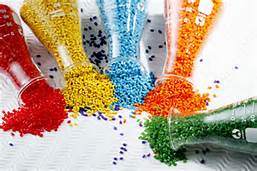
 If we imagine that the plastic suddenly lost its color, and there were only “plastic” white and shades of gray, then 30% of the world around us would be faded and faded. Plastic sets the color of our everyday life, and the problem of the quality and characteristics of “color” – one of the most critical for any manufacturer.
Polymeric materials are not initially attractive in color and texture, but because the molded plastic articles from a homogeneous melt, it is possible to give any color and texture properties using special additives for another processing step. Production of these additives can be arranged directly at the enterprise, combining the most conversion processes, prokraski and actually manufacturing the ink supply.
Staining plastic held “in the mass” – when the material is in a molten state, is added to it a dye or pigment. Thus there is a dispersion (dispersion) of the particles in the latter polymer mass, which provides uniformity and saturation coloring.
Add the colorant in the plastic melt can be in powder form or as part of another melt. Staining bulk polymers by adding a pigment powder is inconvenient, as it has several drawbacks: unsatisfactory optical properties of the polymer to be painted, reduced mechanical properties of the product, unnecessarily high consumption of expensive dye difficulty transition from one color to another due to equipment cleaning. Basically, all these shortcomings are one explanation – the complexity of the complete dispersion (distribution) of the dye in the polymer volume. colorant particles are aggregated (clumped) that leads to divorce, dullness and color unevenness.
To avoid the problems described above, as well as the improvement of working conditions in the dyeing of plastics using masterbatches.
Masterbatches are dispersions of pigments in the substances easily dyeable with a compatibilizing polymer. In other words, when using the polymer masterbatch is introduced into the volume already dispersed dye powder. During the processing of the colorant particles are easily and uniformly distributed throughout the volume of the future product, not slips and settling at the bottom of the cylinder material.
In the name of masterbatches prefix “super” means a high content of dye in the dye powder weight (90%). This, along with just exist Masterbatches dye concentrates that contain in its composition up to 20% pigment. Manufacturers of plastic products is more profitable to deal with masterbatches, since due to the high pigment content of their consumption on the production are significantly lower.
Depending on the method of producing the final product coloring may be in the form of granules, powder, paste or solution.
In the simplest form of masterbatches is a system of two components, a pigment and the matrix (binder). The template can be used in virtually all polyolefins, polyolefin wax, polystyrene, solid epoxy resins, etc. The choice of materials determines the method for preparing masterbatch – dispersing in the melt, for which use screw extruders.
In addition to the above materials, a binder can be a paste some plasticizers steoroks and latexes that can be incorporated into the pigment by grinding. This method of obtaining masterbatches similar offset printing inks kraskoterochnyh machines.
In the preparation of the pigment of the emulsion in the polymer solution using polystyrene, polyurethane, polyvinyl acetate. In this case, the blade mixers can be used, mixers, etc.
Most claimed masterbatches obtained by dispersing the pigment in the polyolefin melt, polyolefin waxes, and polystyrene. This is explained primarily by the fact that the lion’s share of recyclable materials – namely polyolefins.
For coloring plastics, can be used as inorganic and organic pigments. Among the inorganic pigments commonly used titanium dioxide, calcium carbonate, carbon black, cadmium, cobalt, zheleookisnye, chrome pigments, ultramarine, etc. lithopone.
Among the organic pigments are the most important pigments having molecular crystal structure and insolubility in different environments painted. These include azo pigments ftalotsianovye pigments, triphenylmethane and polycyclic. With a wide range of bright colors and greater coloring power, organic pigments are inferior to inorganic by thermal, light and weathering, as well as the migration resistance.
Often, to colored products from polymeric materials have specific requirements. For example, if the polymer product is in direct contact with foods, the additives used in polymeric materials and masterbatches must have permission.
Currently there is a plurality of masterbatches, the polymer dye which allow almost any color and hue within a known color gamut. In addition, there were masterbatches that allow to get different effects when painting on which the appearance of products from polymers varies considerably.
For special effects include pearlescent, fluorescent, opalescent and iridescent color phosphorescent polymers. Additives such effects are used in road signs, advertising, clothing, toys and many other products, where the visual effect is important.
The masterbatches may also be used and Fleck flitter as inclusions in the mass of the polymer fibers, flakes or dots. With their use of color is possible to obtain “a rock” – marble, granite and others. Such effects are achieved due to the fact that these particles are colored inclusions of polymers with a higher melting temperature than the material being sprayed.
iron oxide pigments
Iron oxide pigments can be easily and cost effectively be used to impart color to coatings based on organic binders, such as priming, emulsion paints, wood preservative paints and inks based on inorganic binders, such as silicate paints. Furthermore, these pigments are used in the manufacture of concrete products, cement, curb and finishing cement stone, colored sand-lime brick, tiles and paving tiles, self-leveling floors, colored chalk, gypsum, plaster and other building materials.
Iron oxide pigments have a high light and weather resistance, resistance to aggressive chemicals.
Crown
Pigments of this group are also known as chromate of lead (leaden crown) of yellow, orange and red.
Chromates have proved a very good side in many years of application in automotive coatings, paints for industrial use and construction paints due to their good opacity and gloss retention. At present they are replaced in many countries for toxicological and environmental reasons to other, generally more expensive pigments and pigment mixture.
organic pigments
Pigments have bright color, good hiding power, sufficient stability to light and weatherability, resistance to migration when overcoating, good dispersibility, optimal flow properties in the ink system, resistant to chemicals.
aqueous paste
Dissection of organic and inorganic pigments with a nonionic dispersing agent (in the case of transparent iron oxide pigments – anionic dispersing agent).
Main applications:
dispersion paints, gloss dispersion paints, saturated inyuansirovochnye paint based on aqueous binders, water-borne paints, plastic paints, shtukaturochnye materials, lime and adhesive paint and wallpaper coating paints for color paper, water varnishes for wood.
Alkyd paste
Highly concentrated flowable dissection pigments based on an oil-fatty alkyd resins for air drying industrial enamels, enamels, and wood facade protection systems.
alcohol-Dyes
Alcohol-soluble dyes – is the dyes have good solubility in alcohol, acetone, glycols, ethyl cellosolve, and other environments, close to the alcohol by dissolution abilities.
Applications alcohol soluble dyes.
Alcohol-soluble dyes are used for dyeing nitrovarnishes, furniture varnishes, lacquers, alcoholic, stains and toning compositions for hardwood, for coloring an aluminum foil and tin to give a transparent coloring certain types of plastic, such as polymethylmethacrylate for dyeing in the polymerization process.
fat-soluble dyes
Synthetic organic dyes are readily soluble in non-polar and low-polar organic solvents. Practically insoluble in water.
Application area:
They are used for coloring plastics (poly-MA, polystyrene) gasoline (at 0.05%), technical oils, waxes, household chemical materials (paints, pastes, creams and other shoe.)