
Installation scheme

Figure 1. Kinematic diagram of a twin screw extruder.
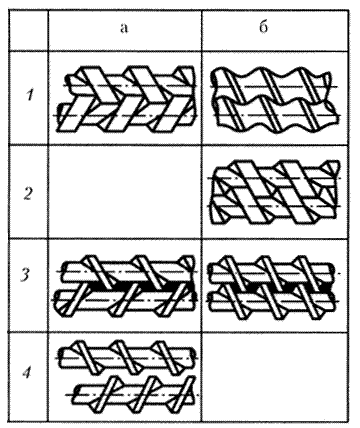
Fig. 2. Construction of a twin screw extruder worms
1a – tight engagement, counter-rotating worms; 1b; 2b – tight engagement, unidirectional rotation of the worms; 3, and – loose engagement, counter-rotating worms; 3b – loose mesh, unidirectional rotation of the worms; 4a – worms uncoupled, counter-rotating.
In contrast to a single-screw machines in the housing parallel twin-screw extruder are two worm. Since the transport of material in such an extruder is not due to the frictional forces, and forced him under the influence of forcing the worms rotating in unison, the morphology and physical state of the polymer material does not affect the performance of the machine. Therefore, twin-screw extruders can process the powder and granular materials, compositions and SHORT particulate filler melts or paste adhering to the worm, and create substantial pressure on the plastic in the gate area of the material of the cylinder.
Principle of operation
Kinematically twin screw extruder consists of a material of the cylinder 1, two screws 2 are generally parallel to the axis of rotation, the mechanical transmission of the motor 3 and 4.
Worms can be uncoupled and the engagement (Fig. 2) rotate in the same or opposite direction, have the right or left cutting. The engagement of worms can be tight or loose. Gaps in engagement between the worm and the worm and cylinder contribute to both ensure their geometric compatibility, and inflow of material to be processed between the coiled sections. Performance feed zone of extruder depends on the free volume between the two coils and the uniformity of the material.
The standard twin screw extruder screws have five zones:
entrance area (capture material and preheating)
plasticizing zone (heating and agglomeration)
compression zone (sealing zone degassing and support plasticizing)
Area degassing (degassing of the melt, including the removal of air)
exit area (complete melting, homogenizing, and eject).
The entrance area is performed capturing mixture and its preheating by internal and external friction and heat transfer. In the zone of plasticization process continues until the point where the powder mixture is heated on the surface so that under the influence of mechanical energy it starts to agglomerate. After the start of the agglomeration process begin to rapidly form large agglomerates, creating greater resistance to the cutting process.
An important element is the feeder extruder having generally the metering screw through which the fine adjustment of the feed.
It is supporting a compression zone by plasticization process that is carried out further densification of the agglomerate and increases the back pressure in the direction of the plasticizing zone. As a result of this pressure, the mixture is amplified backflow through the clearance of both screws. Further compression zone is sealed before the degassing zone.
Function degassing zone to remove a plasticized (agglomerated) of plastic material and of gaseous inclusions trapped air. For this purpose, step helix in this region is increased, whereby the space between the turns of the screws are only filled to 60 – 80% for the degassing process is formed larger surface. It is important that the plastic material is passed this zone in the required state of aggregation. As a result too weak or unequal preliminary plasticization may occur suction powdery PVC. In case of too strong plasticizing gaseous inclusions may be trapped in the melt and due to too high viscosity of PVC can no longer be aspirated.
After degassing zone the plastic material in the area of exit passes final plasticizing and it created enough pressure to forcing through a die. At the same time as possible there should be a further supply of energy, and made only seal agglomerate (beginner plasticised material) until smooth. This area is almost always necessary to carry out the removal of energy through cooling of the cylinder as to prevent overheating of the melt due to friction.
The twin-screw extruder to effectively carry out the process shift, milling and grinding material; forced displacement causes a slight buildup of material in the auger, while avoiding the stagnation of the material. Therefore, in the twin screw extrusion machine can be combined operations of mixing, mastication and, if required, and the mass dyeing.
Compared with the single screw machines, twin screw extruders have the following advantages:
– Higher productivity;
– Minimal specific energy consumption;
– Great flexibility;
– Precise control of pressure and shear forces;
– Most agitating and homogenizing power, whereby it is possible to introduce a large amount of fillers.
Selection and sizing equipment
Defines the parameters when selecting a twin screw extruder are its performance, the diameter D and the relative length of worms L / D.
Performance extruder screws uncoupled defined as the sum of the performance of two single-screw machines:
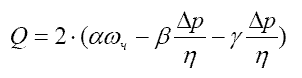
Such extruders are used for mixing and homogenisation of thermoplastic compositions.
For compositions based on polyvinyl chloride, the stabilizer, and mixing of different plastics are used intermeshing twin screw extruder with worms. The performance of these machines depends on the number of visits of cutting screw i, the volume of the closed space of the screw v, and the frequency of their rotation ωch
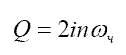
It should be noted that the performance of a twin screw machine, unlike single screw, regardless of the resistance ratio of the geometric forming head.