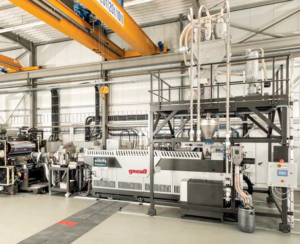
 The patented Gneuss rotary filtration systems are distinguished by a high degree of automation and security and provide almost 100% reliability of the production line. The main feature of these systems is a disk rotating in a closed space between two filter units, in which there are recesses in a circle with nets installed in them. The disc is completely sealed and protected from contact with the environment. Sealed protective cover provides easy access for changing sieves. The shape of the melt channel eliminates the occurrence of dead zones and reduces the time spent in the material to an absolute minimum.
Rotary filtration system
In recent years, all models of patented rotary filtration systems have been completely redesigned. The change of filter housings allowed to expand the area of their application by increasing the active filtering surface and expanding the pressure range. In addition to further enhancing the degree of automation and management convenience, components and modules were standardized to reduce delivery time and reduce costs.
The SFXmagnus filtration system provides automatic continuous operation with constant pressure. It can be applied in various areas. This series has a very large active screen surface, a compact design and extremely simple handling. Changing sieves has no effect on product quality. The company’s flagship model, the RSFgenius system, has an integrated self-cleaning system designed for applications with the highest quality requirements. Sieves can be reused up to 400 times. Sieve can be supplied with filtration fineness less than 10 microns.
KF continuous filtration systems have been developed specifically for production lines operating with frequent changes of material, batch or color, as well as high pressure, such as film extrusion lines for blown film. The KF screen changers are very compact and provide a simple and quick screen change without stopping the production process.
Gneuss Extrusion Line (GPU)
The Gneuss extrusion line (GPU) was developed several years ago and has proven itself in the recycling of PET waste and bottle flakes, as well as industrial waste generated in the production of fibers and films without pre-drying. The extrusion line includes an MRS extruder with unrivaled degassing and decontamination characteristics, a highly efficient rotary filtration system and an in-line VIS viscometer that provides intelligent dynamic viscosity control.
Despite the fact that the MRS technology was originally developed specifically for PET, today it is also used to process polyolefins and nylon. Other materials and applications are currently being tested. Dispersion of additives, such as fibers or fine particles in polymer melts, or doping of various types of plastics are gradually becoming important areas of application of this technology. Thanks to the patented combination of a single-screw extruder with a multi-screw element, the extruder is extremely reliable and is particularly well suited for recycling.
The MRS extruder provides recycling of PET without pre-drying. A simple water ring vacuum system allows the material to be processed directly into high-quality finished products. This is made possible through the use of a unique and patented processing unit. The traditional single-screw extruder has a multi-rotational zone consisting of a drum with eight feed screws, which are driven by a gear ring and small gears. The cylinders located in the multi-rotational drum are 30% open to the outside, which guarantees optimal access to the melt.
Thanks to this design, the degassing efficiency is almost fifty times higher than that of a traditional single-screw extruder, and with a vacuum pressure of only 25-40 mbar. Due to the absence of high vacuum systems and pre-drying, MRS technology is a cost-effective alternative to traditional methods. Other arguments in favor of MRS technology, in addition to energy savings, are simple and reliable design, compactness of installation, ease of maintenance, as well as high quality and homogeneity of the melt.
The area in which this technology is particularly in demand is the extrusion of PET films. In addition to obtaining high-quality PET films that meet the requirements of EFSA and FDA, Gneuss offers a new foaming module that allows you to quickly and flexibly switch to the production of foamed PET films. This line configuration provides extrusion of foamed film, the mass of which is reduced by 50% (depending on the process), and the products are characterized by a uniform foam structure and constant mechanical properties. The content of recycled material can reach 100%.
Sensors that meet individual requirements
In addition to the standard range, Gneuss offers various options for the equipment. Standard devices solve all common measurement tasks during the extrusion process and are compatible with virtually all systems on the market. In addition, Gneuss manufactures sensors that are specifically adapted to customer requirements and processes. These include, among other things, water- and vapor-tight sensors that are used in food processing, wear-resistant sensors with special membrane technology for WPC processing, and sensors for difficult operating conditions, including for technological processes with frequent pressure surges and short-term overpressures . Explosion-proof sensors with HART data protocol support are available for use in the chemical industry.