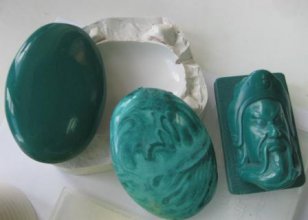
 Grinding and polishing of plastic.
Plastics, they are the same polymers are widely used in the manufacture of various products, we can even say that the objects that surround us in everyday life is mostly made of polymers (plastics). And for the professionals, the terms “polymer” and “plastic” is not the same thing. The plastics can be a considerable amount of various fillers and additives and the polymer which acts as a binder.
Feature plastics during machining and in particular for grinding and polishing, their relatively low melting point (60-150C), low thermal conductivity, viscosity, polymer relative softness (Shore A 50-85). But at the same time, those properties that are impaired in mechanical grinding and polishing, for example a low melting point and low thermal conductivity may be advantage in other methods of polishing.
The main feature for working with plastics is that they can not overheat, ie, cut and polish at high speeds. It can lead to fire plastic, its melting and loss of properties.
All plastics are its hardness, density and thermal stability. Therefore, grinding and polishing process can be different for different plastic (polyurethane, epoxy resin, polyester resin, etc.) And also depend on the content of filler in the composition, the degree of fullness and the type of filler.
Accordingly, all these parameters chosen pasta, circle, sandpaper or other abrasives.
The last and important factor is the quality of the casting. If low-quality silicone mold, and the plastic molding requires more processing costs, including the entire process from rough roughing and finishing finishing polished to a mirror finish.
For example, in the plastics Polystone and Polywood has keramichesiky filler and glass beads. Ceramic filler gives Polystone abrasion resistance and resistance to pressure, respectively, for use more aggressive grinding wheels and paste skins.
Polywood relatively soft plastic and is poorly sanded and almost polished. Although it is easy to cut and cut.
It is best to give in polishing ProtoCast-80R (78 Shore D) and ProtoCast-85R (72 Shore D), they are perfectly cut, milled and processed graver, forming a flat chip. Fantastic soft white polished neproshitym circle or fluff with a polishing paste. ProtoCast-85R due to a low hardness can be easily processed manually graver and abrasives.
MultiCast and 150 ProtoCast-polished difficult due to high hardness and density, but nevertheless can be handled manually, and a drill (or the polishing machine).
Plastics Polishing can be done in the following ways:
1. Mechanical
2. Heat
3. Chemical
Mechanical polishing.
When mechanical polishing polymers must focus on the absence of overheating plastic, that can happen very easily with low thermal conductivity.
If you need to grind and polish a small area, taking into account the compliance of plastic machining, it is better to grind and polish the plastic hand, periodically checking the temperature of the surface of the finger. However, we present machining mode (which for some may be a limitation of manual processing):
Circumferential speed – 12-15 m / s
Specific pressure on the surface to be treated – 0.2-0.1 kg / cm2
That is, in the grinding and polishing required of polymers to the surface pressure 10 times, and the rate is 3 times less than steel when polished. In the final stages of processing the pressure should be the lowest.
Now, what tools to use for grinding and polishing.
With polishing understanding, conventional sandpaper grit take from about 800 grit and smaller and successively grind grain passing to the other, as in any other grinding material. After polishing cloth to step polishing pastes.
Sources say that the polishing paste, not having in its composition of fats, such pastes are easily washed with aqueous solutions (all pasta LUXI) used for the processing of plastic parts, semiconductor crystals.
Different plastics have different ability to interact with the components of toothpastes, so the selection of pastes is always individual. It is necessary to try different before you find the best option polishing paste. Typically, two types of polishing paste used. First a rough (LUXI brown) leveled the surface, leaving it smooth, but leaving a haze. Then polish used LUXI blue or beige. Someone stopped at this stage, but who needs an exceptional shine and gloss should finalize the paste to a thin corundum (LUXI white or orange).
Pastes, water-based, after simply wiping clean cotton cloth, can be easily removed.
In mechanical polishing, it is just as important to any community to apply the paste.
For coarser pastes (LUXI brown, LUXI blue) is yellow or white stitched circle.
For fine finishing pastes (LUXI beige, white LUXI) neproshity white circle of cotton flannel.
heat polishing
Thermal reflow is polished surface irregularities under the influence of hot gas, and it is possible due to the relatively low melting temperature polymers. This treatment is only suitable for so-called thermoplastics – Polymer is melted by heating.
Chemical polishing
Chemical polishing polymers different from chemical polishing of metals, and is exposed to solvent on the plastic. On this principle work for some avtopoliroli plastic. The disadvantages of such funds, solvent-based, solvent vapors are inhaled man, and fire