The most popular polymer today is polypropylene. In the total volume of world production of industrial raw materials, it takes 20%. This material has a unique structure that allows products made from it to restore its original shape after minor deformations. Polypropylene is produced in granules, which is the most convenient form for its further use in the production process. Secondary polypropylene granules are in great demand in the modern market, which have a lower cost, and at the same time, they are not inferior in properties to primary raw materials.
Features and properties of recycled polypropylene
Polypropylene (PP) is a thermoplastic polymer produced from a monomer called propylene. It is of the following types:
homopolymer PP, consisting only of units of propylene;
copolymer. This PP is divided into: random copolymer – flexible and transparent polypropylene and a block copolymer characterized by increased strength.
Secondary polypropylene is produced in the form of colorless or colored granules, depending on the processed raw materials.
The main characteristics of this material
melting point +135 – 159 ° С for copolymer, and +160 – 165оС for homopolymer;
density is from 0.898 to 0.908 g / cm3 for PP of different types, it is the lowest among all polymers;
maximum operating temperature of 90 – 120 ° C;
The temperature at which PP becomes brittle is –20 ° C.
The distinctive properties of polypropylene are:
strength and durability;
resistance to exposure to chemically active media;
environmental safety, secondary PP is absolutely inert material that does not emit toxins and carcinogens;
high thermal resistance;
water resistant
Production and use of recycled granular polypropylene
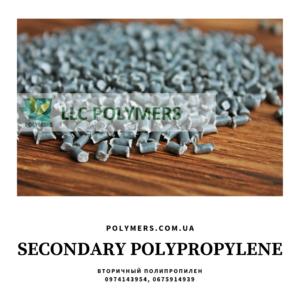 Granules of secondary PP are obtained from the waste of this material, formed during the manufacture of products, as well as as a result of their use. The technological cycle of production of PP granules consists of the following steps:
sorting raw materials, separating from it polymers of another type;
thorough cleaning and cleaning of recycled materials;
grinding it using crushers and other equipment;
granulation crushed polypropylene using an extruder.
The raw material melted in it is pressed through the spinneret, and the yarns formed during this process are cooled with a stream of water or air and are cut into pellets.
The main application of the secondary PP is for the manufacture of the following polymer products:
gas, sewer and water pipes and fittings to them;
hydro and thermal insulation material;
plastic parts in the automotive industry;
bottle caps;
capacities for microwaves;
packaging film;
carpets;
ropes and many other products.