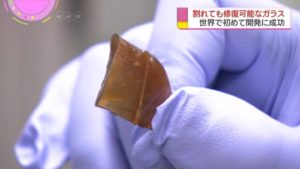
 Scientists at the University of Tokyo have developed a polymer that self-repairs under pressure. Unlike analogues, it does not need to be heated: cracks are tightened even at room temperature. The material is going to be used to create displays that do not need to be changed after damage.
A substance called polyester thiourea was discovered by chance. During the work, the team noticed that the cut polymer, which was going to be used as an adhesive, could stick together if it was squeezed and held for 30 seconds. This occurred at room temperature of 21 ° C.
“Non-crystalline high-molecular polymers usually form mechanically strong materials, which, however, are difficult to recover after damage. This is due to the fact that their polymer chains are highly entangled and diffuse too slowly, so that the damaged surface is connected in a reasonable time, – the researchers write in the journal Science. It seems that these problems have been overcome.
Not believing the random result, chemists and biotechnologists conducted a series of experiments to confirm the properties of polyester urea.
This is not the first self-healing material in history, but analogs often require heating for gluing. The new polymer is structurally stable and similar to glass in terms of density and degree of lumen. This will allow you to use it in creating reliable displays for gadgets.
There is another area where you need self-healing materials. This is a medicine where soft adaptive substances can be used inside the human body to strengthen bones and create tissues.
“I hope that self-healing” glass “will become a new environmentally friendly material that will avoid the need to be thrown out after a breakdown,” said co-author Yu Yanagisawa in an interview with NHK.