In 2021, landfill number 5 is planned to be closed. During this time, the people of Kiev must learn to sort the garbage into at least two categories, so that more will be spent on recycling and less – on incineration. Separate garbage collection: reboot – this is what the current initiative of the KSCA can be called. According to the municipality and private sorting companies, the townspeople are still not ready to sort the garbage by type, and decided to start anew and simple: separate organic matter (the so-called wet fraction) and separately – dry fraction. But it’s not enough to sort it out – will the recyclers themselves take it later, that is the question.
At least two buckets and not to lure
Many have already seen new containers in the city – these are nets, plastic, and even smart ones with an electronic filling panel and solar batteries. In total, 2.5 thousand of them are established in Kiev, and eight companies are involved in the collection and sorting of garbage, private and municipal. Some of these companies install several containers at once: for glass, paper and plastic. But many say that the townspeople continue to throw away plastic bottles and bags in the cullet. And in a container with plastic – paper. As a result, this container will not be taken immediately to the warehouse or to the corresponding plant; Therefore, many companies decided to install at once one common container called “for dry fractions”. After all, the main condition for the successful processing of recycled materials is its purity, which means that we should not allow mixing with food waste.
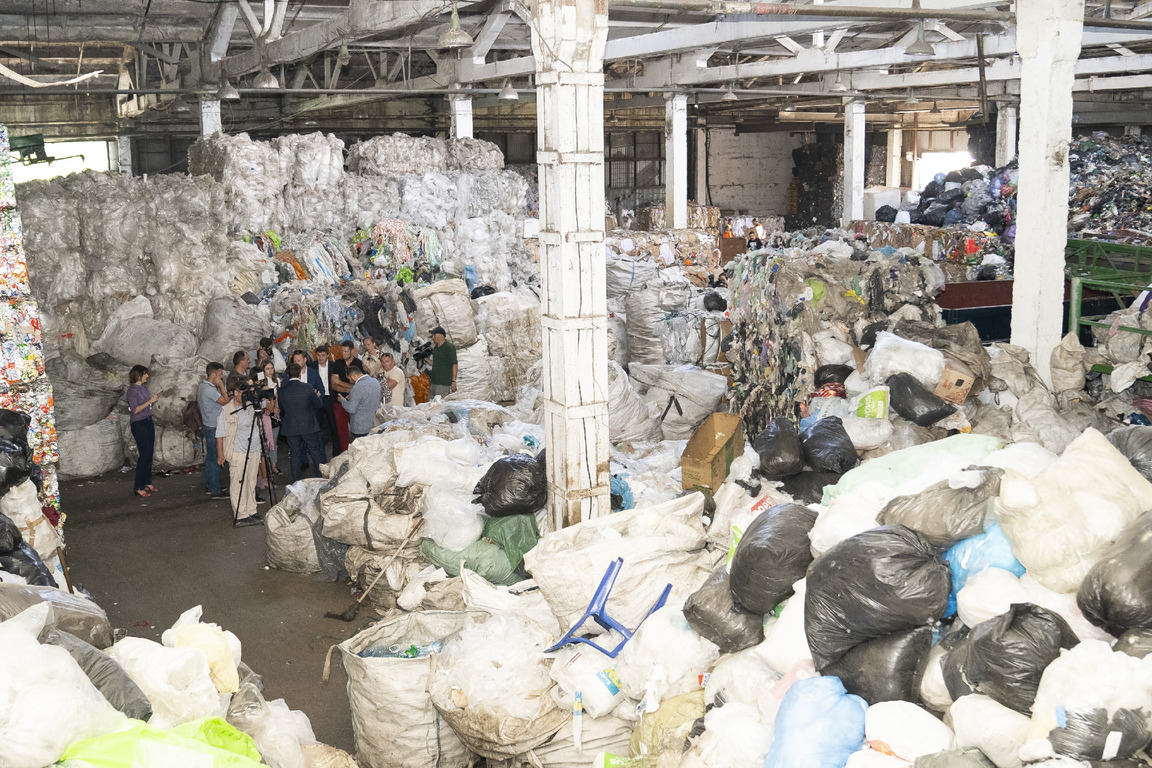
Such dry garbage is brought to sorting lines. Alas, there are no such technological wonders as in Europe, when garbage is checked and sorted by laser and air flow. In Kiev, everything is routine: about 10 employees in the same warehouse hand-pick the brought garbage. Each sorter or sorter has its own type of garbage: plastic of different colors, bags, etc.
Salary sorter garbage – 10-12 thousand hryvnia, the drivers of garbage trucks – 25-30 thousand hryvnia, because they have more responsibility. In total, one such warehouse employs from 20 to 30 people.
“And they sort 100-150 tons per day, although the planned capacity is 280 tons per day,” says Evgeny Nagorny, director of the Eco-Stock company.
The smell in the warehouse is far from the store, it is felt that this is part of the trash. At the same time, the director of another competing enterprise, with a hint of envy in his voice, notes that the raw materials are clean, in good condition, as if bought. From which it immediately suggests the conclusion that you have to work with waste in a much worse condition. This is despite the fact that separate garbage collection activists and public utilities themselves keep saying: bottles should be rinsed before delivery, only clean bags are accepted, bottles from fatty substances are not suitable at all.
Why do you need it
Polygon number 5 is full, according to the KSCA. Now it is being reclaimed, and in 2021 they plan to close it altogether. In August, KSCA plans to hold a tender for the development of a regional waste management plan. They hope that international firms will be among the participants. Already in August will announce the result.
“In general, the city aims to build processing plants. Every year, Kiev produces 1 million 300 thousand tons of garbage, 7.6-8% is sorted out of this mass, ”says the deputy head of the Kyiv City State Administration Peter Panteleev.
So, by 2021, we must learn to sort them and make the most of it, not burn.
In addition, since January 2018, according to the Law on Waste, the sorting of garbage is considered mandatory. Also, the Ministry of Health has published a draft amendment to the “State sanitary norms and rules for the maintenance of territories of populated areas”, where there is an item on the mandatory installation of urns for different types of waste. That is, the ability to throw garbage separately may become mandatory de jure.
Is there anyone to recycle?
Collecting is only part of the story. For example, many Ukrainians are involved in the collection of waste batteries. The project “Batteries, give up” was founded in 2013 and turned into an all-Ukrainian network of 1500 reception points. But in 2016, it turned out that the Lviv plant “Argentum”, which assumed the obligation to recycle this dangerous garbage, is not able to cope with the task. At the moment, 50 tons of dangerous garbage were already in the warehouse of the public project.
In 2018, “Batteries, give up” started a partnership with two European plants: Redux in Germany and Recupyl in Poland. To pay for the processing of accumulated batteries, you need more than 3 million USD, and the project is now looking for sponsors. In parallel, activists launched a new project – “Boxes”. Special boxes will be installed in enterprises that are willing to cover the cost of their processing themselves. For example, two large retail chains that sell such a product agreed to collect it. But it will be only 2% of the toxic waste created in the country.
Boxes for collecting batteries could be found in housing offices and kindergartens. The KSCA also plans to announce a tender for the disposal of this waste abroad – there are no relevant plants in Ukraine. The results of the tender promise to inform publicly.
Garbage from other countries is cheaper
Each type of garbage has its own specifics and obstacles to recycling. For example, recyclers are now reluctant to buy paper or waste paper.
“The stream from Europe: Poland, the Czech Republic, Slovakia rushed to us,” explains the director of Eco-Stock, Yevgeny Nagorny. – Previously, they exported their recycled materials to China. Now China has forbidden to accept, and they brought to us. If our ton is 3000-4000 UAH, then the European one is 2000-2500 UAH. ”
It is more profitable for manufacturers to buy recycled materials at a lower price.
Why is garbage from Europe cheaper – sorters explain the conditions of work at the legislative level. So the neighbors for the processing are paid by the producers of the goods themselves, and more precisely by the buyers: the price of each plastic bottle with a drink contains a percentage that the plant will then deduct into a special fund, and the fund will distribute it as a subsidy between the waste recyclers. In Ukraine, there was also such a rule – Resolution of the Cabinet of Ministers No. 915 “On the Implementation of a Collection System …” dated July 26, 2001. But about five years ago it was canceled: in 2015, a comprehensive reform of the market for recycling containers and packaging was planned. Then the tax experts said that the fee for the collection and disposal of packaging and packaging will be charged at least twice. Apparently, it was not possible to clear the Augean stables. Nevertheless, sorters believe that beverage producers continue to include this percentage in the cost of their goods, but they don’t list them anywhere.
Packaging manufacturers themselves may also oppose such a recycling fee. For example, plants for the production of glass. Some of them themselves have sorting lines, distribute glass by color. They buy crushed prepared raw materials even in Belarus and do not see the reasons for which they have to additionally compensate something for the intermediary collectors. By the way, glass, unlike plastic, has an unlimited life cycle, that is, it can melt endlessly, without requiring disposal. Interestingly, in Poland, broken glass takes up to 70% of the total raw materials, and we have only 30%. At the same time, the production of recycled glass is cheaper (lower melting temperature, and hence fuel consumption) and higher quality.
No time for mistakes
Actually, the volume of sorted waste collection is the main stumbling block and goal of the current campaign of the Kiev administration and transport and sorting companies. Without the proper amount of quality sorted trash, there is no point in doing this at all. During the month of the experiment, glass containers in the city center were filled with only 10%. This is understandable, of course, townspeople and tourists drink from glass mostly in restaurants and all this goes to the sink successfully.
If this result will be in the sleeping areas, then drive half-empty cars for more than 100 thousand euros will be economically uninteresting. So far, the schedule for the extraction of the so-called dry fraction, for example, at Kievkommunservis is two to four times a month. The frequency of arrival of the car will depend on the activity of waste collection by residents.
Each of the eight enterprises serves its own or several districts, but it can also negotiate with individual condominiums or by uniting the houses of other districts. Alas, individual conscious residents of the area are not enough. Residents must agree that they are ready to collect all the garbage at home in at least two different buckets and, accordingly, take them into two containers. In theory, such garbage collection is more profitable than just taking it to the landfill (which, I remind you, they plan to close it). Some sorters even agree to pick it up for free, although they say it is unprofitable.
“Those who wish to install such containers near their homes can turn to line 1551 or to the specialized department,” explains the deputy head of the KSCA, Peter Pantleev.
Containers of the garbage disposal company are installed at their own expense. The city does not spend money on this. Accordingly, the companies themselves should not be interested in simply taking the waste to the landfill, they are interested in its further sales. The whole project is still a test one, in six months the administration hopes to get the first results and statistics, and to understand where to go further.
Summarizing, there are contradictions in who, to whom and how much should. Additional taxes perturb manufacturers, because some of them are engaged in processing themselves. Subsidies are needed or at least to remove the value added tax – for the transport and sorting companies themselves. They want cheaper, if not free, garbage collection by residents themselves. At the national and city levels, they see it a little differently: the land is too valuable a resource to be destroyed by garbage, and it is worth raising the tax on direct disposal of waste. Then separate garbage collection will indeed be cheaper than a garbage chute. It should be noted that the municipalities of the same Poland recognize half of their eco-projects as incapable. So this is a long way to make mistakes and lessons, but we will not have European non-refundable grants, like Poland.