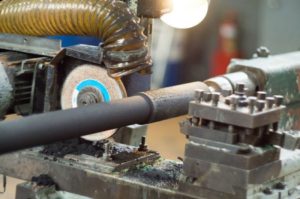
 Re-grinding of the rubberized shaft: is it possible to save and not repair the entire shaft?
For all its external simplicity, the rubberized shaft is a complex and whimsical device in operation. A very small damage to the surface is enough to stop working properly. A repair of the shaft with the replacement of the entire rubber coating (re-trimming, gumming) is a costly process both in time and economically.
But often you can do with “little blood” by contacting the Ligum plant for polishing the surface of the shaft. Let’s spend a little educational program, when re-grinding is recommended instead of re-profiling, and when without a serious repair of the shaft it will not be possible to manage.
The re-grinding will help you if:
Your equipment has a mechanism for adjusting the shaft pressing with a wide range, which can compensate for the natural reduction in the diameter of the shaft after re-grinding, or there is the technical possibility of using a shaft with a reduced diameter elsewhere (this happens in some printing machines: the colorful shafts in the sections are identical in the design of the metal base and Differ only in the thickness of the rubber layer.If you do so – congratulations, you can save a lot)
Damage to the shaft is superficial: for example, oxide film after long storage of the shaft without protective packaging, or a fine network of surface cracks due to one-time mistaken contact with unsuitable chemistry, or small shallow cuts due to contact with jammed edges of the material, or a slight non-cylindricality.
The shaft is in general good condition, does not have deep oxidation of the metal base, is not heavily soiled, has a short working life.
The removal of the layer during re-grinding will not reach the roll bed material.
You can only re-work, if:
The shaft has at least minimal delaminations of the elastomer from the metal base.
Rubber on the shaft has pronounced changes in hardness from the specified, strongly swollen or vice versa, has hardened from the use of unsuitable chemistry or other factors.
Rubber has deep cuts or cracks. Keep in mind that it is almost impossible to assess the depth of a cut or a crack, because each time you push apart its edges, you deepen it by ripping the material further. Soberly evaluate the damage without trying to measure the depth, especially for soft offset rubbers.
Rubber is damaged due to too strong a shaft clamping. Such shafts have deep internal damages in the elastomer array.
Rubber is damaged due to erroneous thermal operation.
Worn or damaged shafts, seats for bearings. Their repair is possible only after the complete removal of rubber from the shaft.
The shaft on the construct has slits, notches or other elements. The fact is that according to the manufacturing technique, the shaft is first made cylindrical, ground, and then it cuts the elements. Grinding after cutting will damage the faces and angles of the elements.
Grinding is performed most often according to two principles: up to a certain diameter or until the damage disappears. In the second case, you will necessarily need data on the minimum diameter, less than which the shaft can not be ground, consult with experts on their equipment.
When preparing the shaft for shipment for re-grinding, please take care of its safety during transportation: the packaging must protect the shaft from damage, the shaft must be in a suspended state. If possible, protect the surface of the shaft with paper and bubble wrap.