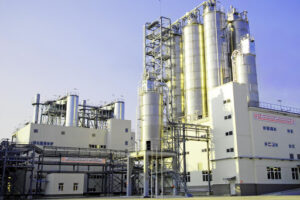
 In the coming days, as part of a special investigation initiated by Karpatneftekhim LLC (Kalush, Ivano-Frankivsk region), preliminary measures may be introduced in the form of import duties on a number of goods. Imports of polyethylene and polyvinyl chloride (PVC) are hit. We clarify that the complainant insists on the introduction of the aforementioned preliminary measures before the end of the investigation.
Analysts see in these actions nothing more than an attempt by Karpatneftekhim LLC to close the import of polyethylene and PVC.
To implement the plan, the company secured the support of the Ministry of Economic Development, which took the form of the mentioned noble investigations in order to protect the unique Ukrainian manufacturer. Karpatneftekhim LLC explained that over the past years, the mentioned products were imported in such volumes and at such prices that could harm the national producer.
However, quite harsh comments are heard on the market that the Ministry of Economic Development and Trade in favor of the Kalush monopolist carries out genocide of Ukrainian business. Many market participants directly declare: there is either a total sweeping of the industry, or there is an incompetence of persons making direct decisions in the MEDT.
There are never too many admin resources
The general director of Karpatneftekhim LLC Yarema Rudik, quoted by Gal-Info agency, said that the company’s management had meetings with representatives of ministries, and the government has an understanding of the situation. According to him, despite the fact that Karpatneftekhim LLC is a monopolist, the situation is currently developing in such a way that without state intervention, the enterprise is not able to operate normally.
Moreover, as representatives of the Kalush enterprise themselves say, they receive maximum support from the Ministry of Economic Development and Trade, and the process as a whole is in favor of the complainant. The investigation is moving at an extremely accelerated pace to exclude bureaucratic delays from competitors.
The last moment is quite important. According to a source in the Kalush City Council, the Ministry of Economic Development and Trade has confirmed its readiness to defend Karpatneftekhim LLC comprehensively.
Attempts to undermine the position of Karpatneftekhim LLC were stopped by very timely requests from the Ministry of Economic Development and Trade to the competitors. The Ministry of Economic Development and Trade does not hide the fact that the requests were indeed sent with some advance, despite the complaints of the participants about the violation of their interests.
It is curious that in the context of the foregoing, complaints are increasingly heard on the market that the MEDT is becoming an instrument of administrative redistribution of the market.
However, the enterprise was not limited only to heavy artillery in the form of MEDT, but also involved administrative support on the ground. The Kalush City Council also supported the initiative of a key petrochemical producer in the country. Over the past three months, deputies of the City Council have repeatedly appealed to the president and the government with requests to protect Karpatneftekhim LLC.
“The Kalush city council is concerned about the situation with Karpatneftekhim LLC and the possible shutdown of the enterprise, which has 2,792 employees. The appeal was supported by all 33 deputies present at the meeting of the extraordinary session of the Kalush City Council, ”the city council said in an official message sent to the president and the Cabinet in early March this year.
Caring for people
It is curious that in its appeal the Kalush enterprise complains about a reduction in the production of goods due to an increase in imports. At the same time, the true reason for this state of affairs is the fire that occurred on January 12, 2019 at Karpatneftekhim LLC as a result of a violation of industrial safety rules.
On the fact of the fire, criminal proceedings were opened under part 1 of Art. 272 of the Criminal Code (violation of safety rules during work with increased danger in the workplace).
As local media reported back then, with reference to the emergency control system in the Ivano-Frankivsk region, the fire arose as a result of the destruction of the gas supply pipe to the polypropylene production plant. The flame rose to a height of 15 m, and for the localization of the disaster, 19 pieces of equipment and 105 people from the fire and rescue units were involved.
“Thus, this event is the true reason for the decline in production at LLC Karpatneftekhim, and therefore, the reference to an increase in imports as a reason for the decrease in production is unreasonable and unreasonable and cannot be taken into account,” PFG Neftekhim specified, which is also an interested party to the special investigation.
As the media wrote, this is not the first case of a fire at the enterprise. In 2017, a flange burned there, which caused a panic among the population of the region.
In general, labor safety at the production site of Karpatneftekhim LLC raises a number of questions. Employees complain about the lack of special protective equipment, including now, during the coronavirus pandemic. This contradicts the thesis about caring for employees, which is presented in the above appeal of the Kalush city council to the president and the government.
In addition, several top and middle managers responsible for industrial safety, labor protection and the environment, after a nominal change of ownership and the flange ignition mentioned above (i.e. after 2017), left the enterprise, which cannot but alarm.
From Russia with love
Karpatneftekhim LLC is one of the largest and most technically equipped petrochemical enterprises in Eastern Europe. It specializes in the production of ethylene, polyethylene, vinyl chloride and caustic soda, a monopolist in some product groups. As of now, the enterprise is capable of annually producing 300 thousand tons of polyvinyl chloride, 200 thousand tons of caustic soda, about 180 thousand tons of chlorine, as well as 250 thousand tons of ethylene and 100 thousand tons of polyethylene (for some items there is still subsidence for the consequences of the fire). In 2017, the plant resumed production after a long downtime and now continues to gradually increase production volumes to the planned design indicators.
According to Vagit Alekperov, president of OAO Lukoil, the total investment of the Russian giant in Karpatneftekhim LLC is about $ 1 billion; at the same time, the head of Lukoil initially considered the Kalush enterprise as a strategic outpost in Ukraine.
Who now owns the chemical giant, which the Russians did not plan to leave under any circumstances?
It is known that in February 2017, the Russian Lukoil unexpectedly made a deal to sell a 100% stake in LUKOIL Chemical B.V. (Netherlands), which owned the plant; then Techinservice LTD acquired up to 50% of the shares.
Techinservice LTD is registered in the UK, the director is a citizen of Ukraine Igor Shutsky, the company is associated with Igor Kolomoisky and the deputy from the Popular Front Andrei Ivanchuk. Moreover, in an interview with Ukrainska Pravda, Igor Kolomoisky confirmed that he owns Techinservice along with People’s Deputy from the Popular Front Andrei Ivanchuk.
The second indirect owner – more than 50% in Karpatnaftohim through the Cypriot Xedrian Holding Ltd – became Ilham Mammadov (a long-term functionary of the Lukoil group of companies in Ukraine). As can be seen from the ratio of the shares of the parties, control over the enterprise is exercised precisely through Ilham Mammadov.
According to some sources, the sale of Karpatneftekhim by Lukoil was of a formal nature, that is, the actual owner of the enterprise is still the Russian Lukoil, while Ilham Mammadov is the nominal holder.
Proponents of this version cite a suspiciously insignificant amount for which the chemical giant was sold to new owners. Recall that Igor Shutsky and the second buyer paid about $ 25 million (for two) for their share of up to 50%.
If we take into account the entire volume of investments in the enterprise by Lukoil (named by Vagit Alekperov and confirmed by documents), it turns out that the new owners paid for their shares only 5% of its real value. Market experts have repeatedly spoken out about this deal as extremely suspicious – even taking into account more than strained relations with Russia.
The Russians simply “rewrote” their share of the above persons, the source said.
It is noteworthy that the aforementioned strained relations with Russia in no way affect the trade relations of the enterprise. The fact is that Karpatneftekhim LLC buys raw materials from the aggressor state, while receiving state subsidies for this raw material from Ukraine, which are fixed by law. The Cabinet of Ministers, by Decree No.299 of April 26, 2017, established for Karpatneftekhim annual quotas for excise-free import and purchase of raw materials for production: liquefied natural gas – 1070 million liters, straight-run gasoline – 1170 million, diesel fuel – 985 million liters. Processing of each of these volumes can ensure the production of 250 thousand tons of ethylene per year.
At this point, the Ukrainian government sends a big hello to the Ukrainian business, which imports similar raw materials on general terms, and Russian puppets during the military conflict continue to support their parent company, also under Ukrainian privileges. The market also expressly states that the manufacturer uses various schemes for additional evasion of payments to the budget, in particular through tolling. All costs and environmental risks lie in Ukraine, and Russian business is very easy to squeeze the balances from independent Ukrainian consumers.
All against one
Investigations in the interests of Karpatneftekhim LLC caused a stormy reaction, which, however, few people care about at the Ministry of Economic Development. Consumers literally bombarded the ministry with letters seeking support that the MEDT ignored
It is noteworthy that the investigation affects many industries. For the sake of one enterprise, manufacturers of plastic film, PVC pipes, wallpaper, plastic windows, cable products should be sacrificed, this list is not complete. Their common misfortune is the relatively small size and the inability to independently counterbalance the scope and lobbying capabilities of Karpatneftekhim on their own.
The first and most obvious problem they see is the absence at Karpatneftekhim LLC of production of a significant part of the products that came under the investigation of the MEDT. The mentioned source in the Kalush City Council, referred to by Gal-Info agency, draws attention to this. A similar position is shared by a number of media in the Ivano-Frankivsk region (“Pravda thy vіst mіsta”, “Legal Technologies Agency”, etc.), it is also indicated in non-confidential versions of comments of other market participants.
In addition, Karpatneftekhim LLC and the Ministry are proposing an investigation by combining in one group both the goods that it produces and those that it does not produce, but whose production technology is similar. In particular, polyethylene is intended for the manufacture of shopping bags, grocery bags, bags, and PVC – for the manufacture of rigid and semi-rigid pipes, profiles, sheets and film. In the framework of the statement of Karpatneftekhim LLC, the aforementioned polyethylene and PVC are one and the same. At the same time, on the basis of the above arguments, according to the participants, combining these products into one group is not possible.
In addition, in the official comments of one of the participants, it is explicitly stated that out of 75 foreign companies mentioned in the statement of Karpatneftekhim LLC as producers of polyethylene, in fact, only 27 are such; and out of 33 declared PVC producers, only 18 are such. Thus, according to the participants, Karpatneftekhim LLC deliberately indicated inaccurate information in its statement.
Consumers also pay attention to the fact that on the part of the complainant there is a game of data. In particular, depending on a particular situation, the company at its discretion either takes into account or does not take into account the 2017 import figures (when it resumed operation after a stop).
LLC “Karpatneftekhim” in the case file repeatedly refers to a reduction in the volume of production and sale of goods. But upon a more detailed examination of the situation, it turns out that the periods of volume reduction indicated by the enterprise occur only in the winter period (January, February) due to seasonality, which is characteristic of the entire industry, and not just the applicant. Thus, this thesis is quite controversial.
In general, according to market participants, the statement of Karpatneftekhim LLC contains more than twenty such controversial theses.
Interviewed experts pay attention to another important point. The concept of “national commodity producer” (which Karpatneftekhim LLC so cares about imposing barrage duties) cannot be supported without taking into account the positions of related industries – producers, but also importers, exporters, processors, consumers, etc. This means that the support of one large monopoly producer will lead to significant losses (reduced productivity, reduced revenues to the state budget of Ukraine, a significant reduction in the number of jobs), which does not correspond to the principle of justice.
By the way, if we talk about the market situation in which all of the mentioned events take place, then, according to the Market Report agency, over the past year, the import of polyethylene into the Ukrainian market grew by 10% and amounted to 268.7 thousand tons (which generally does not so much for this market). And in January 2020, the total volume of imports of polyethylene decreased by 8% compared to January 2019 and amounted to 19.4 thousand tons. And this despite the fact that production volumes at Karpatneftekhim LLC fell due to the fire, and a significant part the nomenclature of imports is not at all produced by Karpatneftekhim LLC. There is a self-regulation of the market, which hardly needs protective measures in this situation.