Any marking is intended to identify the goods. The recycling sign performs two functions:
confirms that the goods are safe and can be processed;
allows the user to determine the disposal of the used product.

Environmental recycling signs
In world practice, a number of symbols are used, which are signs of recycling. The differences between the images are related to the features of the materials from which the goods are made. The resulting waste requires different methods of disposal, labeling allows you to simplify the sorting process. A Moebius loop mark placed on a product shows two meanings:
the product, in whole or in part, is made from reprocessed raw materials;
The product can be recycled through recycling.
Other environmental symbols used, according to the classification of the European Union, have several types:
d2w;
crossed out container;
“Green dot”;
pictogram of a person throwing garbage in an urn;
FSC
Each of the symbols is used for marking in a specific industry. For example, FSC is used in the wood industry, meaning that the production uses wood obtained from responsible sources.
Common Recycling Codes
Codes are placed on the packaging, and graphically look like a recycling symbol, supplemented by two designations: digital and alphabetic. This emphasizes that the recycling codes are divided by the types of materials involved.
Raw materials come from seven industries:
plastic;
pulp and paper;
metallurgy;
woodworking and textile;
glass;
Components;
chemical.
For each group, marking codes are used to determine the type of specific material. Inside the triangle, a digital code is placed, under the triangle is a letter code. The letter part is the material identifier according to the international standard ISO 1043. Such marking will not give information about the dangers of the goods, but will help in sorting the waste.
Plastic Products

Initially, a code system was developed for marking types of plastics that require different processing methods. For plastic products, the following codification system is used:
| Код | Идентификатор | Название | Русская аббревиатура | Примеры | Возможная опасность | Вторичная переработка |
| 1 | PET | Полиэтилентерефталат | ПЭТ | Банки, бутылки, упаковка | Безопасен с пищей, опасен при повышении температуры и продолжительном хранении | Да |
| 2 | PE-HD | Полиэтилен низкого давления | ПЭНД | Канистры | Безопасен с пищей и при умеренном нагреве | Да |
| 3 | PVC | Поливинилхлорид | ПВХ | Тара непищевой продукции, пленки | Токсичен, использовать с пищей не рекомендуется | Нет |
| 4 | PE-LD | Полиэтилен высокого давления | ПЭВД | Пакетированная тара | Безопасен с пищей и при умеренном нагреве | Да |
| 5 | PP | Полипропилен | ПП | Изделия, упаковка, пластиковая посуда: вилки, ножи, ложки, тарелки, стаканы | Безопасен с пищей и при умеренном нагреве | Да |
| 6 | PS | Полистирол | ПС | Строительство, непищевая тара, пластиковая посуда | Рекомендуется избегать использования такой упаковки | Да |
| 7 | O | Прочие виды | Пластиковые комбинации | Безопасен, с пищей не используется | Нет | |
| 9 | ABS | АБС-пластик | Бытовая техника | Безопасен, с пищей не используется | Да |
Paper and cardboard
According to statistics, 40% of solid waste falls on paper and cardboard. European countries are the leaders in sorting and collecting secondary fiber, with an average value of 59.4%. Sorting level using three countries as an example:
Germany (73.6%);
United States (50%);
Russia (12%).
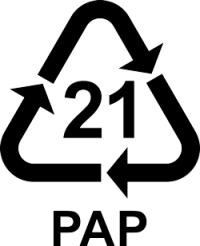
Recycling codes for paper products are less diverse than for plastic: 4 categories (codes 20-23) and 16 free numbers. Unlike plastic, a common identifier is used – PAP. Occasionally used PCB, PBD, PPB. Paper and paperboard products can be processed up to seven times.
Various metals
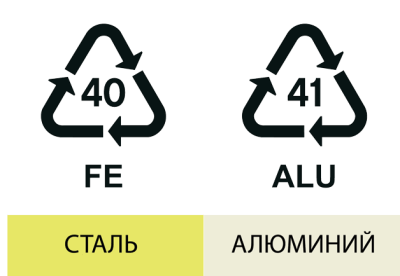
Badges showing the possibility of recycling are designed for only two types of metals: steel (40 FE) and aluminum (41 ALU). For other types of designations are not used due to the fact that they are less common in everyday life. Steel and aluminum are used as part of the following products: cans, cans, coffee and tea packaging, tubes, foil, drinks in cans.
Organic Materials

Organic raw materials are divided by industry:
wooden;
textile.
For the former, for identification of goods, processing codes with the designation FOR (50 and 51) are used, for the latter – TEX (60, 61). The raw materials go to recycling for re-production: wood, textile.
Glassware
Glass is reused in everyday life or in production in two cases:
after washing;
remelting.
In the first case, the container is washed from the remnants of the former filler. For the second case, the glass is sorted by type. According to the environmental labeling, glass has 10 types, for which codes from 70 to 79 are used, and the designation GL or GLS acts as an identifier. In the glass industry, additional marking is also used, reflecting the fragility of the product – the image of a glass.

Multicomponent materials
In recent decades, heterogeneous packaging has become widespread, for the production of which several components are used at once. An example of multilayer packaging is TetraPaki. Recycling signs are designed for such types of packaging. The most common types of raw materials that make up the packaging layers:
paper;
plastic;
aluminum;
tin.
Codification of multicomponent materials begins with 80 and 90, most of them do not have an alphabetic identifier.
Batteries & Batteries
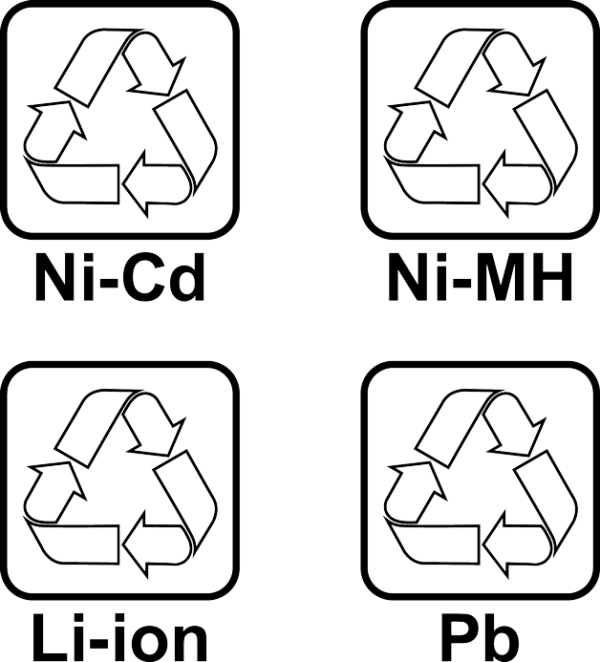
Technically complex devices must not be disposed of with household waste. For this, batteries and accumulators are marked with a recycling mark, which allows them to be sorted for further disposal or reuse.