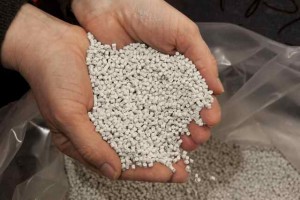
 Polystyrene – synthetic thermoplastic solid, hard, amorphous polymer. styrene polymerization product. Mass produced in the form of general purpose polystyrene and high impact polystyrene.
GPPS – Transparent well paintable easily recyclable material, which is a polymerization product of styrene in bulk or in suspension or in emulsion, and intended for the manufacture of articles by various thermoforming methods. Depending on the properties and purpose in accordance with GOST 20282-86 installed the following brands of general purpose polystyrene:
obtained by bulk polymerization:
PSM-115 – for the manufacture of injection molded technical purposes and consumer goods;
PSM-111 – high heat resistance, for the manufacture of lighting products by injection molding and consumer goods;
PSM-118 – for the manufacture of injection molding products for engineering complex configuration and consumer goods. Mark is characterized by high turnover;
PSM-151 – high heat resistance and low yield for the production of sheets, profiles, films and filaments by extrusion, of consumer goods; for the production of yarns is only the highest grade;
suspension:
PSS – product technical purposes and consumer goods;
emulsion:
PSE-1 – to produce foams;
PSE-2 – for technical products; It is allowed to use for the production of Foam.
Symbol marks GPPS comprises Acronym purpose material (PS), a process for producing (E – emulsion; M – bulk polymerization (block) C – slurry), digital designation marks indicate svetostabilizatsii formulation here color indication staining formulation color, variety and standard notation. The designation of a surface-treated polystyrene introduced alphabetic equivalent of “C” in front of the indication of the variety.
An example of a symbol of general purpose polystyrene block mark 111, light-stabilized, colored red, the highest grade in accordance with GOST 20282-86:
PSM-111-20, red, rec. 136P, the highest grade of GOST 20282-86.
An example of a symbol of general purpose polystyrene block mark 151, unpainted, surface-treated, first grade according to GOST 20282-86:
PSM-151 “C”, the first grade of GOST 20282-86.
HIPS – colorless opaque material, the product graft copolymerized with styrene butadiene or styrene-butadiene rubber, having a two-phase structure. The continuous phase (matrix) formed polystyrene. The discontinuous phase (microgel) – oval particles of rubber to the size of 2-5 microns. The rubber particles are surrounded by a thin film of a graft copolymer of styrene on rubber, and also within the particles contain occluded polystyrene, thereby increasing the effective volume of the rubber phase. From the volume of the latter depends largely on the properties of high-impact polystyrene. High impact polystyrene is produced stabilized in the form of white granules. The main methods of processing – injection molding and sheet extrusion, followed by pneumatic or vacuum forming.
Symbol impact polystyrene in accordance with GOST 28250-89 consists of letters UP – impact resistant polystyrene immediately by synthesis method indicated: M – bulk polymerization, E – emulsion polymerization, C – polymerization in suspension. Then a dash two digits indicate the toughness. The next two digits indicate tenfold residual monomer content. In addition, the letter may be included stamp, signifying the preferred method of processing.
Notation example HIPS obtained by bulk polymerization with toughness 7 kJ / m2 and a residual monomer content of 0.3%, intended for processing by extrusion:
TPC-0703 E.
Average designation of polystyrene in the Russian market of the SS, but can meet other designation: PS or GPPS or a PS-GP or XPS or Crystal PS (GPPS), UP or UPS or HIPS or PS-HI or PS-I (high impact polystyrene) , MIPS or IPS or PS-I (high impact polystyrene average impact strength), SHIPS (HIPS ultra high toughness).
In addition to general purpose polystyrene and high impact polystyrene industry produces a wide variety of modifications and styrene copolymers. Specifically, elastomers having the ability to large reversible deformations due to partial deployment of randomly coiled polymer molecular chain, and syndiotactic polystyrene obtained with metallocene catalysts and having a very high stiffness and heat resistance.
Application: Polystyrene ranked fourth in the world ranking of polymers – 7.5% of the world market. It belongs to the thermoplastics general technical purposes. With good strength properties, transparency and beautiful appearance, polystyrene is widely used in the production of goods for domestic and cultural and community purpose, construction, light engineering, medical equipment, advertising. Because polystyrene is an excellent insulator that works well at low and high frequencies, it is effectively used in electrical engineering, including the production of thin-oriented capacitor films. In addition, polystyrene is the starting material for the production of polystyrene foam.
Technology of production of polystyrene products designed deep enough. It is processed by all methods of processing thermoplastics, well welded and glued, combined with plasticizers, well painted. Its processed by injection molding at 190-230 ° C and a mold temperature of 50-60 ° C and extruded at 130-190 ° C. special brand of dye concentrates and granular pigment developed for coloring polystyrene. Sometimes polystyrene suitable dyes developed for polyolefins.
Polystyrene is used as construction material instead of wood and metal for the manufacture of shells instruments and apparatus, three-dimensional parts of domestic and industrial refrigerators, containers, tanks, bottles, disposable utensils, furniture, stationery, toys, lighting fixtures and fittings, filters, suitcases, pens, packaging for cosmetics, business cards, cable insulation
Oriented polystyrene of less than 75 microns are used for “windows” in cardboard packaging boxes. Thicker films are used for cups for vending machines, a packaging tray for fresh meat packaged in order to see both sides with the purchase of the product packaged.
In today’s construction industry, as well as other industries are increasingly using extruded polystyrene (extruded polystyrene). For making the transparent sheets using polystyrene with lower percentages of additives. This produces a general purpose polystyrene (GPPS), which has a relative ductility and lower friability.
Extruded GPPS produced in the form of transparent, dairy, color sheets. Equipment for the production of this type of material – zkstruzionnye ploskoschelevye line. Extruded polystyrene – plastic sheet, operating in continuous operation under constant exposure to ultraviolet exposure. Polystyrene Extrusion general purpose use in the manufacture of windows, signs, walls, showers, light diffusers, greenhouses, hothouses, supports, price tags, doors, accessories, film.
Is made of polystyrene and products falling under the control of Russian State Committee: Details of milking machines, and refrigerators; articles intended for contact at room temperature with a dry, free-flowing, water-containing food, fruit and vegetable juices, fruits, vegetables, berries: trays, trays, bread bins, sugar bowl, sugar bowl, measuring cups, vases, cups, jars for bulk products; details of the equipment, processing foods: vegetable slicers, graters, juicers; household items: cases for toothbrushes, combs, soap dishes, trays facing children.
A separate segment of the modern market – recycling polystyrene. Many companies in Russia and in the world specialize in buying polystyrene waste from further processing and the sale or use of recycled polystyrene. Typically, this technology is applicable purified extruding and subsequent crushing waste and produce secondary granulated material suitable for manufacturing products.
Properties: Polystyrene – a thermoplastic material having high hardness and good dielectric properties, is chemically stable with respect to alkali and acids, except nitric and acetic. Polystyrene is not soluble in lower alcohols, aliphatic hydrocarbons, phenols, ethers. It dissolved in its own monomer, aromatic and chlorinated hydrocarbons, esters, acetone. Resistant to radiation, but the resistance to ultraviolet rays is small. Polystyrene is easily molded and painted. Well handled by mechanical means. Easily glued. It has a low moisture absorption and high resistance to moisture and frost. Physiologically harmless. Products made of polystyrene have a high gloss.
General purpose polystyrene is very brittle and has low impact strength and low heat resistance: polystyrene softening temperature is 90-95 ° C. The best performance characteristics have different styrene copolymers. High-impact polystyrene are characterized by high impact strength over a wide temperature range (-30 …- 40 ° C). The main disadvantage – low thermal and light stability, associated with the presence of the rubber phase.
Properties of general purpose polystyrene.
1. Density – 1050-1080 kg / m3.
2. The bulk density of the granules – 550-560 kg / m3.
4. Linear shrinkage in the form of – 0.4-0.8%.
5. Lower limit of operating temperature – (-40 ° C).
6. The upper limit of operating temperature 65-75 ° C.
7. Electrical strength at 50 Hz – 20-23 kV / mm.
8. Specific surface resistance – 1016 ohms.
9. Volume resistivity
when exposed energized for 1 minute. – 1017 ohm-cm
when exposed under tension for 15 minutes. – 1018 ohm-cm.
10. Coefficient of thermal linear expansion – 6 · 05/07/10 · 10-5 deg-1.
11. Thermal conductivity – 0,093-0,140 W / m · K.
12. Specific heat capacity – 34 x 103 J / kg · K.
13. Dielectric loss tangent at 1 MHz – 4.3 · 10-4.
14. The dielectric constant – 2.49-2.60.