Basically, the following main methods of molding are used for the production of aprons and disposable containers:
Vacuum – molding;
blow molding;
in the form of punching.
Vacuum – molding.
Manufacturing of products takes place under atmospheric pressure to create a vacuum in the mold. Apparatus for vacuum – molding consists of a vacuum chamber, the clamping frame, a heater, and forms a vacuum – pump.
vacuum process – spinning through the following steps:

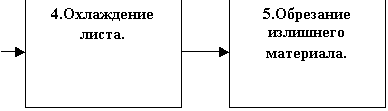
The thermoplastic sheet is placed over a vacuum chamber in which is located a perforated shape. With clamping frame sheet tightly to the open portion of the chamber, forming a sealed cavity. The sheet is then heated to an elastomeric state, the heaters are removed from the sheet and of a vacuum pump evacuated chamber. In the cell in the form of a vacuum and atmospheric pressure on the sheet tightly presses it to the form. After cooling the sheet to a temperature preserving stiffness and outlet clamping frame molded article removed from the mold, excess material (burrs) is cut.
We proposed some improvements of this method, for example, using a pre-stretch or with the auxiliary punch.
During pre-stretch shape with a vacuum chamber set at the end of the piston rod, by which the form is raised and pushed into the heated sheet immediately before evacuation. This allows you to improve the process of forming of complex products.
When forming the auxiliary punch pre-stretch punch made from the outside (with respect to the vacuum chamber) sides of the heated sheet. The use of auxiliary punch useful for deep molding products.
Blow.
Blow molding (from the Greek pnéuma -. A breath of air), the method of forming articles from sheet thermoplastic polymers. Preform when blown 1.5-10 mm is fixed on a contour shape, is heated to a temperature at which the polymer is in a rubbery state, and form a product under the action of compressed air [overpressure 50-2500 kN / m2 (0.5-25 kgf / cm2)]. The main methods of blow – negative, positive, free – similar to those used in vacuum – forming. The advantage of vacuum before blow – molding – the possibility of varying the excess pressure on the workpiece in a wide range, which enables molded articles of sheets of greater thickness.
Stamping in shape.
In the form of punching it is that the heated sheet is formed into an article between the punch and the die. Playback is best mold parts in this method. However, inventory here is more complicated and must be manufactured very precisely with tight tolerances.
Equipment for the production of containers and aprons
The most important factors of machine production containers and aprons – methods of heating, cooling and mandrel design, methods of cutting and printing.
For heating during thermoforming of thermoplastic films and sheets using various types of heat sources, including contact heaters, infrared heating, high frequency heating and heat transfer with hot air or hot liquids. the first two methods are used more often than others. Any method should satisfy the following requirements:
§ film or sheet must be heated to their optimum forming temperature uniformly throughout the molding area;
§ the difference between the temperatures on both sides of the paper should be kept to a minimum;
§ heating time should be as short as possible, but excessive heating of the material should be avoided because of the risk of thermal degradation of the polymer;
§ energy consumption should be reduced as far as possible. It is desirable to reach the process temperature as quickly as possible, and therefore the heating power must be controlled.
Infrared heaters are of two main types – quartz and ceramic. For manufacturing heating panels of different sizes are collected a number of such heaters. These can be sectioned to produce individual control devices, allowing greater heat supply to certain areas of the sheet. Reversible heat may be applied if necessary. Infrared heating is due to the absorption of radiation in the film or sheet surface layers. The absorbed heat is then transferred by conduction to the rest of the material. There may be a surface to overheat, and effective regulation of the radiation is very important.
Cooling usually takes place on the walls of the mold, which is often water-cooled. Since all thermoplastics – bad heat conductors, the molded parts must be removed from the mold once they acquire dimensional stability, to reduce cycle time. Cooling of thick products can often be accompanied by blowing air or atomized water spray, thin sheets or films that are not usually required. Depending on the particular polymeric material and the cooling rate may be some shrinkage. Although generally undesirable shrinkage, it facilitates removal of the molded product from the matrix, especially products with vertical sidewalls.
Construction forms is determined by several factors: the number of manufactured parts (determines the choice of manual, semi-automatic or automatic production), the material of the molded sheet or film, the desired surface quality, the ability to form the material to machining, the required tolerances, thermal conductivity and form possible price. For the manufacture of prototypes or small batches cheapest form of wood or plaster can be made. For the production of large quantities of preferred epoxy resins or metal (usually aluminum).
Cutting unit can vary from the cutting knife to complex presses. For details of small and medium size often use a roller press, with which high performance can be achieved. For large goods driving mill with a suitable cutting mandrel may be more effective. Separation of products in multi-cavity molding can be carried out a combination of longitudinal and transverse guillotine knife. Advantage – Easily adjustable to adapt to different configurations of forms, but only in a rectangular version. If using a roller press, for each product configuration requires a separate cutting unit. It can operate in line or mounted – as a separate cutting unit.
thermoforming operations may be manual and fully automatic. Producing automatic timers, which provide the ability to set the entire cycle with a single push of a button.
The sequence of operations in an automated process with a vacuum forming as follows (beginning with the sheet set in the car):
1) press the source button;
2) The heater is moved forward by a certain time;
3) the heater comes back;
4) supplied with air to form a bubble (if necessary);
5) lift table is raised or lowered auxiliary punch;
6) connects the vacuum system;
7) the surface of the molded article is blown with air or water mist;
8) vacuum and air is shut off, the auxiliary punch (if used) is given;
9) The product is removed from the mold with compressed air;
10) the compressed air supply is switched off;
11) the lifting table is lowered or auxiliary plunger rises;
12), the operator removes the product and fills the fresh leaf.
For a thin sheet or film can be provided with continuous dressing roll.
Briefly discuss the characteristics of the raw material for thermoforming.
Polivinilhlorid.PVH sheets are transparent, tough and chemically resistant. From a thinner sheet can be better obtained molded articles with good registration details. Shockproof polistirol.Eto most commonly used material for thermoforming. He easily molded, gives a fairly tight containers with good extract. Biaxially oriented polystyrene.
High-impact polystyrene – matte material, it can not be used where transparency is required. Pure polystyrene block by itself is fragile, but biaxial stretching of the sheet considerably increases its plasticity and thermoforming from it can be made transparent container. His thermoforming difficult due to stresses in the sheet, but molding is possible using special equipment.
Polistirol.Listy Foamed polystyrene foam can also be subjected to thermoforming, with deep and complex drawing smooth shapes are preferred. The main problem is that this structure makes foamy material much less thermally conductive than a conventional polystyrene. It is difficult, therefore, to heat the sheet surface without overheating. So heated sheet on both sides. The sheet of expanded polystyrene is opaque and has an attractive surface gloss. ABS plastik.Termoformovochnye properties of this material are similar to the properties of cheaper high-impact polystyrene, similar to them in chemical structure. ABS but pliable and can be used in a thin-walled products than impact polystyrene, which provides price reduction products. Low density polyethylene.
This material can be thermoformed, although it tends to sagging when heated, and the resulting product is too fragile.
Polyethylene of high plotnosti.Termoformovat this material lighter than LDPE, because of its increased rigidity and hardness. It is usually desirable bilateral heating due to a significant expansion of the sheet by heating to form folds, which may stick together. It requires fast heating and careful temperature control. Polypropylene.
Polypropylene – a tougher, more resistant to stress cracking than polyethylene, more resistant to high temperatures. Properties of PP with HDPE molding similar properties, and the same methods can be used for both materials. Applied usually where required resistance of thermoformed articles to boiling water or a mild sterilization temperatures. However, PP is not as convenient as HDPE, due to the fact that the impact resistance and other physical characteristics rapidly decrease with decreasing temperature below zero S.
Packaging products
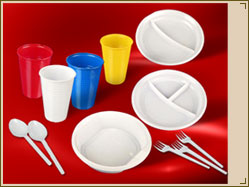 Disposable tableware
disposable plastic ware, which can be divided into market products manufactured by thermoforming (glasses, plates, bowls), and products produced by injection molding (cutlery, glasses, “Crystal” glasses).
Disposable plastic ware can be classified in the following main features.
· Production technology: tableware, produced by thermoforming and injection molding;
· Type of raw materials: utensils made of polypropylene and polystyrene.
Containers and microcontainers
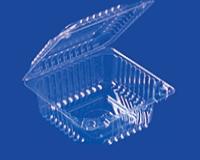 Containers differ from aprons and pallets by the following features:
their design is man-made with elements of decoration,
high degree of standardization, high demands on the physical and mechanical characteristics,
high degree of protection of the product against external mechanical impacts,
Obligatory presence of the lid,
low on the stability of the product requirements,
use for filling a homogeneous product,
requirements for conventional sealing packaging,
The main difference between the containers and pallets from aprons is available covers providing conditional tightness invested in their product. The main consumers of containers are confectioners who packed them in cakes, sweets and other confectionery products. This type of packaging is becoming more standard sizes for the growing market adaptation. This leads to the fact that the containers are becoming more versatile.
At the same time, the important fact is that in this type of packaging the highest requirements for operational and logistical characteristics. At the same time as a mandatory requirement in favor of its decoration, thereby solved the problem of individualization of the universal packaging for the individual consumer.
Microcontainers differ from containers purely man-made design, relatively small geometric dimensions. They are usually relatively small, since they are packed in a volume of product, intended for individual consumption. Therefore, depending on what products ensures tightness, they are packaged as liquid foods and other products consistency up to bulk.
Micro-containers intended for the packaging of ready meals, salads and delicacies sold in supermarkets, retail outlets, Cooking, etc. Ideal for trade ready-made meals and fast food “over the counter” in the self-service system.
Development of retailers, and especially its modern formats (supermarkets and hypermarkets), an increase in the number of companies using the service delivery lunches in the office, increasing the share of packed and packaged products and a number of other factors contribute to the development of the market of disposable plastic containers.
Modern thermoforming equipment can produce a wide variety of kinds of disposable plastic containers, which can be classified in the following main features:
1. The shape of the container: round, rectangular;
2. The material of which are manufactured: polypropylene, polystyrene, PVC, etc.
3. Container capacity: 0.1 to 4 liters.
Here are a few varieties of disposable plastic containers for confectionery products and micro-containers.
Container sealable capacity of 2000 ml.
Blisters
The blister pack consists of a plastic sheet with a flange to which is attached by adhesive, welding or clips corresponding substrate. Blister can be a simple shape (circle or rectangle), or take the contours of the object or objects that you want to pack. Blisters can be produced with multiple cavities, so it is useful to display sets.
As a rule, blister packs repeats three-dimensional shape of the product or product. By using thermo connected with cardboard, foil or the information carrier.
The blister pack – this is one of the most effective and popular in Europe, ways of packaging and consumer goods. It enables the consumer to see the product from all sides, and the manufacturer to place the necessary information (instructions for use, specifications, advertising, etc.). The product is placed in a rigid shell of transparent film, which follows the contour and its shape. The shell can be welded to the printed substrate.
The blister pack can be of the following types:
Double-sided blister packaging;
The blister pack is folded at the edges;
Clamshell welding.
Double-sided blister pack consists of two mold halves, which are separated by grooves for the fold in half. Each mold half has a so-called zahlop – extruded cavity, on which the latching locks provide additional rigidity. The cardboard inserts used as an information carrier. The advantages of the package in the possibility of inserting the marker and heavy products; in fixing the locks; high manufacturability.
Disadvantages – high cost compared to other types of blister packaging.
The blister pack is folded around the edges. This package consists of one mold half. Blister edge bent inward on the left, right and bottom to maintain the carton lining, which is used as an information carrier. The advantages of this package in a low degree of complexity of manufacturing.
Disadvantages – no possibility of inserting the marker and heavy products; outdated design.
Clamshell welding. This package consists of one mold half. Blister field perimeter is welded, and a cardboard insert which is used as an information carrier, is applied for welding lacquer. The advantages of this packaging is very high processability; possibility of inserting the marker and heavy products; protection against forgery.
Round container (tank height can also vary);
conical container;
“Yoghurt” cups.
This classification is rather conditional. The number of sizes of thermoformed packaging dairy dairy products market is wide and varied. The following sections of this market analysis will be considered thermoformed disposable packaging for the dairy industry classification on the following parameters:
raw materials used;
pakuemogo dairy products.
In this section, to a greater extent on the visual representation oriented thermoformed packaging for the dairy industry.
Technical characteristics of thermoformed packaging for the dairy industry.
Statutory conditions of production.
Production of thermoformed packaging for the dairy industry has its own specific conditions associated with its use in food packaging.
To dairy products are not spoiled (they are sensitive to environmental factors), thermoformed packaging must have a barrier – gas impermeability, vapor permeability, water resistance and aromatonepronitsaemostyu, wet strength and grease resistant. Thermoplastics, from which made packaging for dairy products should have the operational reliability, not delaminate, does not deform, ie, do not change their properties when stored in them are packaged dairy products.
Thermoformed packaging for dairy products should be inert with respect to the product and in contact with them should not release any harmful ingredients. This is especially important for the thermoformed packaging for the dairy industry, which components can migrate into the milk product under certain circumstances. Milk is a fairly specific product that can absorb most of the heavy metals and organic compounds, including harmful to humans. For the regulation of the Russian Ministry of Health has developed a process of sanitary rules and norms, the so-called “allowable number of migration” (DCM).
Basic polymers used in the manufacture of thermoformed packaging for dairy industry – polypropylene and polystyrene.
Polystyrene – amorphous polymer having a softening temperature of 80C, so when heated above 60 – 80 ° C is noted in the migration of styrene model solutions (from traces to 0.2 mg / l). Because polystyrene model environment (food) can migrate as plasticizers, lubricants, fillers (TiO2). Highlight all of these substances into the environment and getting them food and drinking water adversely affects human health, but particularly toxic is styrene. Therefore the degree of toxic effect is determined by the concentration of polystyrene styrene migrating into the environment. The results of studying the effect of extracts on the human body served as the basis for establishing the permissible amounts of styrene migration at the level of 0.01 mg / l.
Polypropylene – is practically the most safe in terms of ecology and polymer toxicity ..
Hygienic indicators and ratios of substances released from the materials and products in contact with food.
None of the same material used in the manufacture of thermoformed packaging for the dairy industry, the substance should not be allocated in amounts exceeding their DCM. It must take into account the materials and developers, and consumers. That is the whole packaging products, both domestic and imported, must have high hygienic characteristics and is subject to mandatory hygienic certification in Russia SSES bodies and periodic sanitary inspections.
Packing made of foam polystyrene
The main advantages of products from expanded polystyrene:
closed-cell polystyrene foam causes low weight, high strength and provides good thermal insulation in a wide temperature range.
Styrofoam products are disposable, easily utilized and provide a high level of health
Initially, the feedstock has a grain size of 0.35-0.5 mm and a bulk density of about 650 kg / m3. The resulting products typically have a density of 50-100 kg / m3. The granulated expandable polystyrene particles at a suitable temperature which increases more than 50 times, converted into polystyrene – foamed thermoplastic plastic (foam). When re-heat-treated in a closed mold foam particles are welded to each other, and polystyrene accepts configuration and size of the mold. Thus, a solid inert material, providing good insulation and long-term (98% of the total volume of air foam), impact resistance and resistance to weathering. One square. meter foam contains from 3 to 6 millionov closed cells filled with air. The pores between the cells attached to the material properties of the gas permeability and hydrophobicity of polystyrene – water repellence properties.
About real harmful effects of chemical raw materials in the environment can only be judged by the total effect created them in its life cycle. This cumulative effect can be measured by how much energy is spent on the production of the chemical product, and whether the reuse of its components. From this perspective, expandable polystyrene is the most promising for the efficient use of natural resources. In comparison with it other alternative materials has several advantages:
· Packing of expanded polystyrene does not affect the ozone layer as chlorofluorocarbons (CFCs) are never used in its production
· Recycling of production waste can be carried out by re-use, mechanical recycling or energy recovery
polystyrene waste can be melted and extruded to turn into a compact polystyrene, which can be used for production of wide range of destinations.
Packaging for meat, fish, confectionery, fruit and vegetables:
trays
backing
Trays and retain the substrate during transport, smooth sharp fluctuations in temperature and produce products at the shop windows. Available in various sizes and colors.
Options pack sizes allow products from different product groups. For example, the substrate depth of 10 mm allows to pack sliced sausages or pastries, as depth of 50 mm – meat and chicken products.
Various colors you can select for every product the most suitable color. For example, for the packaging of herbs, vegetables and nuts are a better color – white, with a black background look better meat products and a yellow chicken products. Other colors are more suitable for confectionery products.
Trays and substrate often used in conjunction with PVC stretch film food grade.