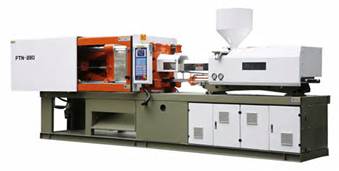
Diecasting precompression is carried out at a melt molding machine, the nozzle block is provided with a crane. When the valve is closed to compress the molten resin in the heating cylinder to a pressure casting machine. After opening the tap melt under high pressure at high speed fills the mold cavity and is further heated by the operation of the friction forces. To prevent mechanical degradation of the polymer material flow velocity of the injection melt runner sometimes limited. Precompression melt allows 1.5-2 times decrease the time of filling forms and increase the melt flow path until its solidification, which allows long-length molded thin-walled parts.
Injection molding differs from conventional injection molding in that the dose of injection of molten polymeric material to produce a fully interlocking shape. The seal material is carried out at the final closing of the form (pressing). The method allows to obtain both a very thin-walled and thick-walled parts made of heat and thermosets. Products made by this method have a less anisotropy (dependence of physical properties of the substance from the direction of) the mechanical properties and lower shrinkage.
Injection molding with the imposition of mechanical vibrations is used for the manufacture of plastics, melts which have a pronounced pseudoplastic properties of liquids. Effects of mechanical vibrations causing a sharp decrease in the viscosity of the melt, thereby reducing the time of filling the forms and is more uniform distribution of pressure along the length of the mold cavity.
Intrusion – Method for manufacturing of thick-walled molding screw injection molding machines, injection volume which can be significantly less than the volume of the molded article. In the process of filling the mold injection molding machine operates in the extruder by injecting the polymer melt through the wide sprues in the mold cavity at a relatively low pressure; After completing the form screw (auger) under the action of the hydraulic cylinder moves the piston forward and takes the form of a higher pressure the amount of melt needed for processing parts and compensate for the shrinkage of the material.
Pim-Technology
The new process of formation of complex articles manufactured from ceramic or metal powder materials. Injection molding powder materials are increasingly used in the manufacture of complex parts for industrial or domestic purposes. Along with the other processes of molding, such as precision casting, powder materials are widely used in the axial or isostatic molding. Parts made of ceramic or metal powder material, are used in the automotive industry, machine tool industry, in the manufacture of magnets in the textile industry, in the watch industry, for the production of consumer goods, in precision mechanisms in medicine, dentistry and porcelain industry. In principle, all materials shown in the form of sintered powder may be mixed with an appropriate-plastic and processed in an injection molding machine. The most frequently encountered be mentioned metal powders, powdered oxides and carbides, and silicates. For processing the metal or ceramic powder materials required to carry out mixing of the powder and the plastic base, thus providing a homogenization of the mixture, then (using a specific extruder) to receive granular material. This granulate, in other words, raw materials prepared by injection molding, is plasticized in the plasticizing cylinder injection molding machine (injection molding) and then injected into the mold. From the resulting part is removed first plastic compound – a binder, and then the resulting billet is subjected to thermal treatment in special furnaces sintering. Casting of metals and ceramic materials becomes cost effective when complex parts of high precision of execution is required to produce in large quantities. The strict sequence of the injection cycle, and process stability allow primary preparations from powder materials. Details internally threaded recesses of complex shape and high surface quality can be produced quickly and efficiently on the injection molding machines in manual or automatic modes.
Multicomponent molding.
The object of multicomponent casting is automatic production of more than one polymeric component within one working cycle. In this process, each color component or clearly demarcated from each other; the subsequent component is sprayed on top of the previous one – as is the case in the manufacture of automotive optics or frame components with integrated display elements. Multicomponent (multi-color) molding may include two, three or four components. This significantly increases the complexity of the mold structure. For complex configurations docking components often use molds with rotary modules.
The index rotary mechanism necessary for these types of tasks can be as a module integrated into the mold and the device mounted on the machine. Depending on the design of the mold can be rotated either an entire half of the mold, or only one inner plate of the mold.
The multilayer molding refers to a special type, sometimes called soinzhektsionnymi. This name reflects the common feature of these methods – compulsory participation in two, and in some cases three injection units, each of which is plasticized polymer material with individual properties. Thus, it is possible to obtain multi-color products, products consisting of various types of plastics (the surface of the HDPE, and the bulk of expanded polystyrene) used secondary polymer raw materials for domestic, non-critical parts of the parts to make products of the hybrid design and so on. The multilayer molding is carried out in several ways.
Sandwich molding is alternately fed into the mold of the two polymer melts kneaders. When using worm kneaders process might look like this. Two nodes are connected to the injection nozzle design which provides a switching device. Typically, the needle valve is controlled (IR). The valve connects alternately or simultaneously with the molding system forms plastikatsionnye nodes. Under the scheme of the host material under high pressure and high speed it is injected into the mold to form the outer cover of the product. Then, the internal volume is filled with product material from the site II, b) after which the work is turned on again the node I, adding the remains of the melt in the mold and “sealing” the product.
Soinzhektsionnoe molding requires the use of specially designed nozzles, also called a dividing head. This technology makes it possible to obtain products with a number of layers greater than two, with full or partial separation tsvetov.Lite in multipart forms (Multi-component injection molding) produces products with a clear separation of colors, as well as details of the hybrid structure (Fig. 10.33), in which of each polymer material performed by the central or peripheral part. In this case, the injection units operate traditional function and design details of the mold device is determined. The diagram is shown the mold has two runner system is constantly stocked with injection units I and II. The punch form are movable insert conveyed pneumatically. Insert draw up one or another structural element of the product. The feature of this method consists in that the work units injection occurs isolated from each other. Therefore, if a node II in the example operates in the injection mode, the node I can act intrusive mode, whereby the volume of the article, the molding of the polymer I, may have very significant resolution.
Rotational molding is a variation of the above method, since it allows to solve the same problem, but requires the use of a removable insert. After registration of the central part of the product (unit I) insert is removed, and the resulting volume of the melt is injected from the node II. The production cycle of the product by rotary casting introduced an additional trip operation forms and removing (installation) of the insert, which does not contribute to the high performance method.
Injection gas is the most economical method of producing thick-visual products. When molding large parts (bumpers, dashboard, body TVs, monitors, etc.) with the gas injection produces a quality product, reducing the requirements for clamping force injection molding machine. When casting the gas used conventional injection molding machines, and it is one of the reasons for the popularity of such technologies. One advantage of cast gas – possibility to use injection molding machines with significantly less clamping force, which gives a large economic benefit for casting large izdeliy.Pri traditional injection molding the polymer in the seal cavity is due to the pressure generated in the hydraulic cylinder assembly injection molding machine (step holding pressure). The pressure is transmitted to the remote area via the cooling of the casting resin, and the bulges on the contrary ribs or bosses there utjazhki. Uneven seal causes uneven shrinkage process, which leads to warping due to high residual stresses.
When casting the polymer with a gas seal is due to the gas pressure (typically 50-200 atm), so the densification process is easier (even at low gas pressure) than in the conventional injection molding. As nitrogen gas is used, which has a low cost, inert and available. The source gas cylinders are nitrogen (for small production volumes) or special nitrogen generators. Moulding gas allows to obtain articles with good surface quality, without sink marks and buckling, with a minimum level of residual stress, i.e. with high stability razmerov.Tehnologiya injection gas provides a number of advantages, such as: – High quality surface of the product (no sink marks); – Reduced cycle time – Ability to use injection molding machines with a lower clamping force – saving technology options materiala.Mnozhestvo casting gas can be divided into two types.
The first type of technology, in which the gas is fed into the polymer melt to form the internal cavity (“gas-assisted injection molding” (GAIM or GAM) or “gas innendruck technik” (GIT or GID)).
The second type of technology gas is fed into the mold cavity and creates external pressure on the product (“external gas molding”). Both types of techniques may be implemented on the same oborudovanii.Suschestvuet several varieties of technologies with gas into the polymer melt (the first type), which can be classified on the specifics of the process, at the place of supply of gas, types of obtained products:
1. Casting incomplete injection of the polymer – (blow up process, short shut process);
2. Casting of a full injection with profit – 100% filling of the mold cavity before the melt feed gas (overflow process / side cavity process / spill-over process and plastic expulsion process);
3. Casting a full injection with the displacement of the polymer melt into the material cylinder injection molding machine (push back process);
4. Casting the local gas supply to the product to eliminate sink marks (compensation process);
5. Casting mold with offset marks (core-pull process) .In molding technology with an external pressure gas (second type), the process is carried out as in the conventional injection molding with the difference that after the polymer injection into the mold cavity gas is supplied. The gas is supplied between the back (nelitsevoy) side of the article and the mold wall. The process provides a high quality of the front surface of the product, the surface reverse side of the product, which acts directly on the gas pressure is uneven. The mold cavity in this process must be tightly sealed to prevent gas leakage