 Greener renewable packaging has been seen by brand owners as an important task for several years now. However, over the past couple of years, the need for effective solutions has been growing at a particularly rapid pace. Consumers are becoming more conscious of environmental issues, and one of the main factors taken into account when deciding on a purchase is the possibility of processing the packaging. Indeed, 48% of U.S. consumers say they will definitely or likely change their consumer habits to reduce their environmental footprint. And among millennials this figure reaches 75%.
Many companies have publicly announced their very ambitious goals for green development, promising to use fully recyclable materials and alternatives to plastic in the packaging industry.
“What we have been seeing in the past 18 months is very different from what happened before,” says Eric Pavone, Business Development Director, BU Web-fed BOBST. – Previously, the mention of environmental issues was used by many almost as a purely marketing move, but there was no significant progress in this area. But over the past 18 months, pressure has increased to such an extent that the industry was simply forced to change its approach, and now companies are devoting huge funds to research and development in the field of environmental friendliness, biodegradability and packaging processing. Many of the promises seem too ambitious, but when you consider that special attention is being paid to this issue now, the announced deadlines are becoming more real. ”
The pursuit of green development stimulates the development of innovative solutions that have significant potential. It is estimated that innovative release models and changing usage patterns will bring the plastics industry around $ 9 billion.
“We need to reproduce 20 years of design”
The main task for brand owners, especially in the food industry, is the production of new packaging materials without compromising the safety, freshness, attractiveness and visibility of the product itself.
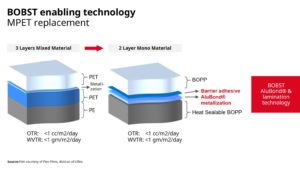
Most types of flexible packaging are a combination of several materials or polymers (e.g., polyester, polypropylene, polyethylene). Multipolymer materials used in flexible packaging have a complex composition aimed at protecting, for example, a food product from exposure to oxygen, water and other substances. However, the use of several polymers greatly complicates the task of processing, and since the composition of the multipolymer packaging is not standardized, there is no real standard way to extract and process these materials.
“Recycling means using one polymer,” says Eric Pavone. – As soon as you mix them, problems arise. But monopolymers are generally inferior in quality to multipolymer materials. The problem is that modern flexible packaging is a high-tech product that emerged from two decades of development and innovation. We need to reproduce 20 years of design as soon as possible in order to find monopolymer materials that will perform their function as well as the existing packaging, and ensure the same efficiency of the equipment along the entire value chain. This is a difficult task, but we have already achieved good results. ”
Partnership is the key to progress
BOBST has teamed up with several partners to produce a new flexible recyclable packaging of high barrier monomaterials. The project involves the use of various monomaterials with high barrier properties, each of which has been carefully tested to meet all industry requirements for manufacturability, safety, barrier and optical properties. Sustainable bottom packages from various monomaterials (MDO PE, BOPE, BOPP and CPP) were first presented at the K 2019 trade fair in Düsseldorf and are the result of significant investments and intensive research by partners.
The list of partners includes Dow, a supplier of polymer materials for the first link in the production chain; Brückner Maschinenbau, a manufacturer of biaxially oriented polypropylene and polyolefin films; Hosokawa Alpine, MDO LDPE; ELBA company, which manufactures packages from finished rolls; and Constantia Flexibles, an LDPE firm bottom metallized bag with high barrier properties.
A joint project team is currently working on these innovations, using BOBST training and expert centers to develop high-performance coatings, printing and laminating, and to test the viability of new materials. The group uses unique BOBST technologies to study the production process in detail and test the barrier properties and adhesion on substrates in BOBST laboratories equipped with world-class measuring equipment.
“This is the first representative of a new generation of monomaterial laminates,” says Eric Pavone. – We organized a partnership because we are faced with an urgent task and we need to combine our efforts and engineering developments – we will not achieve anything alone. “Industrial solutions with high barrier properties already exist in the world, but to change the entire industry it is necessary that the solutions and users of these solutions become more and more.”
The balance between high environmental friendliness and high quality
The main activity of BOBST and its partners after the production of a number of monopolymer materials was the optimization of their viability in the packaging production process and the achievement of a quality similar to modern multipolymers.
“The reaction of these substrates and their parameters are different, and we need to continue developing so that the new materials are in no way inferior to the ones we are currently using,” says Eric Pavone. – Yes, at present, the main priority for brand owners is environmental friendliness, but they are not ready to sacrifice the visual appeal of the packaging of their products. Thus, our task is to ensure the possibility of complete processing without any compromises in terms of appearance. For example, the material must be scratch resistant, and this is difficult to achieve with monomaterials. ”
Boosting Innovation
“The industry’s attention is focused on the development of biodegradable plastics that meet environmental criteria and can be widely used in packaging production,” says Eric Pavone. “BOBST has all the technologies that are needed to test the feasibility of industrial production of various new materials, from raw materials to packaging and labels after printing and finishing, so we can bring great benefits in this area.”
Eric also emphasizes the potential of a material such as paper, which, according to him, is of great interest to the industry. Consumers like paper, and since it is made from natural fiber, it decomposes and is recyclable. However, paper does not have the required high barrier properties that plastic and similar materials have, so researchers are currently actively looking for ways to give paper high barrier properties.
Ultimately, the packaging must fulfill its main purpose: to protect the product inside it. But as the burden on the environment grows, packaging requirements such as environmental friendliness and recyclability become no less important. Perhaps, at the current pace of the emergence and implementation of innovations, this moment is very short.