 In the Moscow region and Tatarstan will apply new technologies in waste management
pilot project “zero landfill” will start in 2017. It provides for the construction in 2017-2020 years of the four plants to thermal treatment of municipal solid waste (MSW) in the Moscow region, and one – in Kazan. Regions, where he began to implement projects not chosen by chance – Tatarstan and Moscow with the Moscow region can not cope with the volume of MSW, which are produced on their territory.
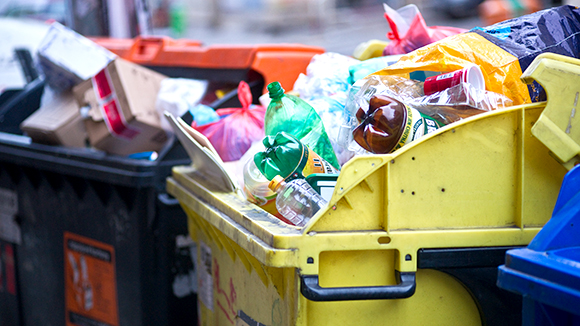
In Russia annually produces about 5.5 billion tons of waste. Among them, according to environmentalists, it is processed less than 5%. The rest is burned, is transported to landfills or gets on illegal dumping. Moreover, the exact number of unauthorized landfills, where millions of tons of waste dumped every year is unknown. The problem of disposal of household waste and other waste got so acute that it has started talking about the country’s top leadership. At a meeting of the State Council in 2016, Russian President Vladimir Putin called the decision problem of excess production and consumption waste one of the important directions of the government.
“Their total number now stands at more than 30 billion tons, – stated Vladimir Putin. – Garbage thrown, where it is necessary and how it is necessary. And these dumps occupy nearly 48 thousand. Ha. ”
disposal of solid municipal waste problem and is seriously concerned about the population. According to the Russian Public Opinion Research Center (VTsIOM), 44% of Russians believe that the greatest danger to their lives are household waste. Environmental problems associated with deforestation, transport and industrial activity, came in second (35%), a third (31%) and fourth (28%) place on the seriousness of environmental threats.
According to environmentalists, in the whole country, the number of unauthorized dumps 20 times the number of legal landfills. Natural landfills contribute to an increase in the population of rodents and birds – carriers of dangerous infections. They are equipped with a special means of protection of soil, water, forests and adjacent areas from pollution. Continuing to leachate contaminates the underground water table falls into the wells and ponds.
Due to the lack of proper control over the burial process MSW is difficult to determine how much of the population is constantly at risk and where a long stay is dangerous to health.
– Special hazard to public health arises in fire in landfills, and the formation of landfill gas – dioxin and furan emissions from landfills and dumps in the atmosphere is 35% of the total – said, “Izvestia” correspondent member of the Russian Academy of Technological Sciences Yury Treger.
In the summer of 2016 there was a big fire at the landfill in Anapa – garbage burned in the area of more than 1 thousand sq. M. m. Then for five days burnt about 2.5 thousand. tonnes of waste, resulting in the release into the atmosphere of about 5 g of dioxins and furans, 7.5 tons of sulfur dioxide, nitrogen oxides 12.5 tons and about 60 tons of carbon oxides. The air was polluted in the territory of more than 10 thousand sq. M. km. Such fires are dangerous to humans – can lead to diseases of the respiratory system, liver, blood, reproductive system. A dioxins, known to cause cancer.
Moreover, issues related to the disposal and processing of MSW, – it is not only ecological, but also an economic problem. Landfill waste in its present form often leads to increased criminalization of business. According to estimates of the Ministry of Ecology of Moscow Region, officially buried in the debris six times less than is taken out from Moscow and the Moscow region. On the road disappears around 10 million tons of waste. A volume shadow economy garbage business only in the Moscow region is about 8-13 billion annually.
– It is a criminal lobby is one of the main drivers of resistance to popularize technological methods of waste treatment used in most EU countries – told “Izvestia” Minister of Ecology of Moscow Region Alexander Kogan.
In the Moscow region are now 89% of waste landfilled and only 5-7% is recycled into secondary raw materials. According Rosprirodnadzor, Vladimir Putin instructed to close 24 landfills in the Moscow region. Today, 18 are no longer running. At six landfills debris still utilized (which is a flagrant violation). It ranges “Alexinsky quarry” (Klin district), “Egoryevsky” (Egorievsk), “Kaurtsevo” (Naro-Fominsk district), “Kulakovskii” (Chekhov district), “Forest” (Serpukhov district), “Saburovo” (Shchelkovo district ). But their work will stop soon. The remaining landfills will not be able to take all the garbage.
Moscow and the region will inevitably have to build new facilities for sorting, recycling and waste incineration. The pilot project “zero landfill” will have to solve the problem of disposal of MSW – it is based on European technology.
– In Europe, over the past 40 years we have formed the industry processing and thermal waste – told “Izvestia” in the state corporation “Rostec”. – Rubbish most involved in secondary turnover by separate collection and sorting. The remaining fraction after separation of recyclable materials when burned produce electricity and heating cities. Only at the very end of the chain there is waste that can not be used rationally – they get to the landfill. For example, in London burying in the ground waste 26%, 34% is processed into recycled. The remaining 40% go to the waste heat treatment plants, where the electricity produced by combustion. In Paris, a heat treatment is subjected to 67% of all waste. In the European capitals plants are often in the city.
In the Moscow region and Kazan will be built factories Hitachi Zosen Swiss-Japanese company, which has built more than 500 plants worldwide: 235 – in Asia, 250 – in Europe and 44 – in North America. According to the Ministry for the Environment, Nature Conservation, Building and Nuclear Safety of Germany, in 2000, these plants processed more than 14 million tons of MSW, and the total dioxin emissions amounted to only 0.5 g
– For example, in Russia, according to data for 2007, fires at landfills burned about 1.05 million tons of MSW and dioxin emissions amounted to 700 g, – said Yuri Treger. – It turns out that emissions facilities for thermal treatment of MSW is more than 8000 times lower than emissions in fire in landfills.