Extrusion – a method of processing polymeric materials of the continuous forcing the melt through a die, the geometric shape of the output channel which defines the profile of the resulting article or semi-finished product.
About half of thermoplastics manufactured products are processed in this manner. Extrusion obtained films, sheets, pipes, tubes, capillaries, rods, siding, different in complexity profiles, coated polymer insulation on the wires, producing a variety of multi-layered in construction and combination of used hybrid plastics moldings. Polymer recycling and pelletizing also performed with the use of extrusion equipment.
In 2006, about 30% of produced in Russia were recycled thermoplastics by extrusion.
The basic process is extrusion equipment screw extruder equipped with a forming head. In the extruder, the polymeric material is melted, plasticized and is then injected into the die. The most commonly used and various modifications single twin-screw extruder.
Sometimes used besshnekovye plastics, circular or extruders in which the working body is forced into the melt head, the disc is a special form. Disc extruders are used when necessary to obtain an improved mixing of the blend components. Because of the inability to develop high molding pressure extruders are used for products with relatively low mechanical performance and low accuracy of geometrical dimensions.
Combined extruders have as a working body of the device combines a screw and a disk part, and called worm-disk. Are used to ensure good mixing effect, particularly in the processing of the composites. They melt processed plastics having low viscosity and relatively high elasticity.
The processes occurring during extrusion.
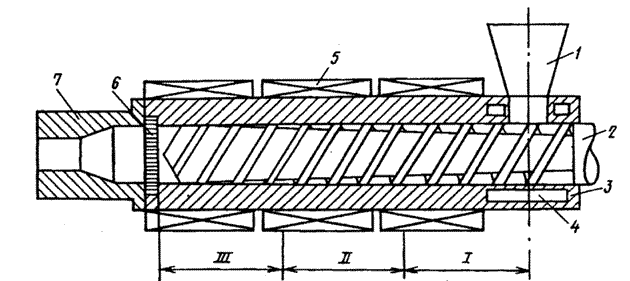
Fig. 1. Driving a single-screw extruder: 1 hopper; 2- screw; 3- cylinder; 4- cavity for circulating water; 5- heater; 6- grille with mesh; 7- head shape.
Process extrusion process consists of the serial movement of the material in its rotating screw zones (see Figure 1..): Power (I), mastication (II), melt dispensing (III), and then advancing the melt channels in the die.
The division of the screw in the I-III zone is carried out on the basis of technological and indicates which operation mainly serves the screw portion. Separation zones conditionally screw since, depending on the nature of the polymer being processed, the temperature and speed of the process conditions and other factors, the beginning and ending of certain operations can be displaced along the screw, capturing different zones or moving from one area to another.
The cylinder also has certain length heating zones. The length of these bands is determined by its location on the surface of the heaters and temperature. Boundaries I-III of the screw and barrel heating zones may be different zones.
Consider the behavior of the material sequentially at each stage of extrusion.
raw material Download. The feedstock for the extrusion supplied into the hopper, may be in the form of powder, granules, ribbons. Uniform dosing from the silo material ensures good quality of the extrudate.
Recycling of the polymer in the form of pellets – the best mode of the extruder power. This is because the polymer granules are less prone to formation of “domes” in the hopper than the powder, therefore, the flow pulsations are eliminated at the output of the extruder.
Interturn space under the loading hopper funnel occurs at an interval screw length equal to (1 – 1,5) D. In the formation of “domes” on the walls of the silo auger stops food material. To avoid this you need to put into the hopper turners.
The flowability of the material depends to a large degree on the humidity: the higher the humidity, the less free flowing. Therefore, materials must first be dry.
To increase the productivity of the machine can be preheated pellets.
Using the device for forced feeding material from the hopper to the auger, also manages to significantly improve the performance of the machine (3-4 times). When compacting the material in the interturn space auger displaced air escapes back through the hopper. If the air removal is incomplete, then it will remain in the melt and after molding cavity forms a product that is married products.
Changing the height of the filling level of the hopper material also affects the completeness of the screw. Therefore, the hopper is equipped with a special automatic gauges, which takes place on the pitch material loading hopper to the desired level. Loading hopper of the extruder is carried out by means of pneumatic conveying.
In continuous operation of the extruder may overheat cylinder under the hopper and the hopper of the hopper. In this case, the granules begin to stick together and stop their supply to the auger. To prevent overheating of the cylinder cavity made therein for the circulation of cooling water (see. Fig. 1, Pos. 4).
feed zone (I). Incoming pellets from the hopper is filled with interturn space auger zones I and compacted. Granules compaction and compression occurs in zone I, usually by reducing the cutting depth h of the screw. Promotion of the pellets is carried out as a result of the difference in strength of the polymer friction values on the inner surface of the cylinder body and the surface of the screw. Since the surface of contact with the polymer surface of the screw is greater than the surface of the cylinder, it is necessary to reduce the coefficient of friction of the polymer of the screw, as otherwise the material will cease to move along the screw axis, and starts to rotate together with it. This is achieved by increasing the cylinder wall temperature (heating) temperature and screw down (inside screw cools water).
polymer heating in zone I is due to the dissipation of heat produced by friction material, and due to the additional heat from heaters located on the cylinder perimeter.
Sometimes the amount of heat dissipation can be sufficient to melt the polymer, and then the heaters are turned off. In practice this rarely happens.
At the optimal process temperature polymer compacted, compacted and forms a solid plug in the interturn space (see. Fig. 2). Best of all, if such a sliding tube is formed and retained at the border zones I and II. cork properties largely determine the performance of the machine, the stability of the polymer transport the maximum amount of pressure, and so on. d.
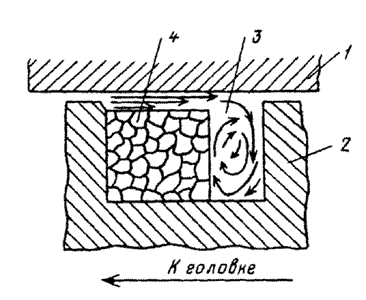
Fig. 2. Tube material melting in Scheme II-sectional area of the screw in the interturn 1- cylinder wall; 2- screw ridge; 3- polymer melt streams; 4- compressed solid polymer (tube) in an extruder.
plasticizing and melting zone (II). At the beginning of zone II submelting polymer occurs adjacent to the cylinder surface. The melt gradually builds up and affects by decreasing the width of the stopper. Since the cutting depth of the screw decreases as one moves material from the area I to the zone III, the occurring pressure forces the tube tightly pressed against the hot wall of the cylinder, the polymer melt occurs.
In the plastication zone and also plug melts under the influence of heat generated due to internal viscous friction in the material to melt a thin layer (Pos. 3 in Fig. 2), where intensive shear deformation occurs. The latter circumstance leads to a pronounced mixing effect. The melt is intensively homogenized, and composite components are mixed.
End Zone II is characterized by the collapse of the plug into separate fragments. Further, the polymer melt with remains of particulate matter falls into the dispensing area.
Melt P main pressure rise occurs at the boundary of zones I and II. This border forms a plug of compacted material as it slides along the screw: in zone I is a solid material, in II- zone melting. The presence of this plug and creates a major contribution to the melt pressure. Also, the increase in pressure is due to the reduced depth of the cutting screw. The stored output of the cylinder pressure is used to overcome the resistance grid, the melt flow channels in the head and the molding product.
metering zone (III). Promotion of heterogeneous material (melt the solid polymer particles) continues to be accompanied by the release of internal heat that is a result of intensive shear strain in the polymer. The molten mass continues to be homogenized, which is manifested in the final melting of the solid polymer residues, and averaging the viscosity of the melt temperature.
The interturn space of the melt has a number of streams, the main ones are the longitudinal and circulation. The value of the longitudinal (along the screw axis) determines the performance of the extruder flow Q, and circulation – the quality of the polymer homogeneity or mixing of components.
In turn, a longitudinal flow of the sum of the three melt streams: forward, backward, and leakage flux.
Forward flow is caused by the movement of the screw in the direction of the forming head. Reverse flow – this imaginary current, caused by the high pressure side of the head; in reality does not exist. Leakage occurs when the flow of melt overflow crest between the cylinder and the screw.
Performance Q extruder based on the velocity distribution of the various streams of
Q = Qpr – Qobr – Qut,
where Qpr, Qobr, Qut – performance extruder from the direct flow and counterflow melt leakage respectively.
Q = αn – β • (ΔP) / (μ • L),
where n – rotational speed of the screw; ΔP – Pressure at the outlet of the screw (at the end of the zone III); μ – the effective viscosity of the melt; L – length of the screw; α – direct constant flow rate, β – constant backflow rate, which depends on the geometrical parameters of the screw.
The main parameters of the extrusion process. By the process parameters include temperature polymer processing, melt pressure, temperature, head temperature zones and cooling modes molded extrudate.
At too high melt viscosity to produce articles by extrusion difficult due to high resistance, melt flow, occurrence of the unstable flow regime. All this leads to the formation of defects in products.
Increasing the processing temperature of the melt may lead to thermal degradation, and an increase in pressure, the drive power at lower temperatures – for mechanical degradation, i.e. extrusion melt polymers should be applied with a rather narrow interval of fluctuations in viscosity.
The main features are a single-screw extruder, L, D, L / D, screw speed n, the geometrical profile of the screw (see Fig.3.) And compression (compression) – the ratio of the volume of one turn of the worm in the feed zone to the volume of one loop in the zone dosing.
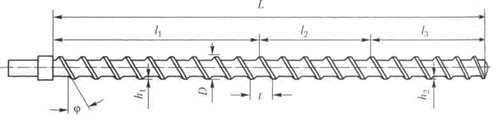 Fig. 3. Scheme of the screw of the band structure
Briefly screw extruders have L / D = 12-18, dlinnoshnekovye L / D> 30. The most common extruder with L / D = 20-25.
An indication of the extruder is effektivnost- its ratio of performance to power consumption.
Materials. Most thermoplastics and their compositions can be processed by extrusion. It is sufficient that the residence time in the extruder at a melt temperature of the polymer was less time thermostability at the same temperature. The most widely used extrusion of large polymers of the following types. PE, PP, PS PA PC, PVC (plasticized and unplasticized) and PET mixture with inorganic fillers and polymer compositions and more complex thereof.
Materials used for the extrusion and processing modes in which the MFR varies within 0.3 – 12 g / 10 min as low viscosity of the melt extrusion is impossible to obtain a solid preform into a film, pipe, profile. If injection molding grades of polymer used, some of them can receive only certain types of extruded products as they MFR is within 0.8 – 20 g / 10 min.
Thus, the pipe, cable coating produced from melt polymer with MFR of 0.3 to 1 g / 10 min. This is due to the choice of high molecular weight polymer. The latter determines the operational properties of products – increased physical and mechanical characteristics.
Films, sheets are made from melt-extruded MFR within 1 – 4 g / 10 min.
Discrete products produced by melt extrusion, followed by blow molding in a form is prepared from melt MFR = 1.5 – 7.0 g / 10 min.
Lamination by extrusion with MFR melt occurs within 7 – 12 g / 10 min.
Products. All the products obtained by extrusion of thermoplastics, may be in principle unlimited length. The diameter of the product is limited mainly to the diameter of the extruder screw. The more D, the wider, thicker products may be obtained.