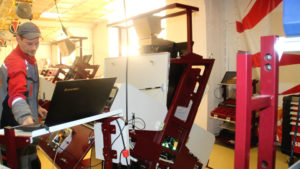
 In Barnaul company “SeaSort” until the end of the year they promise to create a prototype of a photo separator that sorts solid household waste (SDW). If successful, this will be the first Russian machine of its kind, allowing quick and high-quality separation of useful components from trash.
The new task
The problem of separation and subsequent use of solid waste is one of the most acute in the world. Mankind annually produces millions of tons of waste and does not know how to use them wisely. In many countries, this task more or less learned to solve. According to Andrei Istomin, head of the recycling department of the company “SiSort”, in Germany it is possible to extract 60% of useful materials from garbage, in Holland – 97%. There everything goes into action: from biodegradable waste, compost, fertilizers, from other organic materials – RDF-fuel, are used in cement plants. In Russia, 6% of garbage is recovered for further processing, and up to 30% for separate collection of solid household waste.
The waste sorting plant is a cascade of various devices, including sieves, bag breakers, aerodynamic separators for dividing objects by size, type of particles. But it ends with a transporter, along which people select the objects useful for the subsequent processing: plastic – in one pile, paper – in another, rubber – in the third, metal objects – in the fourth. This function can be replaced by a photo separator, whose operation will be cheaper than labor of workers, and the task will be performed more efficiently and faster. Responsible for the development of the garbage sorter Andrei Istomin says that now the process of its design is in progress. “We already know what sorts of materials will be sorted, what size, at what speed,” says the engineer. To teach the sorting the photo separator will be using the “neural network” technology, when the machine recognizes an unknown object, having learned on a large array of known ones.
Now two people work on this project, but at the right time it is planned to attract outside specialists, for example, optics from Peter. With the help of photoseparators it is possible to carry out not only the initial, large-scale sorting, but also the subsequent operations, in particular, to separate one kind of plastic from the other. This technology has already been implemented in the company “SeaSort”. “We have already sold several trough machines to secondary plastic processors,” said Vitaly Savinkov, commercial director and co-owner of the company, “but in the future we will equip them with hyperspectral cameras, with which we can quickly determine the chemical composition of objects.” The prototype of the device (that is, the ability to perform the basic function) is planned to be created by the end of 2018. While the development is done on its own resources, but the company already has potential customers who are ready to take a test sample and begin to operate it.
On the horizon”
I must say that the sorter for garbage will not be created from scratch, but on the basis of the photo separator “Horizon”, which itself only recently came down from factory “stocks” of the company “SeaSort”. This unique device for Russia got its name due to the horizontal location of the conveyor, on which the sorted products move. Usually they work with sticky, light, medium-lump products, in general, with those that are not sorted for different reasons on pitched machines. “Of course, when developing this machine, we took into account foreign analogs,” Vitaly Savinkov admits, “but the” brains “with which she works can not be copied. Ideally, you can design equipment on request. And this machine was created on the instructions of entrepreneurs from the Moscow region, who needed to sort the chips and berries.
“Unfortunately, not all chips are equally beautiful: they are found with defects from potato eyes, overcooked,” explains Vitaly Savinkov. – We went to the customers for production, examined the requirements and fulfilled them. Moreover, they coincided with our plans to adapt a horizontal machine for sorting dried fruits and berries. Certification engineer Eugene Ognivenko explains the principle of the “Horizon”: “The machine sorts by optical attributes. The program covers the dimensions of the defect, brightness, color of the target product. And according to the totality of signs, the machine classifies which berry is good, what is corrupted, and beats it with an air jet to the side. The sorter can look through with his electronic eyes one and a half tons of dried apricots per hour. ”
Certification of the machine according to the European standard is planned for the beginning of March, and by the end of March “Horizon” will appear in wide sale. State support But what can be considered a broad sale? According to Vitaly Savinkov, the market of photo separators is quite small. In total there are about 20 thousand of them in the world. But thanks to government subsidies aimed at cheaper products, this market is gradually expanding. And the share of the company “SySort” on it is growing. Within the framework of the federal program “Development of the electronic component base and radio electronics” implemented by the Ministry of Industry and Trade of the Russian Federation in the fourth quarter of last year, “SeaSort” received about 30 million rubles. These subsidies allowed the company to reduce by 15% the price of equipment sold and thus increase total sales by 20 percent. Support will continue this year, and its size will depend on the volume of output and is planned at the level of 70 – 80 million rubles. The company is assisted by the regional authorities. The regional budget compensates for the cost of certification of equipment for the US market.
Certification is an expensive pleasure, as it is necessary to pay for several trips of foreign specialists who inspect each unit of the car. Last year, from the regional treasury innovative enterprise “SeaSort” received 750 thousand rubles for the creation of the prototype Z-shaped noria, which is a combination of two horizontal and vertical conveyors. Usually, bucket norias are used on elevators, which are not suitable for moving seed grains, as they can damage it. This conveyor has working elements – plastic cradles, which gently grasp the product. “All seed plants are interested in this machine. We sold 12 units last year and expect at least a two-fold increase in orders in the current one, – the commercial director hopes. “Recently, we have bought such a noria from Tabunsky elevator for transportation of oat flakes.”