 Let’s talk today about waste management in Ukraine, and about the place of such devices as industrial waste food recyclers in this office. To ensure a complete picture, so to speak.
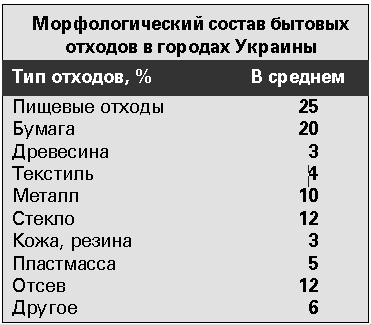
Waste management in Ukraine, as you know, leaves much to be desired. In Ukraine, the amount of household waste is not very far behind the average European and is about 38-40 million square meters per year (or about 10 million tons). The total mass of solid waste in the country reaches 1 billion tons annually. According to their composition, Ukrainian solid household waste meets the categories of transition countries. By the way, it is not easy to determine the structure of domestic domestic garbage – data appears in different sources, often very different:
What can be called a domestic waste management system with considerable stretch, basically consists of such elements:
– sanitation and waste disposal.
– recycling and recycling of valuable secondary raw materials
– heat treatment of household waste
– disposal and disposal of domestic waste
Let’s talk about sanitation and waste disposal.
For example, 56 specialized autoenterprises and 650 shops are assembled and removed from the production departments of housing and communal services, over 7,500 garbage trucks and about 35,000 workers are involved. There are two opposite tendencies in the work of the industry.
On the one hand, due to unsatisfactory funding from the municipal authorities and the public’s failure to pay for communal services, the sanitation system is largely destroyed. Yes, today only 52% of the country’s population is covered by municipal services. In most small towns and in the vast majority of villages this system does not work. Garbage here is exported irregularly, often not to authorized landfills, but to spontaneous rubbish.
On the other hand, in large cities (Kiev, Kharkov, Lviv, Odessa and some others) garbage collection becomes a lucrative business. Under the condition of timely settlements, the company that takes out the garbage has 10-12% of profitability, to which both domestic and foreign businessmen show interest.
As a rule, all commercial firms use obsolete, but powerful and reliable garbage trucks of foreign manufacture, capable of carrying much larger volumes of garbage than Soviet, Russian and domestic cars. This, and also by the effective organization of labor and cheap labor, economic success is achieved.
Another direction of waste management in Ukraine is the utilization and recycling of valuable secondary raw materials. The volumes of secondary raw materials in the country are constantly decreasing. It is estimated that with the waste the country’s economy annually loses 3.3 million tons of waste paper, 550,000 tons of metals, 660,000 tons of polymers, 770,000 tons of glass, 550,000 tons of textiles. Most of these materials Ukraine imports, and this despite the fact that the available technologies make it possible to process almost all components of domestic waste.
The procurement of secondary materials is carried out by the industrial and environmental association “Ukrvtorma” – a network of 45 procuring enterprises, 950 acceptance points and 12 enterprises for the processing of secondary raw materials. Its effectiveness can be judged from such data: in 1990 in Ukraine the Soviet predecessor of the system procured 731 thousand tons of secondary raw materials, including 416 thousand tons of waste paper. In 1998, the volume of recycling used by the reformed association was 27% of the 1990 level, including the production of waste paper was reduced by 75%, of polymeric raw materials – by 80%.
Recyclables and private enterprises and individuals are accepted. As a rule, the sphere of their interest is waste paper, there are precedents for buying polymeric waste from the population. However, an analysis of their work indicates a small scale of activity. There are few enterprises for processing secondary raw materials in Ukraine. Objects of the western type with complex processing of several types of waste at once, with the receipt of various products (for example, at the input – unsorted waste, at the output – scrap metal, polymer granules, waste paper, crushed glass and compost) do not exist. However, in accordance with numerous reports, domestic entrepreneurs and equipment manufacturers successfully solve the problems of recycling of recyclables at the local level, and their technology is several times cheaper than foreign ones.
Another option for combating waste is the heat treatment of household waste. Or, simply, incineration plants (MZS). Fortunately, unlike Western countries, this method does not have much distribution. In total, prior to independence, four MSZs were built in Ukraine – in Kiev, Sevastopol, Kharkov and Dnepropetrovsk. The total design capacity of four Ukrainian MSZs is 1.2 million tons of waste per year, or 12% of their total volume. Another plant was designed in 1991 in Donetsk. However, due to the sharp deterioration of the economic situation and the environmental hazard associated with the activities of such an object, it was not built.
All four MSZs are physically and morally obsolete. Enterprises have not worked at full capacity for a long time. Thus, the productivity of the Kiev plant fell to 45% of the designed capacity, the activity of the Crimean (Sevastopol) plant is almost stopped, the Kharkiv MSZ has been operating for 15% of its capacity in recent years, the operation of the Dnipropetrovsk MSZ is 40%. Constantly deteriorating the quality of the work of enterprises – because of rising gas prices needed to burn waste, it is trying to save, resulting in garbage not burned to the state of slag. In fact, the end product of the MSZ is burnt litter instead of ash and slag.
Special equipment in the Ukrainian MSZ constructed in Soviet times is not designed for effective control of pollution, including dioxins. In general terms, the activities of domestic incineration plants are officially recognized as dangerous. In addition, expensive natural gas and electricity make their activities unprofitable. Their closure is considered a matter of time, and only the lack of funds for alternative methods of waste management is the reason that MRZs still work.
Further – the placement and disposal of domestic waste. The dominant method of handling household waste in Ukraine has been and remains the disposal and disposal of solid domestic waste at garbage disposal and special landfills, which today officially are more than 770. The vast majority of landfills (80 to 90%) operate in an overload mode, with long-broken design targets for Volumes of waste receipt, without observing precautionary measures regarding pollution of groundwater and air basin.
These landfills are located near the cities and take, respectively, urban waste. Concerning villages, in the overwhelming majority of garbage there is simply taken out for the outskirts and dumped into natural deepenings (gullies, ditches, etc.). It is very common to take garbage out to forest glades, fields, other objects that are not intended for use as a garbage disposal facility. Only large spontaneous piles of garbage are about 1000, which is up to 66% of all garbage in Ukraine.
Thus, the utilization of food waste will be of great help to waste management in Ukraine.