There are two variations of polyethylene production method: high pressure low density polyethylene is obtained at low pressure – high density polyethylene and medium density. Since the strength of low density polyethylene is 2-3 times less strength high density polyethylene, its use is limited to low pressure pipe diameters and areas of application which require a high flexibility tubes.
The first high-density polyethylene used for the production of pressure pipes, was a linear homopolymer, high molecular chain of which consisted only of ethylene molecules. At a sufficiently high short-term strength of the homopolymer had low resistance to cracking and breaking due to changes in the nature, t. E. The transition from plastic to brittle, sharply decreased strength properties for long term use. The value of the MRS, which characterizes the long-term strength and used for the calculation of the operating pressure pipelines was 6.3 MPa (see. Fig. 1).
The desire to increase resistance to cracking and avoiding the transition from plastic to brittle fracture within the operation time led to the development of second generation polyethylene. Due to the introduction of co-monomers in the synthesis of (butene or hexene) forming on the macromolecules of polyethylene laterals, could dramatically improve polymer cracking resistance and increase the value of MRS to 8.0 MPa. However, it fell short-term strength, modulus of elasticity and resistance to rapid crack propagation, which makes it impossible to use it for the production of polyethylene pipeline pressure over 6 atm.
The combination of high strength and high short-term resistance to cracking was made by creating a so-called bimodal polyethylene – polyethylene third generation. By purposeful conduct of the process (usually on a two-reactor scheme) receive two distinct groups of macromolecules – long- and short-chain. This comonomer is introduced into the high molecular weight of the polymer, which provides high resistance to stress cracking of polyethylene. The low molecular weight of the polymer forms crystalline regions, due to which increases the density, short-term and long-term (MRS 10,0 MPa) increases strength and modulus of elasticity. The polymer has a high resistance to rapid crack propagation, and according to this indicator there are no obstacles for the production of pipes for working pressures up to 12 atmospheres for gas pipes up to 25 bar for water.
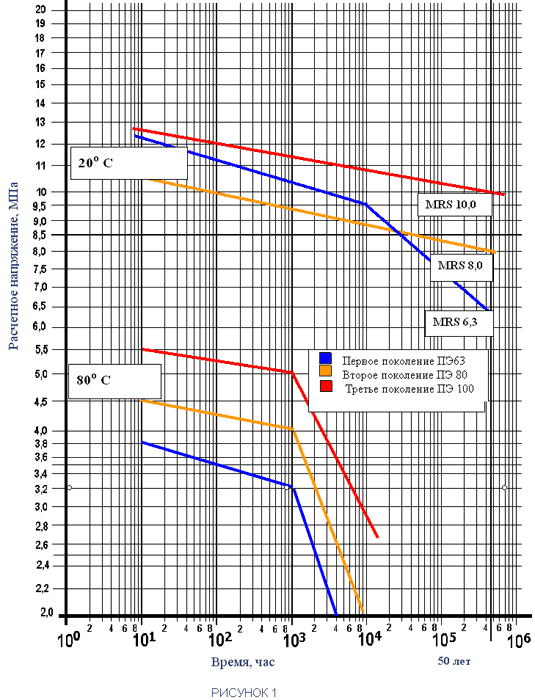
Polyethylene type PE 100 has good processing properties.
Despite the high melt viscosity (melt flow index i5 = 0,2-0,6), the presence of low molecular weight fraction in the melt acts as a lubricant and facilitates polymer extrusion. Production of pipes does not cause any problems, and does not impose additional requirements on the modern equipment.
Confirmation of high technical and economic indicators of the use of polyethylene pipes such as PE 100 can serve as the following example.
It is calculated from polyethylene tube with an inner diameter (bandwidth requirement) to 700 mm water pressure of 10 atm.
As the data in this example, the use of PE 100 for the production of large diameter pipes in some cases allows almost twice reduce material tube. Reducing the outer diameter lossless flow area used to receive the savings connecting parts of smaller diameter.
If there is no possibility of changing the outer diameter of the pipe, the material consumption is reduced by 33-34% while increasing the passage section and a 16% increase in production capacity (in meters per hour) of 20-30%. In practice, for water pipes, this means that if the price of PE 63 in the market of 32 rubles / kg, equivalent to the price of PE 80 is 38.9 rubles / kg, and PE 100 – 47.4 rubles / kg. Take advantage of fluctuations in the price of materials ratio in the production of pipes can be only in case of the forming tool and certificates for all pipe sizes.
Thus, the above ratio of prices for PE of different generations are a serious deterrent to the domestic PE 63 and PE price increases of 80 and an incentive to go to PE 100, especially for diameters up to 630 mm. However, it should be borne in mind that the pipes to the water pressure of 0.6 MPa, made of PE 80 (SDR 21), is virtually impossible to produce coils of the high roundness and creases, and pipes in lengths of PE 100 to the same pressure (SDR 26 ) strongly ovaliziruyutsya during storage and transportation.
Ultimately, an optimal choice for the manufacturer of the material and, accordingly, pipe size in each case should be based on analysis of serious technical and economic parameters of the raw materials in the triangle-production-distribution.
For the consumer, the conclusions clearer. With equal (or close) prices of PE pipe 80 preferably made of PE 63 and PE 100 pipes, PE pipes than 80. However, pipes made of PE 100 with a reduced wall thickness require high-quality welded equipment and highly qualified welders.
For gas pipes is more complicated. If the safety factor (EWC) of 2.5, mainly adopted in Russia today, the transition from PE 80 to PE 100 for 6 bar while maintaining SDR 11 gives no economic benefit, besides increasing to over 2.8 PPC needed in some cases, laying in the settlements. Daylight PE 100 with a change in the SDR 13.6 to 6 bar is possible but rarely applied to a diameter of 225 mm, as the pipes of this type are missing in the existing GOST 50838. For pipes of 3 bar and below the transition to PE 100 SDR 21 also It has a large value as 110 mm in the main pipe supplied in coils, tubes and the demand for bar 3 by 160 mm in diameter is negligible.
The picture changes radically if Russia will be accepted PPC 2.0 for gas pipes from PE 100, not only for the 10-12 bar, but for the 6 bar. In view of the increased resistance to crack propagation PE100 and European practice, in which PPC 2.0 for these tubes is almost universally accepted solution for gas pipes 6-12 bar looks very logical. In this case, PE 100 has a chance to completely replace the PE 80 in the manufacture of gas pipes at 6 bar, because, when already adopted PE at 100 – 47.4 rubles / kg equivalent to the price of PE 80 is not more than 32 € / kg! It may be called to a certain degree, a revolution in the gas production and use of polyethylene pipes, as the weight fraction of the gas pipe 6 bar is more than 70%. In this case, the lot PE gas pipes 80 remain at 3 bar and polyethylene pipes for water supply to 6 bar, mainly to a diameter of 225 mm. As for PE 63, his place – only small water pipe up to 6 bar up to 110 mm diameter and a portion of non-pressure pipe. Since this volume is negligible in most European countries, the production of PE 63 is discontinued.
The conclusion from the above review can be considered the urgent need to change some regulations in the construction of gas pipelines (in the first place – the introduction of PPC 2.0 for gas pipelines in 6-12 bar), as well as production of domestic PE 100. This will reduce the cost of plastic pipes, no matter how strangely enough, while improving their quality and bring production and use of polyethylene pipes in Russia to a new level.