 All Ukraine these days is watching what is happening now Gribovichskoy landfill, which over the past few decades is a unified legal center for the storage of garbage produced by Lviv and the surrounding villages. This 33-hectare landfill, formed in the distant 1958, has long ceased to cope with its function. In the 21st century, and it is still the Middle Ages and lawlessness reigned.
Gribovichskuyu landfill, like most places in Ukraine, a long time ago it was time to modernize, built in its place a modern recycling plant. Only such an approach could have prevented the catastrophe, which killed people, and the state would not now spent huge amounts of money to put out fires and solving the problems.
This is against the background of the scandal around this dump, we decided to introduce you to the 10-D the largest conglomerations of garbage on the planet. Of course, this topic is not the most “delicious”, but perhaps it should illuminate. In order to be able to anticipate in time and prevent problems rather than solve them, when it is “cock pecked.” And of course, the example of some countries should learn how to deal with waste, not just the planet littered with them, and extracting from it benefit.
10. Landfill Xinfeng, Guangzhou, China (92 hectares)
Guangzhou is the third largest city in China with a population of over 10 million. Man. Every day, it produces about 8,000 tons of waste, and all that rubbish goes to landfill Xinfeng, built and operated by «Veolia» French transnational corporation (in this case, hold the landfill is not French, it is in their temporary use).
The idea to send the dump to the jurisdiction of the Europeans came from the Chinese authorities after numerous protests of the local population, who were held in Guangzhou in the late 90’s – early 2000’s.
This site collection is one of the largest in Asia. The construction of Xinfeng spent $ 100 million. And she began to function in 2006, with the expectation that the service life of the landfill will not exceed 20 years. On Xinfeng operates an incinerator, which processes more than 2,000 tons of garbage daily, producing electricity and biogas. 50% received energy takes a Veolia, and the rest of the electricity and gas are the needs of the city.
9. Dump West New Territories, Hong Kong (110 hectares)
For 2013-2014, a huge Hong Kong began to produce more than 15,000 tons of garbage a day. Most of his happened to be on a 110-hectare landfill West New Territories, which is located near the town called Tuen Mun.
This site collection is the largest of the three existing landfills in Hong Kong. It is managed by the French company «Suez Environment», which, like in Guangzhou, produces waste electricity and gas.
8. Dump Deonar, Mumbai, India (132 hectares)
Each year, India produces about 60 mln. Tons of waste (!), Of which only Mumbai produces 2.7 million. Tons. 132-hectare Deonar, located in the eastern suburbs of Mumbai, is the oldest dump in India has formed the British in 1927. Every day, the city produces “born” to 8000 tonnes of waste.
And 5500 tons of dirt Deonar goes to landfill, which can actually accommodate a maximum of 2,000 tons of garbage per day. As a result of the ruthless exploitation of the landfill, to date, the height of the mountains of waste on it already reaches 30 meters. A conducted in 2016. The study found that this landfill has accumulated no less than 12.7 million. Tons of methane fuel. It was he who was the cause of the burst at the beginning of the year the fire at the dump Deonar, thick smoke from which fixed even NASA satellites near Earth.
7. Waste disposal New Delhi, India (202 hectares)
The Indian city of New Delhi produces about 9,200 tonnes of solid waste every day, and all of these waste dumps were conveyed over Narela Bawana, Bhalswa, Okhla and Ghazipur, which together occupy a total area of 128 hectares. With the exception of the newly formed Narela Bawana, dump the rest are very old and have long worked out. For example, the dump height Bhalswa garbage heaps already reaches a height of 41 meters, and while it is still running.
In 2013, near New Delhi under the waste storage area at a rate of more 74 hectares has been allocated, and now the total area of the city landfill is 202 hectares.
At the same time, today in India 20% of the methane produced from the waste is, and according to the International Energy Agency, if New Delhi was able to recycle all of its waste, then she would have been able to generate from it a power of about 25 megawatts of electricity.
6. Dump Sudokwon, Incheon, South Korea (231 hectares)
Since its inception in 1992, Sudokwon dump receives up to 20 000 tons of waste daily from Seoul, with a population of 22 million. People. It is the largest landfill in the country that produces 50 megawatts of electricity.
Polygon also using energy derived from waste, conducts water desalination, and its specialists are engaged in the restoration of soil fertility. It is a museum, employs 200 employees at the landfill itself was planted more than 700,000 trees, and it is visited by about 50,000 students annually, who are studying waste management technologies. Sudokwon dump is an example of how waste can be used to achieve the best results.
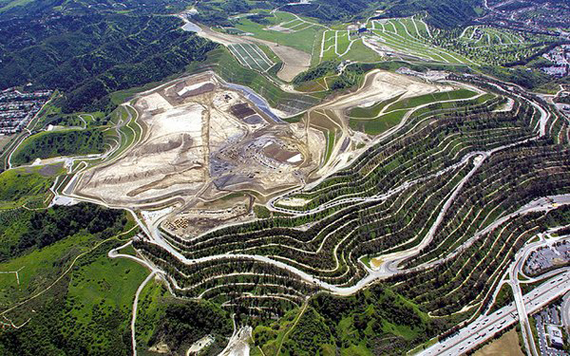
5. Dump Puente Hills, Los Angeles, California, USA (255 hectares)
For three decades, until the closing in 2013, the Puente Hills landfill took into its territory 130 mln. Tons of household waste in Los Angeles. It was the largest landfill in America.
After closing for two years, he has experienced modernization, and in early 2015 opened, and now being able to take as many as 13,200 tons of garbage a day. Its territory runs incinerator and power plant generating 50 megawatts of waste of electricity, which is enough for the life of 70,000 homes in Southern California. Now a large area landfill undergoing a process of transformation into an amusement park.
4. Dump Malagrotta, Rome, Italy (275 hectares)
Landfill Malagrotta – an enormous landfill with a total capacity of up to 60 mln. Tons. In the late seventies, it was illegal waste drop site, but in 1984 she was given legal status.
Every day she receives up to 5,000 tons of dirt, making it the largest municipal facility for the reception of solid waste in Europe. Debris is also converted into electric power and biofuels. However, over the years of its illegal status, dumping has caused environmental Galeria Valley, where it is significant damage, pollute the air, groundwater aquifers and poisoning the soil with toxic chemicals such as arsenic, mercury, ammonia and nitrogen.
3. Dump Laogang, Shanghai, China (336 hectares)
With a height of piles of garbage in the 20 meters and a huge area that is larger than the area near Lviv Gribovichskoy dump more than 10 times, Laogang in Shanghai is the largest in Asia. It takes up to 10,000 tonnes of waste every day. At the same time, of all svezennogo garbage generated 102 megawatts of clean energy, which works in 100,000 homes.
This dump also manages the French company Veolia, which for years of his reign, has significantly reduced the accumulation of methane in its territory.
2. The landfill Bordo Poniente, Mexico City, Mexico (375 hectares)
Until its closure in December 2011, the landfill Bordo Poniente has taken about 15,000 tonnes of waste generated in the Mexico City daily. It was the biggest dump in Latin America. Over the years, since 1985, she has been able to pass through itself 70 mln. Tons of waste. After its closure, more than 1,500 families who gathered at the dump garbage for its further resale, lost their illegal incomes.
In 2014, the Mexican government announced the plans to build on the site of Bordo Poniente plant to generate 60 megawatts of electricity. However, until these plans were not realized, and millions of tons of garbage and rotting under Mexico City.
1. Dump Apex Regional, Las Vegas, Nevada, United States (890 hectares)
Finally, the leader of epic proportions Apex Regional landfill in Las Vegas, which is a daily “swallows” nearly 9,000 tons of municipal solid waste, although it may take, and all the 15,000 tons per day. The landfill, which controls the company «Republic Services», was opened in 1993 and is the largest in the United States.
She predicted 250-year service life. On the territory of this gigantic “dumpster?” Built processing plant, which generates electricity capacity of 11 MW. Just enough to satisfy the needs of 10,000 households in southern Nevada. Construction of the power plant at a cost of $ 35 million. But the US government, calling for help in private companies, the money for its construction are not spared. After all, according to expert estimates, it generated 17.7% of the methane in the country of Apex Regional debris