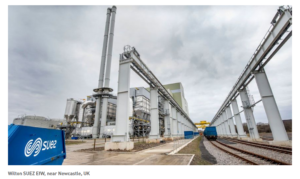
 Prospects for the use of garbage for energy generation were discussed by the Chairman of the State Energy Efficiency Sergei Savchuk with the representatives of the French company SUEZ, which has a more than 160-year history and operates on 5 continents in the sphere of efficient resource management, including energy production from garbage.
This was reported by the press service of the State Energy Efficiency.
SUEZ has extensive experience in processing 40 million tons of waste per year in Europe and abroad. Of these, 7 million tons are used to generate energy at 56 plants.
Among the company’s successful projects – a plant for processing 210 thousand tons of waste per year for further production of energy. The project was implemented in Poznan (Poland) within the framework of public-private partnership.
Given the recommendations of the International Finance Corporation (IFC), SUEZ was chosen to implement the largest private-public partnership agreement in Serbia, in which a plant for the processing of 340,000 tons of garbage a year and the production of electricity and heat will be installed in Belgrade. The electric capacity of the plant will be 25 MW, and the thermal power – 56 MW. The volume of investments will make 300 million euro.
“Following an international tender, the consortium of SUEZ and ITOCHU has been selected for a 25-year PPP to develop a new system for the treatment of municipal waste of Belgrade. This project will allow to close and remediate one of the largest landfills still in Europe, generate over 80 MW of renewable heat and electricity with a 340,000 tons p.a. energy-from-waste plant “, says the company’s website.
“In Ukraine, there is considerable potential for establishing similar capacities. Annually 10 million tons of garbage are taken to the landfills, of which 3.5 million Gcal of heat and 1.2 billion kW of electric power per year can be produced, “Savchuk said.
Having installed biogas stations, the electricity generated by cogeneration plants can be sold to the network at an advantageous “green” tariff, tied to the euro exchange rate. For example, today it is 12.4 euro cents / kWh. Heat, in turn, will be supplied to consumers.
Representatives of the company were interested in the concept of use of garbage for energy generation developed in Ukraine, as well as regions for implementing projects in this area developed by the State Energy Efficiency Agency.
The parties agreed to jointly develop a financial model for establishing capacities in Ukraine to generate energy from solid domestic waste and prepare a number of potential projects.
A source