From January 1, 2018 in Ukraine will sort all the garbage. This is not a pre-election promise of a politician, but the current norm of the Law “On Waste.” Is it really possible to start sorting, processing and recycling of garbage in our country in six months?
The tragedy at the Gribovitsky landfill and over-accumulation of garbage in Lviv demonstrated the danger of putting waste problems on hold for a year. Local officials and elected officials began working on new strategies for handling domestic waste, to seek (often outwardly) investors for waste-processing plants.
At the same time, state officials have long been working on the arrangement of the garbage disposal system in Ukraine “on the European model.” At least, even in 2012, in Article 32 of the Law of Ukraine “On Waste”, a paragraph was added, according to which “in the country it is prohibited from January 1, 2018 that burial is carried out on landfills of unprocessed (untreated) household waste.”
This clause corresponds to two EU Directives – 1999/31 / EC and 2008/98 / EC. They regulate the management of garbage in European countries, provide a clear sequence of actions that must be performed with waste, classify garbage, set a strategic goal to reduce the amount of waste taken to landfills. So the Ukrainian parliamentarians, having supplemented the Law “On Waste” with the ban on exporting untreated waste to the landfills, implemented the European legislative norm in this area. In 2012, Ukraine was already preparing to sign the Association Agreement.
What should the garbage collection look like now?
The Law on Waste states that “waste processing is the implementation of any technological operations related to changes in the physical, chemical and biological properties of waste, with a view to preparing them for environmentally safe storage, transportation, disposal or disposal.”
This means that from January 1, 2018, all Ukrainian garbage must first be sorted by types of materials. Further it should be divided into safe and dangerous for disposal or ready for reuse. Safe will be taken to the polygons. With dangerous conduct operations to neutralize it (transform properties or transport them to special places for storage) and will be taken to landfills. Ready for reuse is remade in accordance with the technology of the enterprise. At the same time, conventional wastes should not contain waste that is biodegradable (Directive 1999/31 / EC).
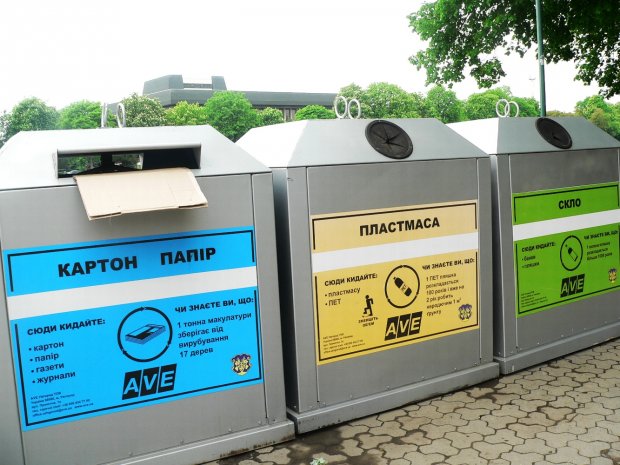
This should be the process of collecting, sorting, exporting, processing and recycling of garbage. If not in the ideal version, then at least according to EU norms. But this Law of Ukraine “On Waste” does not provide a list and sequence of operations with garbage. The deputies introduced a European norm, too broad for interpretation by those responsible for waste management. Under such conditions, the paragraph added to Article 32 of this Law, acquired in 2012, acquires a declarative character. But this is facilitated not only by the vagueness of the document itself.
Will there be a new rule of law?
Expert of the international non-governmental organization Ecology, Law and Humanity, Alla Wojcihovska says that the norm prohibiting the burial of unprocessed household waste is unlikely to work from January 1 of the next year. According to her, Ukraine has no infrastructure for this.
You need to sort the garbage. But a small number of settlements today separately collect garbage and have garbage sorting lines. These are real masters. In means not a problem. The problem in wanting to do good for people and the environment,
– says Alla Wojcihowska.
The report of the Ministry of Regional Development, Construction and Housing and Communal Services “State of the sphere of domestic waste management in Ukraine for 2016” indicates that last year only 5.8% of all garbage in our country was recycled: 2.71% – burnt , And 3,09% – were sent for processing. Also, the agency reports that last year 575 localities introduced separate garbage collection, one incineration plant and three incineration plants (they can process much less waste than the plant).
According to the Verkhovna Rada, in Ukraine as of January 1, 2017 there were 29,722 settlements: 460 cities, 885 local settlements and 28,377 villages. The study of the Ministry of Regional Development does not say which sort of waste is sorted in Ukraine, and also at what stage is the implementation of separate waste collection initiatives. In our country there is still no single plant for complex waste processing.
People’s deputy of Ukraine from “Samopomochi”, Deputy Chairman of the Parliamentary Committee for Construction, Urban Development and Housing and Communal Services Alena Babak does not see the possibility that the rule on banning the burial of unprocessed wastes began in six months.
First, even the available capacities for processing waste – glass, paper, plastic or metal – take materials selectively. For example, it is difficult to find an enterprise to collect opaque plastic from dairy products, the people’s choice says. Secondly, the problem lies in the perception of the idea of sorting by citizens.
The problem is that many of those who sort out garbage do it wrong. For example, it brings contaminated plastic. Therefore, many manufacturers simply refuse the idea of processing such garbage,
– explains Alyona Babak.
How to start a new waste management system?
In response to a question about how the Ministry of Regional Development intends to comply with the norm on banning the burial of unprocessed wastes, the deputy head of the Department of Public Works and Public Services of the department Ludmila Poltorachenko referred to the laws “On Local Self-Government in Ukraine” and “On Waste.” In particular, she noted that “the executive bodies of rural, township and city councils include decisions to collect, transport, recycle and dispose of domestic waste.”
Referring to the Regulations on the Ministry of Regional Development, Lyudmila Poltorachenko wrote that her department “ensures the formation and implementation of state policy, in particular, in the sphere of handling domestic waste.” In other words, the Ministry of Regional Development will primarily monitor compliance with the law “On Waste” by local governments directly responsible for the removal of garbage.
On the same question about whether there will be an item on banning the burial of unprocessed wastes, the Ministry of Regional Development did not give an answer. Ludmila Poltorachenko noted that the agency is actively working on the implementation of the European Union Directives 2012/19 / EC (on waste electrical and electronic equipment) and 2006/66 / EC (on batteries and batteries).
There is an expansion of the responsibility of producers and importers, which will contribute to the sustainable production and consumption of electrical and electronic equipment, batteries and accumulators. It is envisaged to create appropriate legal conditions for their activities and to channel the funds of producers of electrical and electronic equipment, batteries and accumulators to the sphere of household waste management,
– explained Lyudmila Poltorachenko.
Alla Wojcihowska notes that the Ukrainian state is slowly moving towards solving the waste problem. In July, the Ministry of Ecology and Natural Resources of Ukraine finished work on the “National Strategy for Waste Management”. This is almost the first document in Ukraine, which offers a comprehensive solution to the problem of waste. But it requires refinement.
The Strategy details the problem of handling household waste and measures to address it. However, the Strategy requires detailed analysis. For example, at Ukrainian enterprises, the demand for RDF fuel (fuel is obtained from sorted garbage – “24”). And to the RDF / SRF fuel (solid recovery fuel – “24”) in the EU are quite stringent requirements and standards for combustion through the control of pollutant emissions. And this happens both on the part of the enterprises themselves and on the part of the state,
– summed up the expert.
It should be noted that the number of bodies responsible for handling waste can become an obstacle to the implementation of this Strategy. When we appealed to the Ministry of Ecology for commenting on the paragraph “and” of Article 32 of the Law “On Waste”, they noted that they do not directly work on the removal, utilization and disposal of garbage. This is the competence of the Ministry of Regional Development, and the Ministry of Ecology controls the safety of waste treatment facilities.
In the end, the current law “On Waste” may be an obstacle. Adopted in 1998, it remains inadequate to the present “garbage challenges”. Although it was amended according to European waste law, the fate of article 32, paragraph “and”, clearly indicates the ineffectiveness of the document.
In the Verkhovna Rada, six bills are now registered, which directly relate to the sphere of household waste. One concerns the duty on the export of waste and scrap metal – so you can start the export of garbage. The second is the handling of hazardous wastes. The third – suggests changing the mechanisms of state control over landfills.
In the context of recycling and burial of rubbish, bills 4028, 4838 and 6602 are most interesting. 4028, co-authored by Alena Babak, offers a new version of the recycling of commodity packages.
Producers of commercial products in the packaging must take responsibility for the waste of packaging their products. They should create a non-profit organization that will accumulate a financial resource from such producers. This will compensate for the costs of export, sorting and processing of such waste. This ideology is supported by large producers with the EU,
– explains the deputy.
Bills 4838 and 6602 almost completely change the current law “On Waste.” These are the documents that lay the foundation for the introduction of new waste management strategies in Ukraine. In accordance with EU legislation, these acts clearly prescribe a system for monitoring, collecting, sorting, transporting, disposing and disposing of garbage. In particular, they offer a clear sequence of operations in the field of household waste: prevention of waste generation, preparation of waste for reuse, material disposal, other operations for disposal, disposal. They also oblige enterprises to take responsibility for the disposal of their waste. In the end, these two documents propose to postpone the norm on banning the disposal of unutilized household waste from January 1, 2018 to January 1, 2025.
Alla Wojcihowska says that in Ukraine there is a negative tendency to increase waste that is sent to landfills, rather than disposed of. Her organization investigated this problem. It turned out that in 2016 in Ukraine, 1.2% more household waste was buried in landfills, compared to 2015.
Read also: MPs initiate huge fines for discarded in the wrong place garbage
The reasons for this situation are the disinterestedness of the population and producers in reducing the generation and sorting of garbage, the lack of interest of entrepreneurs in recycling (lack of incentives to deal with this) and the outdated legislation.
Also, according to Alla Voicikhoska, Ukraine requires a revision of the principles of garbage processing at those enterprises that are engaged in this. After all, companies that use garbage as a source of energy, do great harm to the environment. Expert says: to make these companies environmentally friendly, you need to spend a lot of money. For example, cleaning equipment at an incinerator in Poland costs 140 million euros, when the cost of the plant itself reaches about the same amount. It is unlikely that any of the owners of incineration plants in Ukraine are now ready for such an investment.