Physicists from the United States, China and South Korea have created a flexible polymer transistors, almost losing electronic tensile properties. Elongation transistor is twice reduced the carrier mobility of less than 10 percent. Scientists have demonstrated a prototype of a wearable device that secures directly to the skin and shrinking and stretching with her. In future, the material may find application in medicine, biocompatible human-computer interfaces and creating “electronic skin ‘. The study is published in the journal Science.
Materials for flexible wearable electronics must meet the weight requirements. On the one hand, they must be flexible and elastic – like human skin. On the other hand, they must have a high mobility of charges in them – depends on the speed of microelectronic systems. Most known approaches satisfy one of the requirements to the detriment of another. To achieve the flexibility possible to use the special conductive polymers, but their electronic properties – the mobility of the charge carriers – by orders of magnitude worse than that of silicon. In addition, such a polymer thick film having a tensile cracks and breaks, that also has a bad effect on the electronic properties.
To combat infringements of materials scientists change the geometry of the structure of the material. For example, to provide the extensibility, it is possible to use the technique or do kirigami wavy material. But this has a bad effect on the electronic properties of the system.
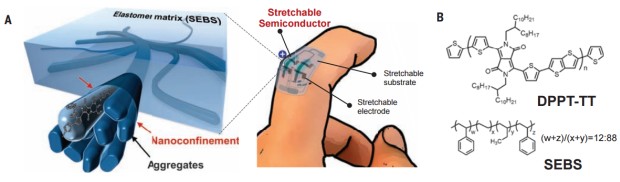 The authors proposed to modify the structure of the material, replacing the net polymer nanocomposite. It semiconductive thin strands of polymer are placed in a matrix of non-conductive flexible polymer. This avoids discontinuities in tension and maintain the mobility of the charge carriers. For the synthesis of the material used, phase separation – this phenomenon concerns the transformation of a homogeneous fluid in a pair of immiscible components. According to materials scientists, it is a cheap and scalable method.
Plastic composite plate has been arranged so that on one side of the conductive polymer out directly on the surface. This allowed us to create an electrical contact between the electrodes and polymer fibers. With the help of polymers filled with carbon nanotubes, scientists have been able to collect material on the basis of thin-film transistor (TFT) and test its properties to mechanical stress.
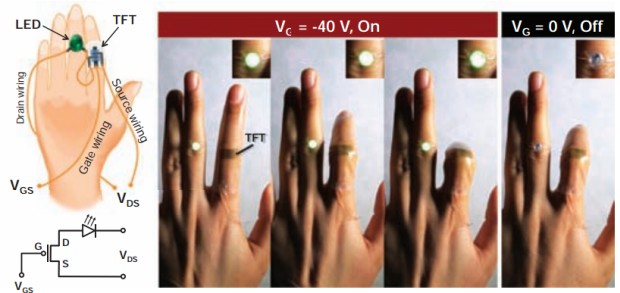
The best of several samples, created by the authors, losing only six to seven per cent of the mobility of charge carriers in tension twice. As a demonstration of capabilities of the device, the researchers placed a single transistor in the crook of the index finger of one of the co-authors of the article and managed with the help of LED.
 According to the Samsung Research Institute (SAIT), participated in the development, the company is interested in such devices. new types of wearable electronics can be developed on their basis. According to the authors, the main result of the work – a new type of polymer semiconductor materials and new methods for their synthesis.
The mobility of the charge carriers in the developed materials is about one square centimeters per volt per second. This value is approximately one order of magnitude less than in the record-setting polymers. Much higher charge mobility in carbon nanotubes – approximately 200 000 square centimeters per volt per second. By the way, recently transistors on carbon nanotubes for the first time surpassed the conventional silicon transistors.
Vladimir Korolev