Australian scientists have created a new kind of rubber polymer that will help develop more sustainable building materials. This versatile new material can be used on its own as regular rubber or mixed with fillers to create completely new composites. And when the product’s useful life ends, the material can be recycled almost an infinite number of times.
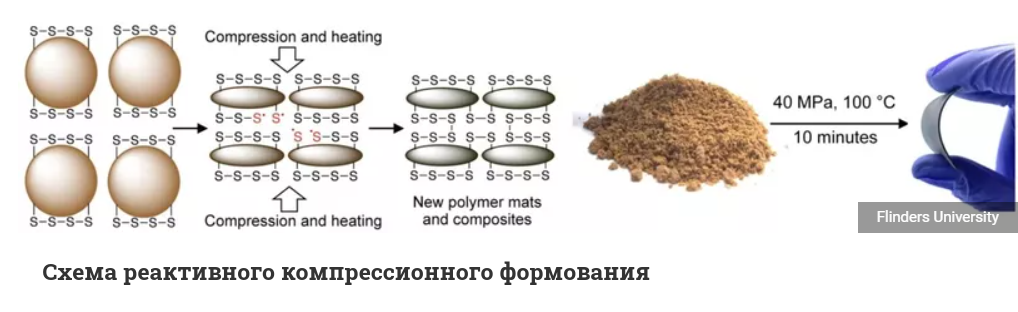
The new rubber polymer is made from sulfur and rapeseed oil and has a unique chemical structure. Rubber does not melt – instead, sulfur bonds in its structure can be broken and transformed by applying pressure and smooth heating at about 100 ° C. This reaction starts when the polymer is in powder form. The research team calls this process “reactive compression molding.”
As a result, you can give the material the shape of pipes, coatings, bumpers, insulation and many other things that are usually made of rubber. But the important thing is that this is only the beginning. As soon as the products wear out or the owners no longer need them, they do not just throw them away. The polymer can be pulverized, put back into the mold and recycled into something new.
Most interesting is that other filler materials can be mixed with the polymer to create new composite materials. And, of course, they can also be recycled in the future.
According to the team, almost any substance can be a filler, but certain combinations will make the final material more durable or durable. And, importantly, it is still recyclable, together with a filler that can give materials such as agricultural waste, carbon fiber, PVC and other plastics a new life.
The team tested several different mixtures and found that some very intriguing options for their use were possible.
“We made one composite in which 70% of the total mass was coconut coir and 30% was rubber polymer,” said Justin Chalker, lead author of the study, in an interview with New Atlas. “The material is very tough and potentially suitable for construction or insulation. If more polymer is used in this composite, then the substance becomes more flexible. In another experiment, we created a composite that contained 80% sand and 20% polymer by weight. The polymer binds sand into a very hard and durable material. We assume that it can also be used to replace, for example, concrete. ”
Other useful combinations are possible. For example, a polymer can be used to purify water. Since it has a high sulfur content, the material can bind to metals such as iron, removing them from the liquid. After capture, the iron-loaded polymer can be subjected to reactive compression molding to make mats or other building materials.