 New material is able to restore its structure due to carbon dioxide from the air.
Pessimists believe that it is impossible to glue a broken cup. Optimists take glue in hand, and chemists create self-healing materials.
Such materials can be, for example, polymers, inside which there are capsules or channels with a liquid substance: if a thing is damaged, they fill the damaged area and quickly harden. There are several different approaches to the creation of such materials, but almost all of them, one way or another, are associated with the presence of active substances inside the subject. Therefore, the solution to the problem proposed by researchers at the Massachusetts Institute of Technology (MIT) turned out to be rather unusual – they created a substance that takes away material for recovery directly from the air.
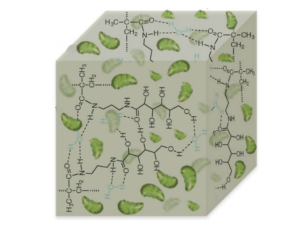
It is quite problematic to build something out of the air, the range of “building material” is too poor: nitrogen, oxygen, carbon dioxide and water, although nature can overcome these difficulties. Researchers have just partially spotted their technology in plants that have learned to process carbon dioxide into complex organic matter during photosynthesis. Chemists from MIT isolated chloroplasts from living cells, placed them in a polymer gel matrix and provided them with enzyme and monomer molecules.
The result was the following: chloroplast in the matrix absorbs carbon dioxide from the air and under the action of light turns it into a series of products, the main of which is glucose. Further, under the action of the enzyme glucose oxidase, glucose is converted into gluconolactone, and the resulting compound, in turn, already reacts with the monomer (aminopropyl methacrylamide), as a result of which a polymer is formed. It turns out that the initial gel matrix absorbs carbon dioxide from the air and incorporates it into its polymeric structure, thereby gaining mass from an external source.
A self-healing (or self-repairing) polymer is described in an article in Advanced Materials. As the researchers themselves say, their work so far is just a demonstration of a fundamentally new concept of material capable of self-healing.
New technology is still very far from practical use. First, the original substance is a gel, and not a solid material, from which it would be possible to make some objects.
The second problem is chloroplasts, which by themselves cannot preserve their photosynthetic functions for a long time. Therefore, the time of active life of all the material is not yet high. If it is possible to replace the chloroplast with a simpler and more durable catalytic complex, this will allow the material to remain active longer.
The author: Maxim Abaev