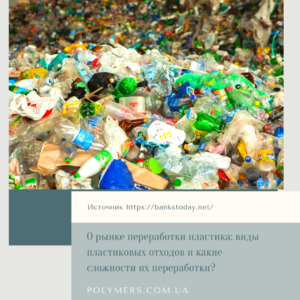
 Waste types
All plastic waste can be roughly divided into two broad categories:
post-consumer
and post-industrial.
Sometimes there is a third – post-commercial, but it is still close to post-industrial.
The post-consumer category includes plastic waste collected by humans. We are talking about plastic, which is first used by individuals or households, and then collected and recycled. This includes:
packaging,
films,
plastic containers,
substrates
etc.
This is a very large segment of the market with a well-defined circle of participants: consumers, management organizations that are responsible for the operation of the house, and therefore enter into an agreement with waste collection companies. At the end of the chain are regional operators for garbage collection, which after the garbage reform have been identified in each region.
It is customary to refer to post-industrial and commercial wastes all secondary plastic obtained from large industrial enterprises and companies in the retail sector, which also produce a large amount of plastic waste. Factories and large retailers are united by the ability to predict both the amount of waste generated and their quality, including information on the composition of the raw materials used. This opens up wide opportunities for further processing. Such secondary raw materials can also be used to produce high-tech materials used in various industries.
Lack of information about the sources of raw materials, on the contrary, often carries risks for processing, as it leads to surprises in terms of the quality of the resulting pellets.
In this sense, it is very difficult to plan production volumes in the post-consumer category, since the amount of recycled plastic is very different every month, and it also differs in composition. Therefore, regional operators working with recycled plastic in the post-consumer category are faced with the problems of organizing stable supplies. Most of the facilities for sorting such waste in Russia are just starting up. In addition, given the low quality of raw materials, only simple materials can be produced from it, for example, paving slabs.
As Japanese statistics show, more than 60% of all recycled plastic is generated in the post-industrial category.
This market was formed even before the start of the garbage reform. Large enterprises faced a choice: either to pay for garbage collection, or to accumulate and compress large fractions in order to sell them to recyclers in the future. Obviously, the second scenario was realized. Now converters, and there are quite a few of them, strive to work in the post-industrial category and actively buy secondary polyethylene, polypropylene, various types of films, cardboard, bushings from factories.
How is the monetization of the processing business going on?
For each segment, the source of monetization is different: for those who process post-consume, the main factor is proximity to regional operators, availability of a cheap and regular resource.
There are two key factors for post-industrial processors. The first is the availability of stable and understandable sources of secondary raw materials, the second is the well-functioning distribution channels with a margin in the sale of pellets.
It should be noted that this year was extremely difficult for the secondary pellet market – prices for primary polymers were falling at a record low, and the potential for reducing the cost of pellets is limited, so a huge number of enterprises for the production of secondary pellets were idle, we will probably see a wave of bankruptcies in this segment.
The future of the recycling market
The processing market is very multifaceted. If we consider it from the point of view of companies that are engaged in the production of granules, then the technology is clear: sorting, washing, crushing into granules.
One of the pain points in the process of collecting and recycling plastic is logistics. It is important to prepare the recycled plastic for shipment so as not to carry a large amount of air. It is in transportation that the biggest operating losses are hidden. On the other hand, this problem has become a good breeding ground for the emergence of tech startups looking for solutions that can close this problem. This is how the IT sphere penetrates into the processing area. IT industry specialists create working aggregator bases that allow for the efficiency of carriers.
If three years ago a large part of the market for recycling of secondary materials, including plastic, was concerned that the Russian population was not ready for sorting, separate collection, today the situation has changed radically. During this time, a whole culture was formed. The psychology of people has changed, and now sorting garbage is an integral attribute of the quality of life. If we talk about recycling, then this is rather a trend that has formed due to consumer awareness.