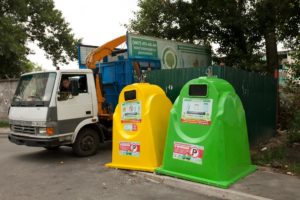
 A pilot project implemented in Vyshgorod demonstrated the population’s readiness to sort waste.
Despite delays in the adoption by Parliament of the necessary laws to implement the National Waste Management Strategy in Ukraine until 2030, the business is already moving towards the European principles of waste management. This is a separate collection and extended producer responsibility, in which the manufacturer / importer of the goods in the package is responsible for the entire “life cycle” of the packaging – from creation to recycling.
This was reported by Anna Tarantsova, environmental protection and public relations manager at Tetra Pak, during a recycling conference held at the XVI International specialized exhibition CommunTech-2018. As an example, she cited a pilot project that is being implemented in the city of Vyshgorod, Kiev region. “Separate collection of waste and its further processing can work effectively in Ukraine. Already a year, as five packaging manufacturers (Tetra Pak, Coca-Cola Beverages Ukraine, PepsiCo Ukraine, Elopak-Fastov and Ken-Pak Ukraine), have jointly launched a pilot project in Vyshgorod.
At their own expense, they established the appropriate infrastructure for separate collection and adjusted all the logistics: export, re-sorting and transfer of packaging waste as secondary raw materials for recycling. The project showed how the system of extended producer responsibility should work in Ukraine, ”said Tarantsova. She noted that 200 containers of two colors were installed throughout the city: yellow – for packaging waste: plastic, paper, metal, green – for glass containers.
The project was launched in November 2017, and for the first year of operation more than 300 tons of recycled materials have already been collected – this is 20-25% of all packaging and glass waste produced in the city. The next year the task is to collect already 30-35% of this type of waste. According to Tarantsova, this result demonstrates the willingness of people to sort waste.
“To collect 25% of the package in the first year is an incredibly good result. We have reached the goal. The same goals are foreseen in the National Waste Management Strategy … People today are ready to sort. We don’t have any big problems with the fact that they don’t know how to do it or don’t want to – in a year the city residents got used to sorting. It takes time and constant systematic work with the residents of the city, and especially with the children, ”she said.
Anna Tarantsova also noted that Ukraine has a sufficient number of plants processing secondary raw materials, which are now underutilized and forced to import raw materials due to the lack of a fully-fledged separate collection and sorting of waste in the country. In particular, cardboard and paper enterprises annually import about 350 thousand tons of waste paper, but the capacity still remains underutilized.
She stressed that in order to introduce European waste management practices in Ukraine, when they are sorted and recycled, and not disposed of or incinerated, laws must be adopted by the Parliament that comply with the National Waste Management Strategy until 2030. “The Cabinet approved this National Strategy a year ago. This basic document is for the development of further legislation. The Plan for the implementation of the strategy is currently under discussion, the development of a new framework law “On Waste” and “On Packaging” is almost complete …
In order for the system of extended responsibility of the manufacturer to work in Ukraine, in order for a separate collection to appear, it is necessary to adopt appropriate legislation, ”Tarantcova noted. As UNIAN reported earlier, on November 8, 2017, the Cabinet of Ministers of Ukraine approved the National Waste Management Strategy until 2030. According to the Minister of Ecology Ostap Semerak, the next step will be the preparation of national and regional plans for the implementation of the strategy. The strategy involves reducing the level of disposal of household waste from 95% to 30% and minimizing the total amount of waste to be disposed of from 50% to 35%. When dealing with household waste, it is proposed to introduce a separate collection, to determine the optimal areas for the placement of regional waste transfer stations, sorting lines, waste treatment plants and landfills. Funds will be created for industrial wastes, the operators of which will be regional state administrations, and the filling agents will be enterprises that do not have environmentally friendly recycling technologies.