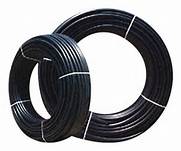
 Polyethylene high and low pressure becomes the most common material for the production of various products. Production of polyethylene pipes established both large enterprises and small shops.
Most companies use a technology of production of polyethylene pipes – extrusion method.
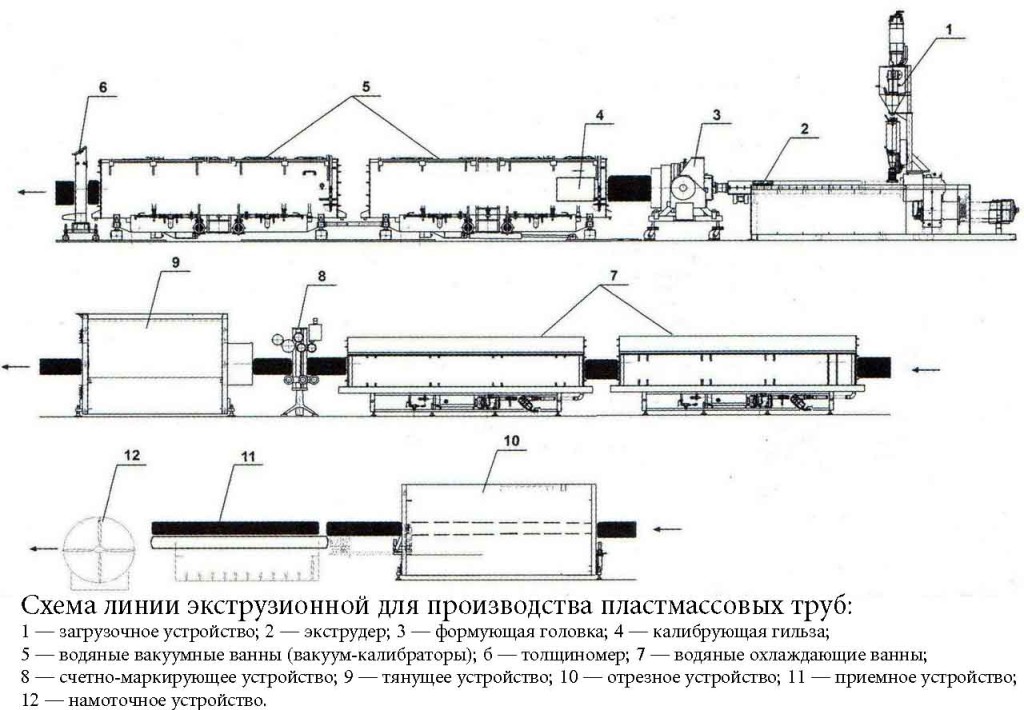
The raw materials constituting the polyethylene pellets fed to the hopper of a single screw extruder. It is plasticized under heat and fed to a screw extrusion die having an annular gap of a given size. The plastic mass under high pressure passes through the die, forming the preform. The hot preform is fed into a vacuum bath in which the desired diameter is acquired by the reduced pressure (calibrated).
On some lines use different calibration technology – high pressure. In this case, the preform is fed into a hollow cylinder, whose inside diameter corresponds to the outer diameter of the next pipe. The feed into the high pressure air expands blank, pressing it against the walls of the cylinder, so the product is formed with the desired dimensions. At the same stage and performed partial cooling.
Important role played by the correct cooling of the workpiece, so the equipment dlyaProizvodstvo polyethylene pipes production of polyethylene pipes compulsorily includes several cooling baths. Passing through them, gradually gives off heat pipe that allows you to remove the residual stress of the material, the violation of this rule (rapid cooling) significantly reduces the quality of the pipe.
Cutting the pipe size of the planetary saw is carried out. Thus the products depends on the length and diameter of the customer requirements. Since tubes having a diameter of 160 mm can be supplied bays 100-200 meters or more, larger products often have a length of 12 m. The finished tube is marked in accordance with regulatory requirements.
All production of polyethylene pipes maximally automated, the operator only needs to control the operation of the system.
The automation system controls:
quality and availability of raw materials in the hopper of the extruder,
pressure and temperature conditions,
the rate of passage through the plastic mass matrix head.
The key to the quality of the resulting product is a modern ultrasonic inspection system, in addition, must be organized and visual inspection of the goods by responsible persons.
The set of equipment for production
Standard Line for production of polyethylene pipes must include the following equipment:
Equipment management and process control.
Equipment for continuous feed into the extruder hopper.
Single-screw extruder with a nozzle forming (matrix head).
Calibration Equipment (vacuum or other type).
Device for cooling the preform and finished products.
The mechanism moving the blanks along the line (pulling device).
Cutter (usually plants with planetary saw)
Equipment for the application of appropriate labeling of finished products.
Hardware dimensional accuracy and geometry of the finished product (considered to be the most effective ultrasonic control)
Equipped with such equipment for the production of polyethylene pipes plant can produce water-pressure pipes with diameter up to 120 cm., Pressure pipes for natural gas pipelines up to 31.5 cm., Technical non-pressure pipes up to 120 cm.
STORAGE AND TRANSPORT OF PIPE HDPE and LDPE
Due to the fact that polyethylene products may be damaged by shock or other kinds of loads, the caution their storage and transport.
If necessary, long-term storage is not recommended to extract the pipe from the factory packaging.
Unfortunately, the production of plastic pipes in Russia in most cases involves the packaging of the finished product. Therefore, refer to the following requirements.
Storage of polyethylene pipes Pipes should be stored in warehouses. It can be stored in the open air, which must be aligned and pre-cleared. It is necessary to protect the product from direct sunlight.
Stack products in bulk should be using wooden pads that are placed at intervals of no more than 1 meter. Bay should be placed on wooden pallets.
Not allowed travel goods portage, as when unloading is prohibited to discharge pipe from the vehicle.
The work of loading and unloading can be carried out using techniques well as manually.
Mechanized unloading must be carried out only with the use of soft plastic straps or mounting rail, which can not damage the surface of the product.
Perekatka polyethylene pipes should be laid and to lag, and the need to avoid hitting the side of the machine.
Polyethylene pipes are most vulnerable to negative temperatures. Therefore it is not recommended to work on loading and unloading at temperatures below -20 degrees. In some cases, allowed such operations with the products in their original packaging.
All of the above rules apply to pipes and fittings made of polyethylene.
↑
Criteria for the selection of pipes
Production of pipes (polyethylene HDPE and LDPE) carried out a variety of manufacturers. Furthermore, there were proposals on the market and foreign manufacturers, unfortunately, not always quality. Therefore, when purchasing, pay attention to the presence of marking, its compliance with the actual size. The pipe should not have chafing and other damage. Proof of the quality of the product may serve as a certificate, from which you can learn all the details of the purchased pipes.
Particular attention to the existence of supporting documents necessary to pay when buying a gas pipe.