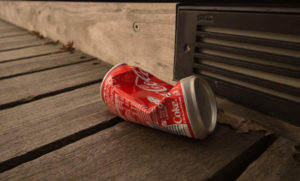
 Here, they seek a “junk” discipline with fines and monetary incentives for recycling
“Pure” – such an epithet among others has always characterized Germany. Indeed, the streets of cities and villages, parks and forests have always attracted attention with accuracy and well-groomedness.
Alas, in recent years the picture in many areas is somewhat different. At least to me, who came to Berlin in early 2015 after a 37-year hiatus, this cut my eyes. Although it is hardly possible to rely on childhood impressions in this matter, nevertheless some memories, as well as conversations of the elders about the accuracy of the Germans and amazing cleanliness, were imprinted somewhere in the subcortex.
Today, in large cities, where a lot of “come in large numbers”, you are no longer surprised by the wrappers and plastic cups lying on the streets and squares, beer cans and bottles. Especially on weekends, when communal workers, like all decent burghers, have a legitimate day of rest. Mass popular festivities, be it a football match, May Day or the gay parade – a separate topic. Urns, which, it should be given credit, are installed in crowded places in abundance, simply do not contain all waste from food and drink walking.
A cursory review of news reports literally in recent days shows that the problem of garbage is not too acute, but it worries both the authorities and the population. News about spontaneous landfills is not so little from different federal lands.
For example, a report on the deplorable condition of some seacoasts: “On the beaches of the North and Baltic seas, according to analysis, a large amount of waste is lying. 389 garbage items were found on 100 meters of the beach! “, – the environmental protection agency beats in July.
Or here is the appeal of the police of a small town of Nienburg in Saxony on August 1: “We ask all who saw who threw old broken furniture into the undergrowth and contact hotline phones.” Someone decided to save, because the fine for the release of furniture ranges from 200 to 600 euros. However, if a person had notified special services, it would have cost him much cheaper, if not completely free.
“The town of Augsburg on the banks of the Werthach river in Bavaria attracts a large number of holidaymakers in summer, including garbage after cheerful picnics,” complains the local newspaper Augsburger Allgemeine on the last day of July. Local residents are annoyed by the empty bottles of vodka lying on the once well-groomed beach and packages of pizza, chips and sweets.
The municipality of Moers in the state of North Rhine-Westphalia is trying to locate the unknowns who “once again threw away the garbage to be recycled-old tires and several waste packages-in the park zone,” and complains that she, the mayor’s office, had to pay for Garbage disposal hundreds of euros. But this is taxpayers’ money, after all. Honest taxpayers …
PROCESSING – PATH TO CLEAN AND ECOLOGY
German taxpayers pay a lot for the “organized” emission of garbage, according to our standards: an average of more than 150 euros per year for a family of 4 people.
They also scrupulously sort the garbage. Not only because for the discharge of the wrong garbage in the wrong container it is possible to run into a fine or even the refusal of utilities to serve such unscrupulous consumers, but also out of sincere concern for the environment. By the way, the need to sort the garbage of FRG citizens is taught from childhood – there are special stories on this topic in children’s books and a special course in kindergartens and schools.
It all began in 1991, when the government of the Federal Republic of Germany passed a law on packaging materials, which obliges producers to be responsible for their goods and after their use (the costs of processing are already included in their cost). Since then, on the packaging to be processed, you can see the corresponding icon, and in the places of waste disposal – various containers: for household waste, for paper, for various packaging and for glass (with separate white and color).
Beer (but not wine) bottles, however, it is more convenient to hand over through special machines in stores, and plastic bottles – even more profitable. Agree, 25 euros for a plastic bottle – not bad at all.
Further, the garbage that is taken out at different intervals is sent either to the post-processing points or to incineration plants. The energy received by burning, as a rule, goes on heating of houses and water heating in a waterpipe. Profitable.
It should be noted that Germany is a champion in the processing of domestic waste: here about 65% of the garbage is recycled or composted (the average for the EU is 42%), and only the remaining 35% is burned. Almost 14% of all raw materials used in the industry of Germany, was derived from waste.
For example, if in the same 1991, 5% of aluminum was processed, today more than 90%, for plastics, growth from 3 to over 60%.
Recycling of garbage is a very profitable business, the turnover of the industry exceeds 200 billion euros per year. Occupied in it about 250 thousand people.
At the same time, Germany also is a European leader in the “production” of garbage. While the average for the EU is 492 kg, in Germany it reaches 618 kg of garbage per average citizen per year.
PENALTIES AS A PURIFICATION PREVENTION
Obviously, this amount is added to the garbage that citizens throw out not in their containers, near houses, but along the way, so to speak.
Whatever was not said at the beginning of the text, but the overwhelming majority of Germans and cultural guests of the country are watching for cleanliness. Stimulates them to this as care for the environment and just proper upbringing, as well as considerable penalties for the ejection of garbage in unintentional places for this. The latter are also a good means of replenishing the budget.
So, Germany is in the top 5 countries in Europe to control the emission of garbage on the street with the help of fines.
So, for a small amount of garbage, sent not to the urn, but wherever it happens, you will have to pay 35 euros, the same for spitting out the cud, for a thrown toe / asphalt stub – 20 euros. Even for “environmental” waste such as sticks, seeds from fruits and berries, and even more banana peel, can face a fine.
But this is if you were caught “on the hot”. Personally, I’ve never seen how it looks in practice. Although there are even special garbage detectives in Germany. The project started 12 years ago in Frankfurt am Main and then spread to some other cities. “Detectives” using conventional cameras, security cameras and analysis of garbage, calculate violators and so then from the fine do not get out (however, only if the hooligan is clearly discernible in the picture, otherwise you can and challenge the claims). Only here cameras are not installed everywhere, and to sit in ambushes makes sense only when in some place they litter very much maliciously and provocatively.
Severely punished sending small needs outside the toilet. The minimum penalty for this kind of hooliganism (or incontinence) is 35 euros. Do not bring you to think of urinating on the monument (someone might even have such a wild idea to come to mind on drunk) – you will have to pay 5 thousand euros. If not, please wait a year for the prison.
And strongly do not advise to collect flowers or cut off twigs in public parks or simply on the streets. Even for your girlfriend. It will be cheaper to buy a bouquet, and even avoid the shame of fining.
Germans themselves listed things, as a rule, and do not allow. For years and years, grafted norms of behavior have affected. Although among the young “uncomplexed” generation there are failures of morals. Tourists, too, generally try not to disgrace their country, having found themselves in the center of Europe.
One must simply not forget that it is necessary to behave culturally not only on a visit, but also in one’s own home. Then it will be pure and pleasant to everyone, and above all, to the owners.
Olga Tanasychuk. Berlin.