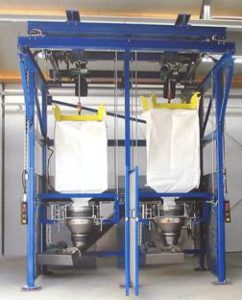
 All the advantages of soft containers can be used provided that the container is properly selected for the type of cargo and the rules of handling are observed.
The use of soft containers makes it possible to reduce overall labor costs, but subject to availability at the enterprise:
• devices for loading (unloading) containers,
• cargo mechanisms for the supply of containers for loading (unloading) and means of intra-plant transportation,
• sites and warehouses for temporary storage of filled containers.
General appeal requirements:
• It is forbidden to operate (load / unload / lift / move) the container at a product (ambient) temperature below -25 and above +60 degrees.
• Protect from direct sunlight and precipitation.
• A safety margin of 5: 1 ensures the integrity of the container, even when jerking, transient overloads, but it is necessary to observe the slinging rules, since if they are not followed, the load on the individual container nodes may exceed the critical and lead to a breakage.
• Transport on forklift at minimum fork height.
• When stacking, place the container flat and set tightly, strictly vertically.
Container loading:
Containers should be preliminarily subjected to a thorough visual inspection in order to exclude cases where damaged containers are used, moisture inside the container, residues of loose products or foreign objects, improper laying of the liner, discharge unit (if any) and other deviations from the required standards are excluded.
Containers should not be allowed to come into contact with objects with sharp edges and with aggressive chemicals.
Before loading, insert the liner into the container, inflate it with air, hang the container on the loading device so that the bottom touches the floor (loading platform), fix the insert on the neck. When hanging the container it is necessary to observe the angles of dilution (information) of the sling.
In order to make the most use of the container’s capacity and create a more stable load unit, it is recommended to vibrate the container during the product loading process
It is forbidden to fill the container abruptly, to overload the container in excess of its carrying capacity.
After loading and removing the container, it is necessary to seal the liner. This is done as follows: the neck of the liner is twisted, after which it is tied at the bottom with a cord (adhesive tape), the end of the liner is bent, both sides of the neck are tied, sealed and fixed inside the container.
Relocation and temporary storage of containers.
Before proceeding with the loading or unloading of containers, it is necessary to make sure that the cargo elements of the container are in good condition, that the load handling and load-lifting mechanisms are in good condition.
It is necessary to sling the containers correctly.
Transport on forklift at minimum fork height.
Raising and lowering the container should be made at a speed of no more than 0.2 m / s without jerking and abrupt stops in order to avoid their strong swinging and falling.
It is not allowed to move containers with fiber.
For short-term storage, loaded containers are placed both in warehouses and in open areas. Open areas should have a hard surface with water flow and ensure that cargo mechanisms can work for loading (unloading) loaded containers into mobile means of road, rail or other transport.
When storing containers in an open area, one should take into account that the shell of the container is not resistant to prolonged exposure to ultraviolet and visible light, although UV stabilizers are introduced into the fabric during manufacture, slowing down this process.
Therefore, if it is impossible to organize storage under the roof, we recommend covering the soft container with a tarpaulin or black plastic wrap.
When storing loaded containers in open areas, the bottom row should be placed on pallets or wooden decking.
The installation of containers in stacks should be made in tight rows strictly vertically, with stability. From the second tier, inclusive, containers are installed with ledges at half their diameter around the perimeter of the stack. The height of stacking loaded containers depends on their type: containers up to 1 cubic meter. stacked in 4 tiers, up to 1.5 cubic meters. – up to 3 tiers; volume of 2.0-3.0 cubic meters. – in one tier. Stacks of loaded containers should be placed apart from each other at a distance necessary for the passage of means of intra-plant transportation. Disassembling a stack of containers is performed in the reverse order of its formation. In heated premises, containers should be installed at least 1 m away from heating appliances.
At negative temperatures, the container should not be placed directly on the ground or on the floor of the vehicle, since freezing and breaking of the lines during lifting is possible.
Container unloading:
Unloading of containers can be carried out by gravity or pneumatic transport.
When unloading containers, accompanying documents should be removed from the special pocket, secured the liner to prevent it from getting into the bunker together with the contents of the container, secure the container to the cargo elements, lift and bring the container to the place of unloading.
When unloading by cutting the bottom, it is necessary to use special tools – a knife permanently mounted on a bunker or a knife mounted on a rod, excluding the presence of the worker’s hands under the container. Unloading by decoupling the bottom hatch should be done only when the container is fixed on the support frame.
When unloading products from containers into receiving bunkers, service personnel should be located on the windward side and use the personal protective equipment provided by the regulations.