Marking of plastic products:
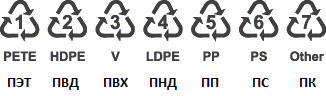
1. PET or PET – polyethylene terephthalate. Used for manufacturing packaging (bottles, cans, boxes, etc.) for dispensing soft drinks, juices, water. Also, this material can be found in packages for various kinds of powders, bulk foods, etc. The most common type of plastic. Good recyclable. It is considered one of the safest types of plastics.
2. HDPE or LDPE – low density polyethylene. Used for the manufacture of pots and packages for milk and water bottles for bleach, shampoo, detergents and cleaners. For the manufacture of plastic bags. Cans for engine and other engine oils, etc. It lends itself to be recycled and reused. It is considered safe for food use.
3. PVC or PVC – polyvinyl chloride. It is used for the packaging of liquids for washing windows, edible vegetable oils. From it are made cans for packaging of loose food and all sorts of dietary fat. This plastic is used for the production of pipes, floor and wall coverings, windows, garden furniture, for the manufacture of blinds, tablecloths, films for suspended ceilings, curtains for the bathroom, various types of packaging, plastic bags and even toys. This plastic belongs to the most dangerous type of plastic and is virtually impossible to recycle. Incineration of PVC releases carcinogenic dioxins into the air (very dangerous poisons).
To give PVC flexibility it added plasticizers (phthalates) that can cause people to liver and kidney damage, sterility, cancer. The PVC may contain bisphenol A and heavy metals such as cadmium, chromium, mercury, lead, formaldehyde. If possible, give up the use of plastic or reduce its consumption.
4. LDPE and HDPE – high density polyethylene. It used in the production of plastic bags, bendable plastic packaging for the manufacture of certain plastic bottles. Good recyclable and reused, but its low-profit processing. It is considered safe for food use.
5. PP or PP – Polypropylene. Because it makes lids for bottles, CDs, bottles of syrup and ketchup, yogurt cups, packaging films. It is used for the manufacture of toys, children’s feeding bottles. Polypropylene wear out faster and less hardy than polyethylene. Scientists believe that it poses no danger to human health and the environment. It is considered safe for food use.
6. PS or PS – polystyrene. It used in the production of trays for meat and poultry, egg containers, cutlery and cups, sandwich panels, insulation panels of buildings. Polystyrene obtained by polymerizing styrene, which is carcinogenic. If possible, give up the use of plastic or reduce its consumption.
7. OTHER or another. A mixture of different plastics or polymers which are not mentioned above. Packaging marked this figure can not be recycled and ends its life cycle in a landfill or incinerator furnace. Often this group include plastic, made from polycarbonate PC or PC. When heated, frequent washing or prolonged use of such products (food containers and bottles) can be released Bisphenol A, which causes hormonal disturbances in humans. At the same time, this type of plastic can include eco-friendly, degradable plastics.
polymers lassifikatsiya:
A great number of polymers can be divided into three main classes underlying the classification adopted today.
The first class includes a large group of carbon-chain polymers, macromolecules which have a skeleton built of carbon atoms. Typical representatives of this class of polymers include polyethylene, polypropylene, polyisobutylene, polymethyl methacrylate, polyvinyl alcohol, and many others. Macromolecule fragment of the former has the following structure: [CH2-CH2] n.
The second class includes at least large group heterochain polymers, macromolecules in the backbone in addition to carbon atoms, contain heteroatoms (e.g., oxygen, nitrogen, sulfur, etc.).
Polymers of this class are numerous simple, polyesters, polyamides, polyurethanes, natural proteins, etc., as well as the large group of polymers elemento:
• polyethylene oxide (polyether)
• polyethylene terephthalate (polyester), polyamide
• polydimethylsiloxane
A third class of polymers – molecular compounds with conjugated bonds system. These include a variety of polyacetylenes, polyphenylenes, polioksadiazoly and many other compounds. Examples of such polymers are: polyacetylene; polyphenylene; polioksadiazol.
This class applies to an interesting group of chelating polymers, which include a variety of elements capable of forming coordination bonds (they are usually indicated by arrows). The elementary unit of such polymers often have a complex structure.
Among the many polymeric materials is the most practical application of the materials found on the basis of the first representatives of the class of polymers – carbon-chain high-molecular compounds. Because carbon-chain polymers can obtain valuable materials – synthetic rubbers, plastics, fibers, films, etc., and these polymers have historically found first practical use (reception phenol resin, synthetic rubber, glass and organic al.).
Many of the carbon-chain polymers subsequently became classic targets for research and development of the theory of the mechanical behavior of bodies of polymeric (eg, polyisobutylene, polymethyl methacrylate, polypropylene, and phenol-formaldehyde resin, etc.).
By the ability to recycle the polymers are divided into thermoplastics and thermosets. Consider the first details.
thermoplastics
By thermoplastic or thermoplastics materials (thermoplast, thermoplastic) are polymers which when heated during processing change from solid to liquid state of aggregation: rubbery or viscous flow (injection molding thermoplastics pass into a plastic condition). Upon cooling, the material, the reverse transition to the solid state. Behaviour on heating differs from thermoplastics or thermosets of thermoset materials (thermoset), which are cured with treatment and are not able to continue to move in the liquid aggregate state.
The physical condition of thermoplastics
Depending on the received phase states are divided into thermoplastic materials are amorphous and crystalline (crystallizable precisely). In crystallizing molded thermoplastics is always saved some share vitreous (amorphous) material, so these materials are sometimes referred to as a partially crystalline. Some materials (PC), in principle capable of crystallization, do not crystallize during injection molding, remains amorphous.
There are materials which may be amorphous or crystallizable depending on casting conditions. Others – greatly alter the degree of crystallinity and properties changing technological regime. Ability to crystallization – a very important material property that determines their behavior during processing, and which have to be taken into account in the design of products and molds, and the choice of technological casting regime. Crystallized material have a high level of shrinkage and shrinkage anisotropy (the difference between longitudinal and transverse shrinkage). Pigments and other additives acting as nucleators (crystallization nucleating agents) can significantly alter the structure and properties of crystallizable materials.
Depending on the temperature of amorphous thermoplastics are three physical states: vitreous, highly elastic and viscous flow.
For the glassy state are characterized by small elastic deformation. The transition from the highly elastic state to a glassy occurs over a temperature range whose center is called the glass transition temperature Tc (glass transition temperature, Tg). Depending on the method of determining the glass transition temperature can vary significantly. When the glass transition temperature amorphous material increases the operating temperature.
The polymer in the rubbery state is capable of great reversible deformations reaching hundreds more%. With increasing temperature, the injection molding thermoplastic material passes from the highly elastic state in a plastic. this transition temperature is called the pour point Tm. Higher flow temperature polymers exhibit permanent deformation of the viscous flow. When heated, the amorphous material is typically visually observed nefazovy transition resembling melting process for crystallizing thermoplastics. The temperature of this transition is conventionally called the melting temperature (melting temperature, Tm) of the amorphous material.
In thermoplastics crystallizing amorphous phase can acquire the physical condition described above. Upon heating, the crystal phase melts. The temperature of this phase transition is called Tm melting temperature (melting temperature, Tm). The properties of polymers depend on crystallizing the crystalline phase content and from the physical in which state (the glassy or rubbery) is operating at a temperature of the amorphous phase.
Classification of thermoplastics by Performance
Thermoplastic molding materials are divided into several groups depending on the level of performance properties. These properties primarily include long-term operation temperature.
Plastics quite conventionally divided into groups (in the various editions are different classification criteria):
• General purpose materials or General purpose (general purpose plastics)
• Structural plastics or plastics engineering and technical purposes (engineering plastics)
• of high performance (super-engineering plastics) or highly thermostable polymers (high temperature plastics).
Among the thermoplastics emit a special group of thermoplastic elastomers and thermoplastic elastomers (TPE), which by technological properties are conventional thermoplastics, and on performance like rubber and rubber, that is, capable of great reversible deformations. Depending on the long-term operating temperature thermoplastic elastomers also divided into general-purpose materials (general purpose TPE) and engineering and technical purposes (engineering TPE).
Classification of the chemical structure of thermoplastics
On chemical structure numerous molded thermoplastic materials are generally divided into several groups (classes). Modern industry produces a large number of types of polyolefins (PO), the most important of which are the group of polyethylene (PE) and polypropylene (PP). Numerous types of materials are presented in groups of the styrenic plastics (PS), polyamides (PA), polyesters (polyester).
Traditionally isolated group of polymers based on cellulose (cellulosic plastics), fluoropolymer or fluoropolymers (fluoro plastics). Manufacturers of acrylic polymers or acrylates (acrylic) often indicate only the material belonging to this group and do not result in the type of material.
Classification of thermoplastics in terms of production
In literature often secrete large-group materials (volume plastics), which include polyethylene (PE) and polypropylene (PP). basic styrene plastics (PS) and especially ABS (ABS), acrylates (acrylic), PVC (PVC) and a PET bottle (PET).
Homopolymers. Copolymers. Stereoisomers
Polymers built identical monomers called homopolymers (homopolymer), from different – copolymers (copolymer).
For some types of materials (. Polypropylene, polystyrene, etc.) in addition to the chemical formula has stereoisomerism important – the type of the spatial configuration of the atoms of the side groups of the polymer chain. The most important types of stereoisomers:
isotactic (isotactic) – side groups are arranged on one side of the polymer chain
syndiotactic (syndiotactic) – side groups are alternating on one and the other side of the polymer chain
atactic (atactic) – disorderly arrangement of side groups on one and the other side of the polymer chain
The development of technology for synthesizing polymers using metallocene catalysts has allowed to establish commercial production of various stereoisomers in recent years.
As an example of the effect on the performance properties of stereoisomerism material can lead syndiotactic polystyrene (SPS), which is a crystallizable material unlike the conventional amorphous atactic polystyrene.
According to the structure of the copolymers divided into several types:
a block copolymer (block-copolymer) – regular alternation sequence (block) units in the main chain
random copolymer (random copolymer) – irregular alternation of units sequences
graft copolymer (graft copolymer) – has a backbone in the form of a homopolymer or copolymer, to which are attached side chains
alternating copolymer or alternatny (alternating copolymer) – regular alternation of units in the main chain
Recently, great progress has been interpolymers – copolymers forming a homogeneous structure (components are not separated into individual phases).
Besides double copolymers constructed from two types of monomer units, terpolymers produced (terpolymer), consisting of three types of units, and copolymers having four or more taps types. Terpolymers are ABS plastic (ABS), ACA-copolymer (ASA), and others.
Classification of thermoplastics for the type of filler
Fillers can significantly change the performance and processing properties of thermoplastics.
Thermoplastics containing glass fibers, etc.. Kinds of glass fillers, traditionally referred to as fiberglass (glass filled). In recent years, large distribution received the materials, filled with long glass fibers, which require special processing conditions.
CFRP (carbon filled) referred to materials containing carbon fiber.
Sometimes isolated group of “special” thermoplastics. These include materials that contain flame retardants (materials with high resistance to combustion), electrically conductive additives (antistatic, conductive, EMI shielding materials), anti-friction additives (materials with low coefficient of friction), an additive to give durability and others.
Secondary processing of PE, PP and PS
Polietilen_PE
Low density polyethylene (LDPE) and linear polyethylene (LLDPE) made films for consumer packaging (including plastic bags, bags and sacks) and for industrial packaging (such as bags for fertilizers in agriculture), which are raw materials for further recycling.
In the first case, processing is quite simple, t. To. Vtormateriala quality very close to the quality of the primary polymer because of the short product life cycle. The polymer is exposed to external factors in the short term and undergoes only a slight decay of the structure. The material structure largely affected during its regeneration by plasticization.
Another source of poor properties of the processed reclaimed material waste is the use of different molecular structures (e.g., both LDPE + LLDPE), which necessarily leads to a decrease in the mechanical properties of the resulting material
When using the secondary industrial packaging is somewhat more complicated. As a rule, industrial use film has a larger life cycle than consumer. Exposure to sunlight, temperature variations, and so on. E. Also has a detrimental effect on the polymer structure. Everything else, used industrial plastic film may contain significant contamination in the form of dust and fine components, which are almost impossible to remove, even with the most careful washing. Naturally, this has a negative effect on the properties of the recycled material.
The use of recycled plastic is calculated from their average properties. In the case of LDPE and LLDPE can be some degree of certainty that the secondary polymer raw materials of these types of films can be processed in the same conditions (and about the same final properties) as the primary plastics.
As examples of the utilization of LDPE can be called a re-production of film for household and commercial packaging, bags for garbage nesypuchego and garden mulch film. Material properties of the finished product is very similar to the primary polymer base properties, but the number of recycling cycles “of the product in a product” is limited due to deterioration of polymer properties during multiple repeated material melting process