Since January 1, 2018, legislative changes have come into force on sorting and processing of garbage, for which the Verkhovna Rada voted back in 2012. But it turned out that several years are not enough to start the process of processing household waste. Hence, there is no practical sense in sorting household waste by fractions – dry – wet, dangerous – recyclable, etc.
So, nothing has changed since the New Year – the number of containers in the yards has remained the same, and even that rubbish that Ukrainians accurately put into different containers, then dumped in one garbage truck and sent to a landfill. NewsOne figured out how the scheme for sorting household waste should have been made, why it could not be launched and will it ever be possible to do it?
What went into effect?
Since January 1, 2018, new wording has been developed and the existing in the Law of Ukraine “On Waste”: sorting of waste, operations with waste as secondary raw materials, waste management, services for processing and disposal of waste, etc. have been expanded. That is, citizens have to start preliminary sorting of garbage, local authorities – to provide populated areas with containers for different fractions of domestic waste, and for violation provided for punishment.
This treatment of household waste is in accordance with the requirements of the European Union – the Framework Waste Directive, the Dangerous Waste Directive, the Comprehensive Pollution Prevention and Control Directive. In 2012, amendments were made to the Code of Administrative Offenses on fines for the burial of unprocessed domestic waste. For this violation, citizens must pay a fine in the amount of 20 to 80 non-taxable minimums (340 – 1360 UAH), from officials, business citizens – from 50 to 100 tax-free minimums (850 – 1700 UAH).
How should it work?
The law “On Waste” contains a vague wording “waste sorting” – mechanical waste distribution according to their physical and chemical properties, technical components, energy value, commodity indicators. This is the first action in the process of waste management, which Ukrainians must implement. There is adopted in 2011 and the current procedure for the separate collection of household waste:
– large-sized and repair waste should be collected in containers on special paved surfaces;
– hazardous wastes are collected in red containers in order to transfer them to specialized enterprises that have a license to carry out hazardous waste handling operations;
– liquid household waste is stored in cesspools and exported at least once every six months;
– for solid household waste, the following classification is provided: organic constituent, which is easily subject to rotting; paper and cardboard; polymers; glass; household scrap; textile; tree; hazardous waste in the household; bones, leather, rubber.
In theory, for each type of waste in the yard of the house there should be a separate trash container or at least the necessary minimum – containers for fractions such as plastic, glass and paper, given their high percentage of the total mass.
In the Law on Waste (Article 35-1), the waste management vertical is described as follows:
– residential areas should be equipped with container platforms, urns for household waste;
– owners or users of sources of origin of domestic waste (according to law, sources – including residential houses) provide separate collection of solid domestic waste and make a contract with the provider of services for their removal;
– separate collection should take place in accordance with the methodology approved by the central executive authority, which ensures the formation of state policy in the sphere of housing and communal services. That is Minregionstroy;
– collection and removal of household waste is carried out by a legal entity authorized by a local government body on a competitive basis.
The chain is more or less clear, and the Cabinet quite clearly articulates who is responsible for sorting. In November 2017, the Cabinet approved the National Waste Management Strategy until 2030. Here is a quote from it:
“In Ukraine, there are 460 cities, about 500 districts, 885 urban-type settlements and 28 388 villages, whose local governments are fully responsible for organizing the provision of services for handling solid domestic waste.”
So, if containers have not appeared in the courtyards of apartment houses since January 1, local authorities should ask questions: village, town and city councils and their executive committees, regional and district councils.
By the way
66% of Ukrainians do not sort the waste precisely because there are no containers for separate collection. At the same time, 85.5% are ready to sort the garbage if there are proper conditions for this. Almost 29% of Ukrainians are ready to sort waste into two fractions – dry and wet, and almost 49% – to 3-4 different factions. These are the data of the poll of the Ilk Kucheriv Foundation for Democratic Initiatives, held in autumn 2017, commissioned by the NGO Ecology – Law – Human.
Why is sorting necessary?
In the National Waste Management Strategy, the Cabinet gives eloquent figures: in 2016 only 5.8% of domestic waste was recycled, and the rest are on landfills and dumps, of which there are almost 5,500 in the country. For comparison, in European countries about 60% household waste.
In order to ensure such a result, infrastructure is needed – waste sorting lines and waste processing plants. Here it is necessary to start business practically from zero, because in the country there are units of such capacities. Until they appear, sorting garbage by citizens is a half-measure. The National Strategy states that in 2023 it will be possible to reach a 15% recycling rate if 23% of Ukrainians start sorting out the garbage. In 2030, 50% will be able to process, if 48% are conscious citizens. But there is a reservation that this requires the same processing capacity.
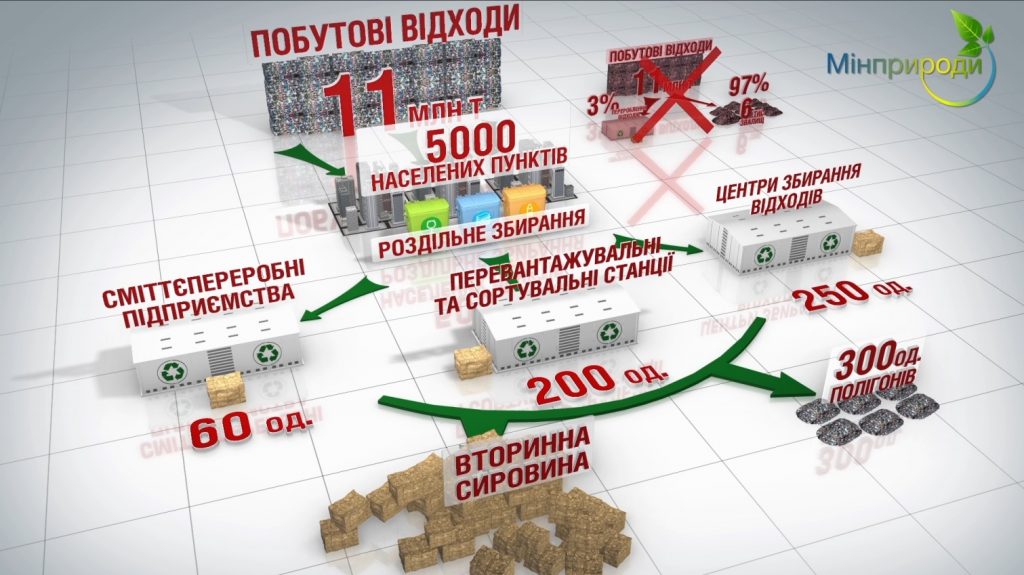
To create an ideal picture, you need 60 waste-processing enterprises, 200 reloading and sorting stations and 250 waste collection centers. Plans are cosmic, but now the industry is in a zero state and there is no noticeable desire to develop it. That’s why experts are very skeptical about plans for sorting household waste.
“Initially, everything is silly done, why sort the garbage if there is no place to process it? If sorting, only fractions are harmful substances: batteries, mercury lamps, thermometers.” That is, those things that can not be thrown out to landfills in principle, they must either be recycled or “says Vladimir Boreyko, director of the Kyiv Ecological and Cultural Center,” Plastics takes up 80% of the garbage, but there’s nowhere to recycle it. “Then, what’s the point of sorting it?” They increased fines for burial of unprocessed wastes. Initially, the law had a lot of shortcomings: a group of people who are well versed in this problem should deal with legislation, but nobody has to deal with this problem.) The national strategy and any strategy in our country is nonsense. I know a million strategies, and none work You just need to give benefits to a business that is engaged in or wants to process waste, after which the process will go in. Then they will not cut down the forest and sell it to Europe, but will waste because we have plenty. “