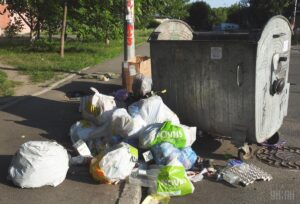
 If in the near future Ukraine does not begin to sort and recycle waste, then in a couple of years we will sink trash in the mountains and spend a lot of money on solving this problem. UNIAN tried to figure out what needs to be done to solve the problems, and what tariffs for garbage collection for the population can be in the new model of waste management. In recent years, Ukraine has faced an acute problem: the lack of a clear state policy regarding domestic and industrial waste. Our cities and towns are periodically covered with piles of garbage, illegal landfills appear like mushrooms in different parts of a green, beautiful country yesterday, polluting our land and bodies of water.
This worsens the environment and affects the health of all residents of the country. Regarding the efficiency of working with household waste, Ukraine, admittedly, is decades behind European countries. However, things may change soon. In the near future, the Verkhovna Rada is preparing to consider a package of bills on the management of household and other wastes, which will lay the foundations for a new legal regulation of the sphere of waste management. “We are trying to implement a comprehensive approach – these are ten bills. Plans to take the entire package in the spring. So that we can show the logic and the rules that are in force in Ukraine, firstly, to attract investors here, and secondly, to place demands on those who should be responsible for the waste that appears, ”the UNIAN Minister of Energy said and environmental protection Alexey Orzhel. Without legislative changes, our country will not be able to fully implement a sustainable and responsible model for waste management.
With this you can’t delay anymore. Ukraine is one of the ten countries in the world with the largest amount of garbage per inhabitant. On average, one Ukrainian generates up to three hundred kilograms of garbage per year, and in the country, according to environmental experts, about ten million tons of municipal solid waste are produced. Of this volume, only three percent is processed and the same amount is burned.
The remaining 94 percent of the waste is disposed of in landfills, where these periodically burning mountains of garbage will decompose for many decades, polluting the environment and destroying the health of citizens. Most of the landfills opened in Soviet times are in disrepair and are being decommissioned. Therefore, in the near future, even such a primitive method of waste management, such as landfill, will become less accessible and more expensive for Ukrainians. Many remember the tragedy of three years ago at the Gribovichsky dump, where waste was collected from all over Lviv. A fire and a lump of rubble took the lives of three people. After the forced closure of the emergency landfill, the city budget spends one million hryvnias daily to take out garbage to other regions. Experts and activists say that if Ukraine does not learn how to sort and recycle waste in the near future, then municipalities will be forced to spend almost half their budget on solving problems with garbage. What kind of urban infrastructure development will we talk about then?
Waste management
In the ability to manage its waste, Ukraine not only lags behind the countries of Central and Eastern Europe for decades, but also fails its previously approved plans. The National Strategy for Solid Waste Management, approved and adopted for implementation in 2017, provides that by 2023 the recycling of citizens’ waste should grow from three to fifteen percent. And by 2030 – up to thirty percent.
What is the reality like now?
Consultant in the field of waste management Tatyana Omelchenko says that, given the already ongoing projects for the construction of waste recycling plants, as well as the pace of development of waste sorting by citizens, Ukraine will be able to recycle fifteen percent of its waste in only ten years. “The economic model of calculations that were laid in the development of the National Strategy showed that it is possible to achieve the processing of fifteen percent of waste by 2030. Now two complexes are being built in Ukraine: one – 240 thousand tons and another sorting line for 80 thousand tons. Until they go into operation – this is another plus five years. Thus, for separate collection, we will reach twelve percent over the course of five to six years, ”she said. The founder of the public organization “Ukraine without trash” Yevgenia Aratovskaya believes that the country cannot advance in solving problems with waste, because a corrupt system allows private “landlords” of landfills to turn mountains of garbage into mountains of gold, but for themselves. Unfortunately, there is no place for competitive business in the existing system of shadow schemes and low tariffs for garbage collection for the population. “Our waste system is tied to populism and corruption. These are two factors that did not allow us to come to a normal European model of waste management. Today, the only profitable model is burial. The entire garbage business earns exclusively on the logistics of garbage into the environment, ”she said. No other technologies are practically developing in Ukraine, because they simply cannot compete with cheap disposal: five euros per ton of garbage, plus five hryvnias per ton as a burial tax. In European countries, landfill rates range from 20 to 80 euros per ton.
Tariff incentives
The head of the International Finance Corporation in Ukraine (IFC) of the World Bank Group, Olena Voloshina, said that the corporation has repeatedly considered projects for the implementation of waste recycling technologies in Ukraine, but most of them have not passed the economic justification, because the current rates for garbage collection do not allow businesses to pay off. “Most of the technologies that were offered are environmentally friendly and good. But they didn’t beat them economically. At today’s tariffs, none of these projects “flies.” Therefore, you need to look for a project that will “fly”. To do this, we need to do a comprehensive study of what is happening in our country, ”she explained.
Experts suggest that we should talk about raising tariffs for waste disposal five to six times. Indeed, the current low tariff does not include the costs of land reclamation and maintenance after their closure. However, this does not mean that the population will have to pay five to six times more for garbage collection. For example, one family pays an average of 31 hryvnias per month for a service for the collection of municipal solid waste, of which 20 hryvnias are transportation and 10 hryvnias are burial. Accordingly, such a family will pay not thirty, but seventy hryvnias per month, that is, we get two and a half times growth. Experts doubt that the issue of raising tariffs for garbage removal and recycling will be raised in the coming year, because on the eve of local elections in the fall of 2020, politicians are afraid to make sharp movements affecting voters’ payments. “We need to consider the political component. The elections are coming soon, and no one wants to raise tariffs, ”said Omelchenko.
Recipe from the Minister
Minister of Energy and Environmental Protection Aleksey Orzhel told UNIAN that the package of bills that the government is preparing for consideration in parliament includes documents that will regulate the treatment of waste of various origins. The bills will provide for an extension of the responsibility of producers and distributors who manufacture and bring to the country the main source of waste – packaging and containers. “A logic of behavior is being created for each of the wastes. But if we talk about specific ones: medical goods, batteries, accumulators, electrical equipment, there is the possibility of their processing. The main thing is introducing such a concept as the extended responsibility of the manufacturer: when the one who launched the goods on the market is obliged to utilize it, ”the minister said. According to Orzhel, Ukraine has long been talking about how to resolve the issue of garbage and its processing. But decision-making at the level of legislators receives resistance due to lobbyism from large companies, which now have no responsibility for the disposal of packaging.
“Those who do not pay environmental taxes and do not undertake obligations under the extended producer responsibility are not interested in adopting laws. These are large companies that produce goods in packaging. For example, manufacturers of the same batteries, accumulators. They have no obligations: they sold and forgot. This is not the case in other countries: “the polluter pays.” Therefore, it is necessary to fulfill indicators of responsibility. If you don’t do it, you pay tax, ”the minister emphasized. The minister said that as part of the fight against environmental pollution, the ministry plans to remove thin packets from the market – up to 50 microns, and also to gradually ban disposable plastic. “The packages that you see in supermarkets will have to be paid for, and this is already a certain discomfort and restriction in order to use them.
Since 2021, we have a proposal to completely ban packages so that people take reusable packages with them. But this is not for all types of goods. For bulk, meat, fish, these packages still remain, ”said Orgel. According to the minister, a transition period will be provided for the ban on the use of plastic utensils to adapt national producers of these products. “There is disposable plastic, and if you calculate how much it takes to render harmless, and what it takes and the damage to the environment, it’s easier, maybe, to re-profile those enterprises that are in Ukraine,” the minister explained. Orgel hopes that parliamentarians will be able to consider and adopt the proposed package of environmental laws on waste management by the end of spring so that the new rules work already this year. Everyone should create a new waste management system: the state, municipalities, producers and, finally, consumers. Only then will the struggle for a clean future for our country be effective. It must be remembered that the sources of the formation of garbage mountains in Ukraine are primarily our families, apartments and houses. When Ukrainians understand how the ability to manage their waste is related to health and quality of life, then citizens themselves will be willing to pay more for environmental friendly technologies.