The following main directions of recycling and disposal of plastics waste are used in industry:
* Processing of waste into polymeric raw materials and its reuse for the production of products;
* Combustion with household waste;
* Pyrolysis and obtaining liquid and gaseous fuels;
* Dumping in landfills and dumps.
Despite the significant advantages of reusing polymer materials, only a small number of them are utilized in this way, which is associated with the laborious collection, separation, sorting, and cleaning of waste (especially household waste). Therefore, along with the secondary processing of plastic waste in products in the industry, other methods of utilization are also used.
Combustion of plastics waste is the least effective way of removing and neutralizing them, as the costly polymer and other plastic components are completely destroyed. It is used in the processing of plastic waste only in cases where other methods can not be used for technical or economic reasons. In particular, incineration of plastics waste is used when their separation from a mixture of other wastes is impossible or too expensive.
The designs of the furnaces used for burning plastics waste can be very different, but they must take into account the burning characteristics of these materials. During the burning of plastic waste, a high temperature is created in the oven, which requires special protection measures. In addition, it is necessary to equip furnaces with systems for afterburning, cleaning and processing of flue gases, since when burning plastics, toxic gases such as ammonia, nitrogen oxides, hydrogen chloride, dioxins, etc. are formed.
It is very promising to recycle plastic waste with pyrolysis, as a result of which, from plastic waste at 425 ° C, a fuel is produced, 95% consisting of liquid hydrocarbons and 5% of combustible gas. The use of this technology for the processing of plastic waste is economically viable. The plant, which processes 11.3 thousand tons of waste per year, pays for itself in three years. The use of these facilities is advisable only in areas with waste resources of at least 465 thousand tons / year.
The disposal of plastics waste is the least expedient way of removing them, as it directly damages the environment and leads to irrational use of natural resources. Unlike burning, the disposal of plastics waste does not allow the use of potential energy resources contained in polymers.
The most rational way to recycle plastic wastes is to reuse them for their intended purpose. Capital costs for this method of recycling are small. At the same time, not only is a resource-saving effect achieved from the re-engagement of material resources in the production cycle, but environmental pressures are significantly reduced.
In the event that there is a market for the sale of processed products, the continuity and regularity of the receipt of waste is realized, an economical technology for their processing is developed, and the incoming waste is standardized, it makes sense to create specialized enterprises for processing waste. If the amount of polymer waste is small, then it is advisable to transfer them for processing to the primary producer of the product.
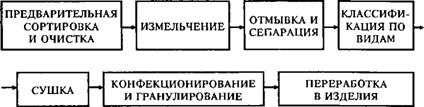
Depending on the quality and purity of the waste, such a scheme can be implemented in full or reduced volume. Typically, industrial waste does not require the execution of all the process steps shown in this diagram. Household polymer waste, on the contrary, needs careful preparation.
Processing of technological waste of thermoplastics should begin with determining the degree of change in their properties and choosing the most effective technology for their use.
The high quality of the finished products and the stability of the technological process can be ensured only with uniform dosing of the crushed or granulated waste and a good mixing with the raw material.
When processing waste at factories that produce thermoplastic products, they are returned to the main technological process.
During the secondary use of plastics, it is necessary to prevent or reduce the deterioration in their physico-mechanical and rheological properties due to aging caused by shear stress and heating-the thermomechanical action that the polymers undergo in milling, melting and molding. To this end, additional stabilizers are introduced in the composition based on secondary polymeric materials, which allow maintaining their performance characteristics without changing the technological properties of the polymers. For various types of polymers, such stabilizing agents have been developed and are known.
In general, the sequence of operations for the processing of plastics waste with the purpose of their reuse is shown in Fig. 11.1.
Burning plastic samples is a reliable way of identifying it. For this, a piece or strip of plastic is taken with forceps, tweezers, mites or another similar instrument (powder material is poured onto the blade of the knife or other convenient tool) and brought to the flame. The results obtained are compared with the known behavior of plastics during combustion. The following characteristics are taken into account: ease of ignition, the character of melting, the duration of burning after removal from the flame, the presence of soot, the color of the flame, the smell. In this case, it is necessary to remember the safety measures for determining odor and when igniting samples. The behavior of various polymers in the flame of the burner is evident from the data in Table. 11.1.
Polymeric materials containing chlorine (for example, polyvinyl chloride) can be recognized by attaching a red-hot copper wire to their surface. If, after introducing it into the flame of a match or a burner, it turns green, this indicates the presence of chlorine in the polymer.
In addition to burning materials, experiments with the dissolution of plastics can help to identify the material. The behavior of plastics in various solvents is described in chemical reference books and other specialized literature.
Reuse of thermoplastic wastes, as a rule, is preceded by grinding and granulation. To this end, special machines and plants have been developed to produce secondary raw materials, which in form and size correspond to primary raw materials.
Primary raw materials used in the processing of plastics are mainly granules with a standard grain size, with a constant bulk density and good flowability.
The mechanism of destruction of polymeric materials is fundamentally different from the processes that occur during the grinding of low-molecular compounds, since the energy of destruction of polymers is mainly used for mechanical losses. This applies both to plastics and, to an even greater degree, to gums, i.e., materials capable of considerable back strain. Therefore, optimal conditions for grinding waste polymeric materials occur at high rates of deformation. Destruction is also facilitated by a decrease in temperature at which the material becomes vitreous, brittle, or rising temperatures to values when its strength properties drop sharply
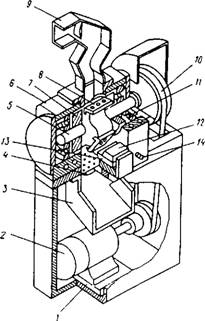
Granulation in extruders has a number of advantages associated with the possibility of using almost any waste, including waste generated in the production of fibers, fabrics,
Knitted garments, waste products from coatings and calendering, vacuum-forming waste, etc. When pelletizing in an extruder, directional modification of the waste can be carried out to produce products with improved properties, which makes it possible to use them in various industries.
Worm extruders for granulating waste thermoplastics have a degassing unit. Depending on the sequence of the two processes that take place during the granulation – cutting and cooling – grinding is carried out in two ways: by granulation on the extrusion head and underwater granulation. The choice of the granulation method depends on the properties of the polymer: the viscosity and adhesion of the melt of the thermoplastic to the metal.
When granulating on the extrusion die, the melt is squeezed out through the lattice holes (the number of which reaches 300) in the form of bundles (strands) and immediately cut off by sliding knives along the grating. The granules obtained by cutting are cooled by air or water. When granulating polyolefins, the cut pellets enter the bath with water, where they are cooled.
With underwater granulation, the polymer melt bundles immediately enter a bath of water and are already cut into granules. The water temperature is maintained between 50 and 70 ° C, which allows it to evaporate intensely from the surface of the granules during their drying. The water flow is 40 m3 per 1 ton of granulate. The size of the resulting granules depends on the size and shape of the holes, the speed of rotation of the screw and the number of cutting knives.
When granulating in an extruder, the material is constantly under the influence of mechanical forces and high temperature, which contributes to the process of thermomechanical destruction of polymer chains.
Agglomeration is used to prepare for the processing of bulk waste from plastics, for example a film. Agglomerators provide continuous preparation of granular granules from film, fibrous and porous wastes of thermoplastics of all kinds: polyester, polypropylene, polystyrene, polyamide, polyvinylchloride, etc.
An agglomerator has been developed for granulating waste thermoplastics with low bulk density, bypassing the preparatory stages. It is a rotating cylinder with electrical heating. During operation, the temperature in the cylinder is maintained above the melting temperature of the thermoplastic. The cylinder is located inside the heated cylindrical shell, displaced relative to the axis of the cylinder. The casing and the cylinder of the agglomerator form a chamber with a decreasing cross-section and terminating on the opposite side of the rake, beyond which is a head with apertures or slots.
Getting on the hot surface of the rotating cylinder, the material introduced into the hopper melts and sticks to its surface. Since the cross section of the chamber decreases with the rotation of the cylinder, the molten material is pressed against the most restricted area of the chamber and, finally, to the ruckle, and then extruded through the head. From the material, which passes successively the cooling device and cutting elements, granulate is obtained. The particle size is 2-15 mm, the bulk density is 400 kg / m. In the process of agglomeration, it is possible to introduce any additives (fillers, dyes, etc.) into the composition.
Separation of mixtures of waste polymers is carried out by various methods. Mixed waste thermoplastics contain, as a rule, substances that differ in mechanical and chemical properties, which makes it possible to use physical and chemical methods for their separation.
Separation of thermoplastic mixtures can be achieved by combining screening and air separation processes, the basis of which is the difference in precipitation rates, particle size and density. Full sorting is achieved when the settling velocity of the largest particles of the light component is equal to the settling velocity of the smallest particles of the heavy component. With this method, you can divide up to five or six kinds of materials.
A flotation method based on the difference in water wettability of polymers can be used to separate plastics waste by type. In order to increase the separation efficiency, surfactants are used, which change the wettability of polymers and surface tension at the air-polymer-water interface. In particular, aqueous solutions of the sulfonate of a dibasic aliphatic alcohol, polyoxyethylene sulfate and other surfactants are used to separate from the waste PVC particles.
Good results are obtained by sequential separation of waste of various plastics in salt solutions with different density (heavy-weight separation method).